The Golden Sombrero Baseball Blog | MLB, Fantasy, College & High School Baseball News

Mike Rosenbaum’s 2010 Predictions

April 7, 2010

hanson

NL East: Phillies, Braves, Marlins, Mets, Nationals
NL Central: Cardinals, Brewers, Cubs, Reds, Astros, Pirates
NL West: Rockies, Giants, Dodgers, Diamondbacks, Padres
NL Wild Card: Giants
NLCS: Cardinals def. Phillies

NL MVP: Albert Pujols
NL Cy Young: Tommy Hanson
NL ROY: Stephen Strasburg

AL East: Yankees, Rays, Red Sox, Blue Jays, Orioles
AL Central: White Sox, Tigers, Twins, Indians, Royals
AL West: Rangers, Angels, Mariners, Athletics
AL Wild Card: Rays
ALCS: Rays def. Yankees

AL MVP: Evan Longoria
AL Cy Young: Justin Verlander
AL ROY: Austin Jackson

World Series: Cardinals def. Rays in 6 games.
World Series MVP: Adam Wainwright
Are Offensive Signals Necessary?

April 7, 2010

bad

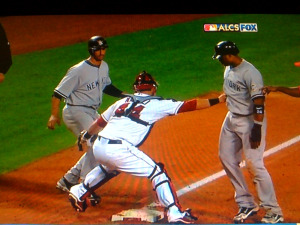
In a telephone conversation with Griff the other night, I was stunned when he told me that his C-Teamers missed a whopping 19 signals in double-dip.  Immediately I wondered why Griff was giving his hitters 19 signals over two games in the first place.  I considered that we were talking about young players developing in a system, and obviously a necessity for that development is knowledge of the club’s signals.  Still, this scenario reopened an internal debate that I have had since I first realized how foolish any and all hit-and-runs are.  Are signals from base coaches a necessary component of the game, or are they simply another piece of the game’s antiquity?

Last summer, I coached third with basically three signals and no indicators.  Two of the signals were green-light-types, and the other was the take sign which was simply me raising my index finger.  Everyone in the stadium knew when we were bunting because I basically yelled to the hitter to bunt.  We bunted very, very sparingly.  Our runners knew who had the green to go and who didn’t, so I basically did not give signs across the diamond.  Guys who could drag knew when to drag because I told them when good times were.  Obviously we did not have an hit-and-run sign because forcing a hitter to swing at whatever the pitcher throws is a bad way to prevent outs.

Was our offense in any way lacking because we did not have sophisticated signals?  Was it inhibited by the fact that we had no secret strategies for run creation?  First, what is each offensive player’s objective at the plate?  To get on base.  No player needs to be reminded of this by a coach.  What about sacrifice bunting?  This is 2010.  How about stealing bases?  Utilizing a simple green light allows the player the freedom to gauge his own chances while ensuring that he does so in a reasonable situation.  What good can come from sophisticated signals?  I guess there are times when a delayed steal or get-picked sign could be advantageous.  Answer me this, though: would yelling across the diamond at a runner to get picked change the outcome?  Probably not.  More importantly, does the limited frequency of plays such as these justify using practice time for them?  Of course not.

Signs can’t possibly hurt.  The problem, however, arises when players forget what the real goal is because they are too busy hitting-and-running or leaving early.  Hitters are there to reach base.  Runners are there to touch home.  OBP is the primary predictor we know of for run creation.  Hitters hopefully don’t need a signal for getting on base.  Varying from this default setting, therefore, is likely only to reduce run production.  By that line of reasoning elaborate signals should only be given when trying to score fewer times.

Griffin Phelps’ 2010 Predictions

April 6, 2010

NL East: Philly, Atlanta, Florida, New York, Washington

NL Central: St. Louis, Milwaukee, Houston, Chicago, Cincinnati, Pittsburgh

NL West: Colorado, Los Angeles, Arizona, San Francisco, San Diego

NL Wild Card: Atlanta

NL Pennant: Colorado

NL MVP: Troy “Too Legit” Tulowitzki

NL Cy Young: Ricky Nolasco

NL ROY: Jason Heyward

AL East: New York, Tampa Bay, Boston, Toronto, Baltimore

AL Central: Minnesota, Chicago, Detroit, Cleveland, Kansas City

AL West: Texas, Los Angeles, Seattle, Oakland

AL Wild Card: Tampa Bay

AL Pennant: Rays

AL MVP: Evan Longoria

AL Cy Young: Justin Verlander

AL ROY: Austin Jackson

World Series:

Colorado beats Tampa Bay in 6 games.

Tulo is the MVP

Justin Abramson’s 2010 Predictions

April 6, 2010

AL East: Yankees, Rays, Red Sox, Orioles, Blue Jays

AL Central: Twins, Sox, Tigers, Indians, Royals

AL West: Angels, Rangers, Mariners, A’s

AL Wildcard: Rays

NL East: Phillies, Braves, Marlins, Mets, Nationals

NL Central: Cardinals, Brewers, Cubs, Astros, Reds, Pirates

NL West: Rockies, Dodgers, Giants, Diamondbacks, Padres

NL Wildcard: Braves

ALCS: Rays def. Yankees

NLCS: Rockies def. Phillies

World Series: Rays def. Rockies

AL MVP: Evan Longoria

AL Cy Young: Felix Hernandez
AL ROY: Austin Jackson

AL MOY: Ron Gardenhire

NL MVP: Albert Pujols

NL Cy Young: Roy Halladay

NL ROY: Jason Heyward

NL MOY: Bobby Cox

Work That Wire

April 6, 2010

Working the waiver wire; who wants to worry about that?  Not many people work the waiver wire correctly.  Too often I hear people talking about, “Oh I don’t need to worry about that.  My guys are doing just fine.”  Or, “Who could there possibly be that is better than anyone I have on my bench already?”  Sure, you might not need a guy, but why not take a flyer once in a while?  Find a guy on a hot streak to replace that cold bat.  Or how about finding that arm for a quality spot start?
Working the wire is all about timing.  More often than not, if you are willing to take a risk, an educated one, it pays off big time.  Me, I have three different times where I try to use the wire to my advantage; spot start SP’s, a bat due for a good streak, or just to horde a guy before anyone else in my league can grab him.  Let’s take a look at spot starts.
Spot starting a pitcher is an excellent way to take advantage of quality matchups to help boost your pitching stats.  Before I go grab just anybody off the wire though, I always check trends.  The first trend I check is the pitcher’s home/road splits.  Don’t check just for the current season though.  Make sure to view career trends.  Obviously, the larger the sample size, the more accurately you can make your decision.  I like to use Baseball-Refernce.com for this.  They have a vast amount of data that can be used for just about anything you want.  If a guy has a huge difference in is home/road splits, let’s say road for this example, then take a look at his next couple of starts.  Who is he facing?  Where is the game played?  If you like who the pitcher is going against, i.e. the Pirates, take a look at line-ups.  How many lefties/righties is he facing?  What are the pitcher’s splits there?  Also, I recommend taking a look at what the pitcher has done over the past two-three years.  Two years ago, I was able to grab Cliff Lee off the wire after two starts.  Most people in my league laughed, and told me he was a fluke.  What they forgot to recognize was that only two years prior, Cliff Lee was being called a future Cy Young candidate by scouts.
What about hitters?  How do you find the guy that nobody is talking about?  I like to take a bit more risk with these type of guys, because if it doesn’t work out, so what.  It’s not like you’re losing much if you drop a guy from your roster that never plays.  Once again, I like to take a look at the next three or four pitchers that said hitter is facing in the coming days.  What type of success rate has he had over his career versus these guys?  I especially like to look at a hitter’s isolated power in this scenario.  That tells you a lot about how often the guy squares up balls, and that is the most important.  Even if he has a multitude of K’s, I am always willing to take a chance if the majority of balls hit are hit hard.  I also always take a chance on a guy riding a hot streak.  He’s 9 for his last 15?  Fuck yea I can find a spot on my bench for that guy the next few days!
The last reason I like to scour the wire is a simple one.  I want to prevent the other teams from getting something that I could potentially have.  Even if he just sits on my bench and I don’t record his stats, at least I know that nobody else is going to either.  This comes in handy late in the season when a few SB’s or RBI’s means trading spots in the standings.  Once again, don’t be afraid to subscribe to the theory of, “Even if I get nothing out of this guy, I didn’t lose anything in the player I dropped to clear roster space.”
All in all, working the wire can turn out to be pretty fruitless.  I easily make more than 100 transactions a year.  I may only keep a guy for a day and turn around and drop him for the guy he replaced the previous day.  With bench players, there is never a reason to fret over dropping them.  Most importantly, don’t be afraid to take a risk.  So go out there, find that diamond in the rough, and turn it into a thing of beauty.  One.