The Golden Sombrero Baseball Blog | MLB, Fantasy, College & High School Baseball News

Why Didn’t They Just Walk Casey? The use of the intentional walk in Major League Baseball

April 14, 2010

casey

Saturday night, in the bottom of the 14th inning with the Padres up one run on the Rockies, manager Bud Black had a decision to make.  There were two outs and the tying run was on second.  Ian Stewart was at the plate and Chris Iannetta was on deck.  Black decided to walk Stewart, putting the winning run on base, and pitch to Iannetta (even though Iannetta had already gone deep in that game), who struck out to end the game.  He looked like a genius at the time, but things could’ve been much different had Iannetta ripped a two-RBI double down the right field line to win it.
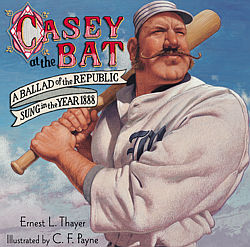
This reminded me of Ernest Thayer’s famous 1888 poem, “Casey At the Bat”.  For those who don’t know it, it can be found here.  The story details a team down by two runs with two outs in the bottom of the ninth inning.  Two weak hitters proceed to hit a single, then a double, which brings up the star hitter, “Casey,” with the tying run in scoring position and two out.
We all know how the story ends.  But what might a major league manager have done in this situation?  If he’s 2009 Manager of the Year Jim Tracy, he might have walked Casey.  And this seems to make sense.  First base was open and Casey represents the most feared hitter on the team, if not in the game.  In addition, Casey was likely a big, strong home run hitter built like Jason Giambiit’s unlikely that he had even average speed, and so he may not even have been able to score on a double from the next hitter.  What’s not to like?

The first thing not to like is that an intentional walk increases the expected number of runs scored in any inning (Source: Baseball Prospectus at http://www.baseballprospectus.com/statistics/sortable/index.php?cid=68778), regardless of how many are on base and how many are out.  Of course, this doesn’t mean it’s never a good idea—sometimes the hitter at the plate is significantly better than the one on deck, and sometimes the extra 1/3 of a run (or so) that the walk creates would be nearly meaningless to the outcome of the game.  In the top of the ninth, with the pitching team down a single run and with runners on second and third with two outs, an intentional walk does not hurt the pitching team in any significant way, because if that run were to eventually score, it would mean the difference between having to score three and four runs in the ninth inning—a scenario so unlikely anyway that only a small difference in ability between the on-deck hitter and the hitter at the plate would prompt an IBB.

Steven Biel did an analysis here: http://bleacherreport.com/articles/320766-rating-the-managers-by-intentional-walks of intentional walks issued in 2009, and he ranked the managers by how often they issued intentional walks that had no statistical chance of improving the pitching team’s chance of winning.  For this analysis, I care less about the manager and more about the aggregate picture of the walks issued.  In 2009, there were 1179 intentional—roughly one every two games.  Biel’s very conservative analysis (done with the help of Baseball Prospectus’s run prediction indexes) showed that 246 of these provided no help to the pitching team.  This is an amount in excess of 20%.  More than one in five times where the manager decides to go to the well with the intentional walk, it is a mistake.  Further, with 246 “bad” IBBs in 2,431 games in 2009, this means that once in every ten games (well over once per day) a manager is making a mistake and putting his team at a disadvantage by allowing another runner to reach base.

So to answer my own question earlier, issuing an intentional pass to Casey might have worked out all right.  But considering that Casey was probably batting in the #3 spot, walking him would have put the winning run on base with the cleanup hitter at the plate—likely providing a much better opportunity for joy in Mudville than the opposing team did by taking their chances with Casey.  However, Biel’s analysis suggests that many of the 30 major league managers would have chosen to walk Casey, as Bud Black did most recently on Saturday, April 10.  Taking into account the number of intelligent people in the United States who would leave well-paying jobs today for a chance to make $10 an hour as a major league manager, it does seem strange that managers so often make the move to put a runner on base when it makes no statistical sense to do so.

Why It Sucks To Be An Astros’ Fan

April 12, 2010

killerbs

As an avid, lifelong, true Astros fan, I have experienced bliss as well as turmoil.  It was only 5 years ago that the ‘Stros found themselves in the World Series.  Yet there is now a putrid taste in my mouth when I think of my beloved big league club.  How could this be?  What went so wrong that only 5 years removed from winning the NL pennant, Houston is now ranked as one of the worst organizations in professional baseball?
For starters, we can look at a couple declining stars.  While it hurts me to even utter these words (let alone type and post them for all to see) Lance Berkman and Carlos Lee are finally on the downhill track of their careers.  The Puma is always a health concern, even managing to find himself on the DL before the 2010 season even started.  2009 was the first season that Fat Elvis fell short of the 600 PA plateau since 2005, and only the 3rd time since he became an everyday player.  Secondly, his WAR, according to FanGraphs, tied a career low at 3.2 (as compared to previous years in the 6’s.)  While his BB rate increased last year from 14 to 17%, his K rate has been on the rise since 2005.  It made a jump from 15.4% in ’05, to 19.8% in ’06, and has continued to hover at, or above, the 20% rate since then.  All of this, along with the fact that Berkman is not getting any younger (he is 34 this year) tells me that we may be seeing the beginning of the end for the Big Puma.

Then there is Carlos Lee.  By most accounts, El Caballero had a tremendous season last year.  There are just a few stats that concern me.  The first being his O-swing%, or percentage of balls swung at outside of the strike zone.  This number stands at a gaudy 36.6% for last year; a whopping 13% above his career average.  The next problem I have is Lee’s isolated power.  Last year C. Lee posted a paltry .186 in this department.  You can chalk some of this up to age, (he turns 34 this June) but when you play in one of the most hitter friendly parks, Minute Maid, it makes you wonder a little. Even if you don’t want to look at the numbers, face the facts that most big leaguers do not have very successful careers once they reach the age of 34-35; including Berkman and Lee.

Well what about the guys we have coming up?  Sure there is Wandy and Pence, and maybe even Bourn will work out. (I am a big Bourn supporter despite what most critics predict.)  Ok, sure those are a few guys who have the possibility to be studs for a while.  But for those few guys, there are the J.R. Towles (a busted stud), Tommy Manzella (a 27 year old “prospect”), of the organization who have not panned out.  Sure, Houston is devoting new time and efforts into finding quality prospects internationally, especially in the D.R., but only time will tell how that works out.  For now, we are stuck with what little we have on the farm.
To top it off, we go and make Brandon Lyon one paid motherfucker at 15 mill for 3 years.  Why give that kind of money to a guy who has only had one season of 15 saves or more, has a career ERA of 4.23 as a reliever, and has never shown dominant stuff on the hill?  I don’t know why, and there may be more to it, as Mclane has shown that all these oddball signings come off the book at the same time in a few years.  But until then, we will have to settle with that putrid taste, and have to do enough other things during the summer to help reduce the strength of that taste.  One.

Battle to the Mistake

April 12, 2010

Plan the work, work the plan.  This is a mantra that I heard over and over again while pitching for the University of Arizona.  Thanks Coach Lopez.  It might be one of the best pieces of advice I have ever heard.  It transcends the baseball field and carries over in to the real-life sector as well.  Regardless, it was the first thing that came to my mind after reading fellow authors Justin Abramson and Dee Clark’s opposing pieces on hitting philosophy.  As a coach, I rely heavily on teaching my hitters to plan their work, and work their plan.  When it comes to hitting, I want them to plan on hitting the mistake.

As a former pitcher, I am quite familiar with what quality hitters do with mistake pitches.  They shit all over ‘em.  It never mattered if it was the first pitch or the 8th pitch of the at-bat either.  It only mattered that the pitch was not where it was supposed to be.  As a hitting coach, I now work to instill this idea in all of my hitters.  I preach, “Battle to the mistake.”  If I were to subscribe to Dee’s philosophy this might mean trying to work a 9 pitch sequence.  On the other hand, if I were to subscribe to Justin’s philosophy, this would mean that I should jump at the first fastball I see in the sequence.  While I tend to be more conservative in my plate approach (I was schooled by Dee in the ideas of plate approach) I still am very fond of seeing a good pitch early and jumping all over it.  Sometimes pitchers will attack the zone early with fastballs to get ahead, and this often times leads to a pitch finding itself traveling over too much of the white, or heart of the plate.  Other times, especially in later or more meaningful at-bats, a hitter may not see a mistake pitch until the 4th, 5th, or even 6th pitch of the AB.  If the latter is the case, the hitter must be disciplined enough to withstand the pitchers attack until the pitcher makes a mistake.

No matter when the mistake pitch is thrown, the hitter must have it in his mind to attack the mistake.  When dealing with high caliber baseball there is usually just one mistake pitch thrown per AB (if that.)  This means that if the hitter neglects to take a chance (swing) at the mistake, he will more than likely end up swinging at a pitcher’s pitch and have difficulty squaring up the baseball, thus leading to a probable out.  This is why it is so important to take advantage of the mistake, no matter when it occurs.  You can bet the farm that you will not get any second chances that AB.  I guess what I am trying to say is that as a hitting philosophy, I believe in hitting the mistake.  All pitchers make them, so why not try to hit the one pitch in the sequence that the pitcher wishes he could get back?  While the more pitches you see tends to give you a higher percentage chance of seeing a mistake, what happens if the mistake is that 0-1 CB that hangs in the zone?  You bang the damn thing.  Just ask Pujols, or Longoria, or any other high caliber hitter in Major League Baseball.  Taking advantages of mistakes trumps any other hitting approach.  So plan your work and work your plan, and battle to the mistake at the dish.  This mentality, or philosophy if you will, will give you the highest percentage opportunity for success.  I’ll put a Griffin Phelps guarantee on that one.  One love, I’m out.

Gallardo a Steal?

April 11, 2010

gallardo

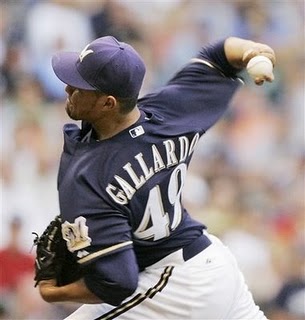
Yesterday Milwaukee inked 24-year old Yovanni Gallardo to a five-year deal worth a minimum of $30.1 million and potentially as much as $42.5 million.  The deal could keep Gallardo a Brewer through 2015 if the club so chooses.  The deal is really quite novel in that it provides both the Brewers and Gallardo a number of incentives, such as parameters regarding which teams Gallardo could potentially be traded to as well as bonuses based on Cy Young voting.  While Cy Young voting is a rather subjective way of distributing payment, the clause at least provides the Brewers some level of merit-based control on their checkbook.  Compared to the contracts awarded to a few of Gallardo’s peers such as Justin Verlander, Tim Lincecum, Felix Hernandez, and Matt Cain, Jon Lester, and Zack Greinke this deal comes off looking rather genius for the Brewers.  The question, though, lies in whether or not Gallardo can justify being considered a peer of these elite young righties.

Last year Gallardo cracked the 200-strikeout milestone for the first time in his career while making 30 starts for the first time as well.  Considering that he was coming off a season shortened by knee surgery in 2008, 2009 was a significant step in the right direction.  He still failed to reach the 200-IP plateau, but in many ways I consider that a good thing for the Brewers considering they were fully aware that they would ultimately miss the playoffs relatively early in the season.  Why not manage their young ace conservatively if he is basically just practicing for next year?

How about his stuff?  The wrap on Gallardo since he was a flame-throwing yet erratic high schooler has been that he lacks a developed third pitch.  I’m not sure that remains the case.  He still tends to favor his fastball (95+ whenever he needs it)/curve (at least plus, sometimes plus-plus) duo, but his changeup has made considerable strides since Gallardo reached the Bigs in 2007.  Still, he does not use it enough.  Gallardo’s high ¾ release point and carry on his fastball, when coupled with Miller’s short porch, tend to drive a lot of balls to the seats, but that same carry allows Gallardo to pitch at the letters a little more often, especially to righties, in order to generate strike 3.

Delivery?  It sounds like Milwaukee extensively analyzed Gallardo’s delivery to determine if anything about it would lead to career-threatening injuries later on.  From the sounds of it, Gallardo checked out nicely.  Personally, I think he fights to create a downward plane more than someone with his build and athleticism should, – primarily by using his front side to “climb” – but that same athleticism probably allows him the necessary leeway he needs to do it.

So why am I not convinced?  Gallardo is not efficient.  His K/BB is the worst of the pitchers I mentioned earlier as potential peers, he has thrown the fewest innings, and he has had a major surgery already.  Still, with the way his contract is structured, the Brewers have provided themselves with a situation that will provide Gallardo incentive for finding ways to solve these problems.  I think he has the stuff, athleticism and organizational support to really make a run at a few Cy Young Awards, and that would help both Yovanni and the Brewers.

The Umpire’s Opinions is News-Worthy Now?

April 11, 2010

joewest

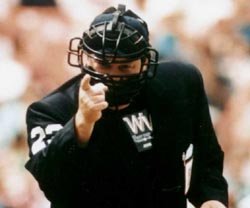
Following a thrilling opening series between the Yankees and Red Sox earlier this week, umpire crew chief for the series, Joe West, blasted the two organizations for playing a little sluggishly, even making the suggestion that there perhaps is a positive correlation between ability and rate of play.  While everyone realizes that this was simply a case of an elderly, grumpy, obese man not wanting to stand up for an extra hour given his strenuous 3-hour work days, what I don’t understand is why anyone even cares.  Let’s be real.  Is there any more easily replaceable job in the game?  We are talking about an umpire here.

This scenario harkens back to the 90’s when umpires first began to deal with MLB’s attempts to standardize the game’s officiating.  When Questec provided a realistic and reasonable measurement of an umpire’s ability to accurately gauge balls and strikes, and slow-motion video replay allowed the same level of evaluation with outs and safes, the game began to look a little differently.  The on-base revolution throughout the sport was only possible once umpires were forced to call a more standardized strike zone.  Well, a lot of umpires got upset and quit.  Even West helped organize a mass resignation in response to bargaining disputes with MLB late in the decade.

I guess I just don’t understand a Major League umpire’s complaint about anything.  I realize that umpires must pass examinations over the rules as well as practical examinations, but it’s not like these tests are the MCAT, or even the GRE for that matter.  I’m not saying I know every single word of the rulebook, but what I am saying is that absolutely everyone could if they really tried to.  Furthermore, these guys get to watch the game from the best seat in the house: the field itself.  Come on now.  That is so sweet.  Complaining about a 3 ½ -hr game?  Every other fan there, and umpires are really just interactive fans, is ecstatic about just being at the field and watching a little more of the game…especially when it’s Yanks/Sox in the first series of the season.  I think there is a small country’s worth of folks who would wait in line to do Joe West’s job voluntarily.