May 23, 2010
As nothing more than a casual baseball fan that doesn’t play fantasy, I have always been more fascinated with all-time records and idiosyncrasies than the statistical minutiae most of you pore over regularly. I would rather find Babe Ruth’s highest combined total of home runs hit and hot dogs consumed in a single game than hear about Pujols’ OPS for the month of May. I make my way through Wikipedia, page after page, delving deeper into the obscurities of our national pastime with every click of my mouse. Knowing more about mind-altering substances than I probably do about baseball, I find the fact that Dock Ellis threw a no-hitter on acid to be arguably the most impressive feat in baseball, if not all sports, history. I learn and subsequently forget useless baseball trivia habitually, but last summer I came across something I felt compelled to remember and share with as many people as possible. This was something so remarkable that when given the chance, I felt that I had no choice but to inform an entire nation of gilded-Mexican-hat-wearers.
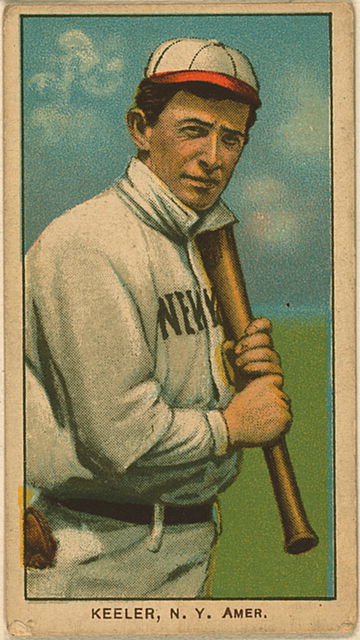
While investigating the mysterious figures that stand atop Major League Baseball’s all-time career batting average list (Dan Brouthers of the Boston Beaneaters is in the top 10, really?!), I discovered a man who I believe to be the most influential baseball player you’ve probably never heard of, Wee Willie Keeler. Now, if you are in fact already privy to the accomplishments and influence of Mr. Wee Willie, please stop reading this and notify me immediately, I want to personally congratulate you for your studiousness and depth of knowledge regarding baseball history. Since I assume most of you are still reading, allow me to elaborate. Standing a shrimpy 5’4” and weighing in at just a paltry 140 pounds, William Henry Keeler made his professional debut playing right field for the New York Giants in 1892. Wee Willie reportedly used only a 30” bat, and with that diminutive stick the pocket-size player hit safely 2,932 times over his career for a lifetime batting average of .341. Wee Willie won the NL Batting Title in 1897 with a career best .424, tops in single-season history for a leftie and 8th best all-time, and then won it once again in 98. He also had eight straight seasons with 200+ hits, a mark tied by Pete Rose and broken only last year by Mr. Consistent, Ichiro Suzuki, who had his ninth straight 200+ hit season in 2009. Keep in mind, however, that Wee Willie never broke 600 AB’s during his streak. And, his 44 game single-season hit streak is second only to Joe DiMaggio, with 56. While all this is impressive, there are an astounding number of hitters who compiled incredible statistics during the dead-ball era in all categories except home runs, of course. No, it isn’t statistics that you need to know about Wee Willie Keeler; it’s the way he played the game that crafted his indelible legacy.
Physically outmatched due to his slight stature, Wee Willie developed a number of techniques to become the game’s greatest place-hitter. He once described his strategy to a reporter in five simple words, “Hit ‘em where they ain’t,” advice I still remember hearing from my little league coach shortly before being benched for either hitting ‘em where they were or more likely not hitting ‘em at all. His fifth year in the league Wee Willie was traded to the Baltimore Orioles, where under manager Ned Hanlon, he and his teammates epitomized what is known today as inside baseball, more commonly referred to as small-ball. Yes, much of the strategy during this time focused on manufacturing runs through speed and smart base running, but Keeler and his Orioles took it to another level. The term “Baltimore Chop,” used to describe a ball hit hard off the dirt in front of home plate and high into the air, is directly attributable to this team. While this now typically happens only by accident, the Baltimore Chop was such a focal point of Keeler and the Orioles’ strategy that the groundskeeper mixed hard clay into the packed dirt in front of home plate to provide them higher bounces. Using this extra hang time, Wee Willie actually once legged out a double on a Baltimore Chop.
Wee Willie was also a remarkable bunter. Honus Wagner once said about him, “Keeler could bunt any time he chose,” and he was right. In his 1898 NL Batting Title campaign, only 10 of Wee Willie’s 216 hits went for extra bases. There are no records for how many of those 206 singles resulted from bunts, but I believe it is safe to say Mr. Keeler was more than adept at getting on base without using power. And it was this propensity for bunts that caused the league officials to reexamine the rulebook. Wee Willie could foul off bunted balls almost indefinitely and was solely responsible for the rule change that now results in a batter being called out if he fouls off a bunt with two strikes. This might not seem like a big deal, but in the 5th inning of the Mariners game against the Padres on Thursday, the M’s shortstop Josh Wilson did exactly that with two runners on base and I bet he would’ve been cursing Wee Willie on his walk back to the dugout had he known the legend’s adroit bat control was responsible for his being called out.
In today’s age of hitter friendly parks and moon shot bombs, it is easy to forget about the little guys that paved the way for the game we know today. Even Hall of Famer George Brett asked, “Is he the guy they named the cookie after? Wee Willie Keebler?” after being told by a reporter he tied Keeler for 20th place on the all-time hits list. But what Wee Willie lacked in size, he made up for with highly-skilled batsmenship and baserunning. As Ted Williams once said, “he was small in size but he was huge with the bat.” This combined with his impact on both the strategies and rules of baseball still to this day should make you want to go out and inform someone less knowledgeable than yourself about the wondrous career of the one and only Wee Willie Keeler.
 October 16, 2010
|
Posted by Daniel "Dee" Clark
October 16, 2010
|
Posted by Daniel "Dee" Clark
 I will admit that this article will probably interest Brett, Griff, and a handful of high school baseball players from Colorado and Utah who also frequent the Newschoolers forum…and literally no one else. Sorry Arlo. This is just what September and October mean to me: baseball playoffs and the anticipation of winter. The title probably doesn’t make a lot of sense to very many readers, but these are a few nicknames of some of skiing’s greats. Growing up the majority of sports media to which I subscribed were ski magazines, Internet forums devoted to skiing, and ski films. I paid way more attention to the world of professional skiing than I did to the world of professional baseball until I was around 20. At that time I found myself at school in Iowa playing baseball. Iowa surprised me with something that at least resembled skiing in the form of a trash dumb covered in manmade, but it was far enough from the skiing that I knew that I let it go a little. This time of year always brings me back to yesterdays and the days to come on the hill. Griff and Brett are two of my favorite people in the world to ride with, so I am really glad that they also write for The Sombrero. Anyway, with this piece I will compare a legendary skier to the Big Leaguers that I believe their personalities, talents, and styles most represent.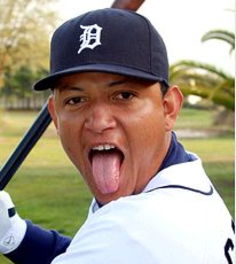










Recent Comments