Daniel “Dee” Clark | The Golden Sombrero Baseball Blog | MLB, Fantasy, College & High School Baseball News

Recent Trade Involvement in the Denslow Cup

May 22, 2010

Jim got engaged!  To a terrific young lady I might add.  Congratulations, buddy!  We’re really proud and excited for you.  Two more engagement shout-outs: first one for our buddy, Kevin (Kev Kong) Wilcox; second one for my dental school classmate/friend and cadaver dissecting partner, Val Sanchez.  Very fun things.

Before I get going with this post, I want to apologize for not posting anything lately.  My finals week lasted about 15 days/nights and was a truly painful experience for everyone involved.  I still am awaiting confirmation that I passed my last two exams, but I did not need to do that well on them to make it to 2nd year.  I don’t think when I began dental school or even when I was applying that I had any idea what it would actually be like.  Grinnell is a challenging undergraduate institution that consistently ranks among the most extensive in the country in terms of workload.  It did not remotely compare to what was expected of each student at Baylor.  They say the first year of professional school is the most challenging of any student’s career.  I really hope that is the case.

Moving on.  I have tried not to write much about fantasy on this blog because I am fearful of disclosing information that has helped me succeed in previous to my competitors.  The blog comes first now, though, so hopefully none of what I disclose is seen as particularly novel.

This post will center on some recent trades I have completed in my 16-team 7 x 7 (AVG, OBP, SLUG, HR, SB, R, RBI x IP, W, SV, K, ERA, WHIP, K/BB) league that I play in with my friends, many of whom write for the Sombrero.  Before I begin I should mention that I tend to give the team I drafted a month or so of a chance for two primary reasons.  First, it takes approximately 100 plate appearances or so to produce a meaningful set of results capable of evaluation.  Second, this evaluation should help determine a reevaluation of the predraft rankings implicit within are new projections and expectations.  This reevaluation should generate some inefficiencies and potential bargain deals throughout any league.  Hopefully a month into the season every one of your players are playing over-their-heads and producing at unsustainably high levels.  This will inflate their values to the point that they are capable of fetching players ranked considerably higher in the predraft rankings.  A month into the season the rankings that should be taken the most seriously remain those produced prior to the draft because they are based in the most extensive and reliable numbers.  Some players are streaky, and some streak/slump oscillations express periods of a month or longer.  For these reasons, I target May as the month in which I need to work the hardest in fantasy.  This unfortunately coincides with finals and has been hindered more than usual this year.  Nevertheless I have made a few moves that I think will really help my squad, the Heights Knights (named after my 8th grade basketball team), find their stride and hopefully begin to climb in the standings.

CLAR traded Kevin Youkilis, Bos 3B to A-holes
CLAR traded Nate McLouth, Atl OF to A-holes
CLAR traded Kevin Slowey, Min SP to A-holes
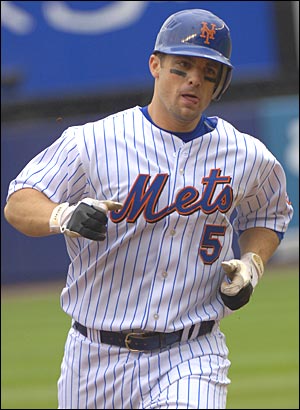
MVW traded David Wright, NYM 3B to Knights
MVW dropped David DeJesus, KC OF to Free Agency
MVW dropped Nick Hundley, SD C to Free Agency

This trade took place in early May and heavily reflects my love for David Wright and very little else.  Simply put, I lost this trade.  Youkilis plays for a better team in a better yard, makes contact more often and has better control of the strike zone, probably more power, is more consistent, and, most importantly, will be an easier guy to move later on.  This final reason is a product of the fact that as the season progresses, Wright’s strikeout totals will likely seem more astronomic by the day.  The Mets are a pathetic organization.  I blame their management and front office entirely for David’s recent and ongoing struggles with contact.  That’s a different subject for a different day, though.  Back to the trade.  Slowey’s command is second to none, and even though he lacks a put-away pitch or above average anything, his ability to locate makes him a serviceable two or exceptional three in any rotation.  In a league like ours that uses IP as a category, Slowey is a horse and will always outperform his 5×5 ranking.  McLouth has not looked like the all-star he was in 2008 because he is not making contact often enough.  He will continue to lose playing time as long as he fails to put the ball in play, but, when near his best, McLouth makes Melky Cabrera look like the minor league journeyman he should be.

Eunuch (MVW) beat me on this trade, but I have David, my favorite player, and I am much happier moving forward now as a result.

TOWL traded Nick Markakis, Bal OF to Knights
CLAR traded Yovani Gallardo, Mil SP to Corporate Towls

This trade was mostly a reflection of our cap on starts.  Essentially three starters should be able to reach the cap (100), and I had five at the time.  Gallardo was my highest ranked according to ESPN, but in our league should have been dropped extensively due to his notoriously high pitch counts and less-than-ace-caliber walk totals.  In standard formats, these are virtually meaningless, but in our league make Yo a 4-category contributor in a 14-category format.

Markakis has been one of my targets since 2006.  His ability to both differentiate balls and strikes as well as center the baseball make him lethal in formats such as ours that utilize both average and OBP categories despite having just 15 to 20-bomb power.  Because OBP is not included in the standard format, Markakis is far more valuable in the Cup than he is according to ESPN.

Budz dropped Kris Medlen, Atl RP to Free Agency
Budz dropped J.J. Putz, CWS RP to Free Agency
Budz traded Billy Butler, KC 1B to Knights
CLAR traded Todd Helton, Col 1B to ChronicL’s
CLAR traded Josh Willingham, Was OF to ChronicL’s
CLAR traded Matt Lindstrom, Hou RP to ChronicL’s

Ty9 traded Carlos Lee, Hou OF to Knights
CLAR traded Billy Butler, KC 1B to POO

These trades happened within hours of each other, so I will treat them as one mega deal in which I move Helton, Willingham, and Lindstrom for Carlos Lee.  A trade like this is only possible if you really know the other managers in the league.  My first trading partner in this deal was Griff.  Griff is after a first-place finish this year, and I know it.  He has produced increasingly higher finishes each year and made it into the top-5 last season for the first time.  In a 16-team league, saves are a big deal.  Not only are there only 30 closers at any time but also a 0 in any category means a lot more when one team is getting 16 and the average team is snagging 8 or 9 from that category.  I find it very hard to envision a first place team getting last or even close to last in the saves category.  A single stable closer (30 saves) for the entire season is probably enough to avoid a catastrophically low saves total, and closers are hoarded in our league as a result.  The effects of this hoarding are an enhanced demand and a reduced supply of saves.  Griff recognized that the longer he waited, the less the return and the higher the cost.  By a stroke of luck, Alfredo Simon, the new Orioles closer was available as well as Manny Corpas making Lindstrom somewhat expendable.

Willingham is another guy who is worth more in our league than in a standard league because of his skill at reaching base, but what some folks have been slow to accept is the quality of the heart of the Nationals order.  Hitting behind Adam Dunn should provide Hammer with a shot at 100 RBI’s.  He has a chance this season to be an all-star and is especially valuable in a platoon.

Todd Helton again is more valuable in our league due to his combination of average and on-base skills.  Jason Giambi is a ridiculous distraction and almost comical nowadays, but he should be eliminated shortly I suspect due to the imminent season-ending injury that surely accompanies 39-year old, fat, steroid abusers.  Griff actually got Helton at a time when his value may be somewhat deflated due to his slow start, and in general this trade is looking as though I came away the loser.

However, I knew if I could just snag Butler that Ty9, a lifelong and diehard Royals fan, would probably give me Carlos Lee in exchange.  Lee has been getting a lot of bad publicity recently because of his slow start, but the guy can take every square inch of the zone 450 ft.  I saw his slow start as an obvious opportunity to buy low on a guy that has a 3-year mean OPS over .880 and a 5-year average of 31 dongs/season.

Everyone other Tyrone won this one.

Bob dropped Mike Adams, SD RP to Free Agency
CLAR traded David Ortiz, Bos DH to of Shelley
CLAR traded Chris Coghlan, Fla OF to of Shelley
Bob traded Carlos Pena, TB 1B to Knights

As noted earlier, I have a tendency to fall in love with certain players.  Carlos is one of those guys for me.  I have never had him on my team.  He is clearly underperforming right now, but has shown the ability to stay inside and above the ball with good lower body action in the last week or so against good arms.  The ball Gardner took away was an excellent swing, and the next night Carlos went deep twice.  I love him and rolled out the red carpet this morning for him.

I’m a Coghlan believer.  I think his mechanics at the plate allow him to handle almost all pitches even though they probably are good for no more than fifteen jacks/season.  As everyone has always known about Coghlan, his skills play better at 2B than at a COF spot.  Not going to happen with Uggla on 40-jack pace.  Still, Coghlan should be around a .300 hitter the rest of the way while walking at a respectable clip.

Papi is so tough to evaluate right now.  Sometimes he looks as good as ever, and sometimes he looks like he could go 0-for a beer league game.  This suggests that Papi is guessing and cheating his hands at the plate to compensate for either reduced pitch deciphering abilities, reduced bat speed, injury, or a combination of the three.  I suspect that I may have moved him at the perfect time, and while I have normally been a fan of Papi, the failed PED test was a big turnoff for me.  Considering I plucked him off of waivers a week before this deal, it was easy to pull the trigger.

I am very satisfied with these trades and the way my team is looking.  This has been one of my more successful Mays, and, with the addition of luck, health, and a few more quality moves, it should put me in position to challenge for my first title.

The current Knights:

C Carlos Ruiz
1B Carlos Pena
2B Dustin Pedroia
3B David Wright
SS Hanley Ramirez
OF Michael Bourn
OF Nick Markakis
OF Carlos Lee
UTIL Adam Dunn
Bench Jim Thome
Bench
P Cole Hamels
P Alfredo Simon
P Manuel Corpas
P Aaron Heilman
P J.J. Putz
P Carlos Villanueva
Bench Scott Baker
Bench Jeff Niemann
Bench Ted Lilly
Bench Ervin Santana
DL Mike GonzalezDL15

Piedra Vista Wins First District Title Despite Loss; Farmington Baseball Prepares for State

May 8, 2010

Friday evening saw what will go down as a historic District 1AAAA title game between Farmington High and Piedra Vista High. The game saw two Division 1 signees in dead lockstep on the mound, extra innings, and victory for the home team. As FHS 3B, Joe Cervantes, touched home in the bottom of the 8th, the Scorps raced from the dugout to celebrate at the plate while the Panthers sauntered off of the field. All was not lost, however, since, due to a rule which is ripe for amendment, the Panthers still retained enough of a runs scored/allowed difference to collect their school’s first title.

The following morning, coaches from both schools carpooled and caravanned together southward to scout various potential opponents they may face in the upcoming state tournament in what will surely go down as another first. Prior to this season, the coaching staffs of the two powerhouses were bitter rivals and enemies. With a new generation of coaches at both schools has come a sense of cooperativity both in the school ball season and the club seasons. It is the opinion of the local baseball community that this cooperation was entirely overdue. The rivalry at times destroyed friendships, resulted in criminal activity, and, most importantly, stalled players’ development. No doubt the schools shared some of their scouting information in an effort to ensure the state title comes home to Farmington. It’s about time that eastside and westside Farmington were viewed as a single baseball community.

Sunday morning the two schools snagged the top two seeds in the state tournament bracket (PV at the top) ensuring that the earliest the two clubs can meet is the title bout. The road will be tough for both schools with a number of strong Albuquerque metro schools as well as a couple strong squads from the southern half of the state. Nevertheless, none of these schools should stand in the way of what should break the current tie between the two powers from up north.

PV has never won a state championship, but they have played in a handful.  They are the heavy favorite to win their first one this month, but what FHS proved last weekend is that this juggernaut has a weakness or two. Most notably is the fact that their entire lineup is right-handed. Scorpion starting arm, Eli Freese, held the Panthers to just two hits and never allowed a ball into the outfield in the air. Good downward and heavy action from righties will cause PV trouble at the plate. They play exceptional defense and have easily the strongest rotation and bullpen in the state, but other schools possess a more diverse offense. Don’t get me wrong, though. PV has proven they can scrape runs across when they need primarily by means of speed and an aggressive approach to running bases.

The state tourney kicks off this weekend with both Farmington High and PV hosting regionals at Ricketts against Bernalillo and Deming respectively. The visiting squads should not beat either of the home junior varsities, so let’s hope the Scorps and Panthers can get some of the early postseason jitters out Friday so they will be ready to attack in the quarters the following weekend.

As an alum of both of these programs (played at FHS and coached at PV), I am not sure I have ever been as proud to be a member of the Farmington baseball community as I am now. The way these two rivals have turned their war into something that benefits everyone has been nothing short of inspirational, and both schools will reap the rewards for generations. The perception held by kids now is not that they will eventually be a Panther or a Scorp but rather that they will represent their town in a way that is shared and owned communally. Finally. Best of luck to both of these schools. Leave no doubt in anyone’s mind where the blue trophy belongs: Ricketts.

Things to Consider When Dealing with a Young Player’s Motivation

May 3 , 2010

Coaches set out to accomplish a few things at the beginning of every season. At the very top of this list is the development of players. In other words, the primary objective of any coach is to provide the resources and skills needed to ensure that each of his players turn more of their potential into performance, ultimately leading to the eventual fulfillment of the players’ talent. Sometimes it is very easy to find the desire and inspiration to attack this task. Sometimes, players find themselves in the middle of winning streaks or hit streaks, and during these times, the yard is quite alluring. When players come to the yard with joy and excitement on their faces, it is easy to get the most out of ourselves as coaches. We know that the players’ intentions during these times revolve around having the most fun they can between the lines or in the cage. All we have to do is roll them a ball and they will develop at a rapid pace.

Other times, however, it is a search to find the same smiles and joy in the players’ faces. What are we to do when our suggestions and criticisms are received with hostility and contempt? Is it fair to expect players to love the game even if they haven’t won a game in a week and are 0-for-June?  Fairness may ultimately be a futile ambition when excellence is the goal. However, the illusion of fairness for the sake of motivation is possible.

Players understand that their actions are perpetually evaluated and that their roster spots are always up for grabs. This insecurity reasonably leads to internal competition. The important point, however, is that the coach must create a situation where he is seen as the competition. Thus, a unified attempt to defeat the coach will ensue as opposed to a number of isolated individual battles between players competing for the lineup. Players thrive off competition, and the coach must understand that at times, he must be defeated in practice settings in order to bring the team a new sense of community. Players must compete daily, but this can be very uncomfortable at times, particularly those times when players know they are fighting for tomorrow’s at-bats. The coach must find ways to ensure that these competitions are still intrinsically motivating, however, and this may mean allowing himself to become an occasional antagonist.

I am not suggesting that the coach must only be seen as an enemy. Rather, the coach must demonstrate that he is a friend first, but a friend willing to be blunt to the point of insult.  Players need honesty so that their ability to evaluate their own performances are accurate and consistent.

These can be difficult parameters in which to find fun, but it is certainly still possible. The point is that practice must be fun if a player is going to allow games to be. By producing stressful situations that the team must overcome communally, the coach trains his players to handle competition as a group. Teams are fun. Baseball has very little to do with teamwork during games, but the comfort present in a player who feels safely backed by his friends allows him to experience stress with his team and not alone.  Comfort is the first step toward righting any slumps or doubts. Players have fun when they are allowed to express themselves, and a coach willing to allow his team to view him as the occasional enemy stands a stronger chance of developing comfortable players capable of letting the game be a reflection of themselves. That sounds fun to me.

Golden Sombrero Nation

April 27, 2010

tgs

So this blog has existed for around a month now.  We have almost 30 pieces written by six different bloggers from various corners of this country and London.  I personally view the blog as quite the successful project even though it is only in its infancy.  Arlo(Mike), the mastermind of the operation, has done an exceptional job creating the layout and design of the blog, and I personally think it is a real joy to read.  Most of all, however, the blog represents to me a way that I can express my ideas on the game to my friends as well as a way that they can convey their thoughts on the game to me.  Since we can’t physically be in the same place all that often…I did get to see Towel(Justin) last weekend and will see Griff this coming one…this is a pretty awesome way to maintain the conversations that were started years ago in the dugout or around a television or on a bus.  Griff and I have been having this same conversation for almost 20 years now.  His new project on Ricketts truly hits me in the heart because everything he says about that yard is the way I and every other San Juan County player feels.

I love talking about baseball.  Every single day at school I talk baseball with people who neither are interested in nor truly competent of the game.  I still ramble off information during lectures to my neighbors that they likely deem distracting, disruptive, and useless.  All the while, up until a month ago, I was thinking to myself, “It sure would be nice to have a medium that would allow me to communicate my thoughts on the game with someone who may actually be interested.”  Who better than my old homies?  This blog allows me to talk the game with people I love who I know want to hear what I am thinking.  Thanks, dudes.  I love reading all your stuff too.  It was a very pleasant surprise to see Rickathee’s(Rick) name on a post, and we are all really glad you are onboard.  I think your upcoming pieces should be really fun.  The first one sure was.

So, let’s expand.  My guess is that most of the folks reading this blog are our old buddies.  If you are reading this, write something down.  Put your name on it.  Send it to Arlo.  Let’s get this conversation bigger and better.  I can think of a handful of dudes right now who have tons of cool and creative ideas on the game.  Let’s hear them.  Bloggers, let’s have another great month.

Thinking at the Plate

April 22, 2010

A lot of coaches, fans, parents, friends, and critics talk about the elimination of thinking during at-bats. In some respects I have no room to argue. Thoughts, typically those deviating from the task at hand, are simply distractions and ultimately lead to inefficiencies likely resulting in a slow bat. However, I have found through playing, coaching, and fan-ing that certain types of players simply cannot shut down their thoughts. Ever. When these players are slumping, it is common to hear critics suggesting that these players are “thinking too much.” That very sentence demonstrates an unreasonable and useless analysis and critique of the given player because the suggestion is impossible to carry out. Even the most dimwitted player is at least awake and is therefore thinking on some level at the plate.  While I cannot argue that baseball has its fair share of morons, it has its share of geniuses too. It has its compulsives as well.

So what do you tell a young player who is clearly not allowing himself to function because he is too caught up in the ticks and routines that he has developed over time? What do you tell the player that is concerned with his statistics, or his role, or anything other than the ball and the release point?

I have been lucky to coach a player that I feel has a lot of the same concerns that i did as a player, and it has led me to some conclusions about managing a cerebral player of that fashion. First and very foremost, it is imperative to understand that players of this type cannot and will never stop thinking. The suggestion to do so is both insensitive and illogical and represents a respect-less and erroneous opinion of the game and the player. I have had success with this player by suggesting to control thoughts and aim them in different directions. By taking the reverse route and suggesting to think equally as much if not more, the player does not begin by addressing a negative but instead by embracing and utilizing a positive. The advantage that intelligence has over stupidity is that it provides awareness. A player capable of understanding simple logical schemes like release point variations and scouting charts can provide the cerebral player with key advantages.

For example, by focusing thoughts on a pitcher’s release point, players well-versed in critical analysis are capable of noticing deviations from normal patterns and may stand a better chance of recognizing off-speed stuff. The same applies to running bases. Even bench players can pick signs and find creative ways to deliver them to teammates such that the other team may never catch on. One weekend at Grinnell we had another team’s signs from the fourth pitch until the last one of the series. When we met the following season, we had them from the first one until the last.

Intelligent players may understand that emotions tend to be controllable on some levels, and that player may have noticed that he tends to perform better in certain emotional states. His ability to recreate this emotional state may be the highest level of of thinking we have as athletes because it essentially allows us to begin controlling our nervous system and hormonal output. Through the use of certain stimulus such as music, movies, movements, dietary patterns, or conversations, players possess the ability to arrive at their own favorite emotional state for a game. Intelligent and aware players understand more how to control these patterns.

Never before have we had such extensive and readily available research regarding the game and how best to play it. Moneyball had a monumental effect on the style of play I exercised on the field. The game has come a long way since then too. Nowadays players have access to so much literature that can help them develop. The interested and intelligent ones have at their disposal countless theories to utilize, but very few actually will explore these mediums. The intelligent ones have quite the leg up in this regard.

I’m not trying to say that dummies don’t have their place in the game. My point is simply that intelligence is by no means a disadvantage. It is traditional for the field to be a place of inclusion, and because it is more acceptable for smart individuals to dumb down than it is for stupid folks to “smart up” the game between the lines has traditionally been dumbed down. That is why it took a century to discover that a proficiency for avoiding outs would inevitably lead to runs. Intelligent players must embrace their talents instead of hiding them. By focusing thoughts in useful and advantageous directions, smart players are exercising a unique skill arguably as valuable as any other of the five traditional tools.