Daniel “Dee” Clark | The Golden Sombrero Baseball Blog | MLB, Fantasy, College & High School Baseball News

FHS/PVHS Round 1

April 22, 2010

fmnm

If you are unfamiliar with Four Corners or New Mexican high school baseball, this post will probably be meaningless to you.  However, if you are familiar with baseball in this area, then you know that this year is a very unique one for baseball in San Juan County.  Both Farmington High School and Piedra Vista High School have new management for the first time in over a decade.  Gurus Don Lorett and Dick Laughlin retired from their respective managerial positions after the 2009 season.  That was the first season since PV opened ten years earlier that they finished higher in the state tournament than FHS, and they were able to do it while graduating just five seniors, only 3 of which started.  Since PV opened, FHS has won 6 AAAA state titles including a 4-peat from 2005-2008.  Along with Eldorado, and Carlsbad, FHS has been the school with the deepest tradition in the state, winning titles in every decade since the 1960’s.  Thrice since PV opened have they fallen to FHS in the state championship.  It is the deepest rivalry in the state and never before has it seemed as though FHS was the underdog.

The new managers at FHS and PV respectively are Sean Trotter, Lorett’s assistant of 13 years, and Mike McGaha, FHS’s hitting coach since 2004.  When McGaha crossed town, he brought with him FHS’s strength and conditioning coach as well as the head JV coach, who handles PV’s stunning pitching staff.  Adding to the suspense of the rivalry is the fact that many of the top players from both schools play for the same club organization with management that has represented both schools.

At the top of the PV rotation sits UNM-signee, Jake McCaslandMcCasland boasts a fastball that has registered as high as 96 mph as well as three average off-speed pitches.  Following McCasland is everyday SS, Tim Bailey, who sits in the 86-88 mph range and who can reach back for 89 mph when he needs it.  Tim’s changeup and curveball can be above average, and he tends to get the ball on the ground well.  Following Bailey is junior, Dominic Moreno, who works in the 84-86 range from a low ¾ slot.  His fastball has excellent arm-side action, but his breaking stuff tends to be on one plane despite having above average tilt.  His changeup is better and also has good arm-side fade and some sink.  These three guys make up the deepest pitching staff either Farmington school has had since 2002, and the 4 and 5 are not bad either.  Senior, Chandler Joe, leads Farmington’s staff.  Joe works in the low to mid-80’s with an excellent changeup that plays his FB velocity up a tad.  Following him is utility player and UNM-bound, Eli Freese, who works in the mid to high-80s from a very low ¾ slot.  When Freese is in the strike zone, he dominates right-handed opponents because his fastball rides in very hard.  His secondary stuff (slider, curve, change, and splitter) can be equally devastating, but have occasionally been tough for Freese to get in the zone.

With a knee injury to FHS SS, Chris Weaver, PV’s lineup from the top down is head and shoulders above Farmington’s with the exceptions of 3B, Joe Cervantes, and Freese.  With a month left in the season, McCasland has already broken the school’s single-season HR record that was formerly held by Air Force-signee, Kyle Henke, in 2008.  Not to take anything away from Jake, but there are at least three players in the PV lineup equally skilled at the plate.  On paper, FHS is overmatched against PV in every way this season, but the same was true last year, and FHS was still able to wrap up their ninth consecutive District 1-4A title.  The FHS tradition of excellence is tough to overcome.

Well, PV had a very easy time overcoming it this time around. In front of a couple thousand fans they put up 4 runs in the first, and McCasland proceeded to toss a 1-hitter to lock up round 1 with a score of 5-0.  The war continues Tuesday with Freese on the mound against Bailey, and this should prove to be the more competitive of the two regular season bouts.

I think the community of Farmington is already anxiously awaiting the state seedings in hopes that PV and FHS will not meet until the title game.  The rivalry between the two schools has changed a lot over the last year.  The rivalry in the past has resulted in violence, vandalism, and a deep hatred for the opposing school that caused a sizeable rift in the framework of baseball in town.  With the new management a noticeable and long overdue burying of the proverbial hatchet seems to be taking place, and the community is benefiting from it.  Both coaches have been, at least superficially, very complimentary of the other school’s program and players in a number of interviews.  While the rivalry still exists and in many ways has never been stronger, in this particular season, it really does seem to be all about what happens between the lines.  It makes me proud to have once been a part of the same rivalry.

I am equally proud to be a Grinnell Pioneer today.  GC swept Illinois College at IC and has jumped out to 6 and 0 record in Midwest Conference play.  The Pioneers currently find themselves on the inside track to earning the host rights to the conference tourney in a month.  GO PIONEERS!

Mike Nodzenski, GC’s catcher, currently boasts slashes of .456/.518/.912.  Let’s just give this guy the MWC POY award now.  All-America anyone?  I say so.
My Current Thoughts on Hitting

April 15, 2010

Recently my thoughts on hitting have been addressed in other blogger’s pieces.  While I certainly don’t take offense to these allusions, I feel as though it is necessary to explicitly state my current hitting philosophy.  Before I begin, however, I must make perfectly clear that, like all philosophies, my thoughts on hitting are perpetually evolving and truly quite fluid in time.  To think that it has taken me twenty years and countless influences to develop the philosophy to which I currently subscribe reminds me of how far the game has travelled and that where it is going can scarcely be imagined.

Let’s begin.  We must first define hitting before we can explore it.  Hitting in its simplest terms must reflect in some way the ultimate goal of run production.  Since only a single player can be the hitter at any given period of the game, hitting therefore is the individual act of run production while in the box.  How does an individual influence run production while at bat?  The only way to score without the assistance of teammates essentially is by going yard.  I would certainly call that the best result.  Since this is a rare occurrence, we must address ways to score that eventually involve teammates.  The only way to score is by not getting out.  If a player is out at any point along his way to home, he cannot possibly score.  Therefore, the goal of hitting must be to prevent getting out.  Implicit in this statement is the act of prevention.  Already we notice a flaw.  Hitting the ball requires a great deal of positive action, so beginning with a negative inevitably results in conflict.  We will address this more completely later.  For now, we will simply continue understanding that homeruns are best, and getting out is failure.

What must we do to accomplish the first goal?  Homeruns are products of bat speed, bat path, and contact.  Contact means both the area on the bat striking the ball as well as the point in the swing where contact takes place.  Ideally, force will be greatest at a position in which the ball strikes the “sweet spot” of the bat.  This area is defined as the portion of the bat that produces the least mechanical vibration and varies with the bat.  These vibrations are basically wasted force that could have been transferred to the ball that is instead being transferred elsewhere.  In terms of body position, we find the greatest force to be created with the hands at the plane of the lead hip and with the lead triceps contracted while the rear biceps contracted.  We desire a lead leg with the quadriceps contracted and a rear leg with the hamstring contracted.  What we find when these all take place in unison is a head in line with the rear thigh and torso.  The torso will rotate as a product of these factors, but I prefer not to think of hitting in terms of rotational vs. linear.  Hitting is a combination and a rejection of these absolutes all in one. The goal of the lower half is to drive as much mass forward as possible as rapidly as possible, thereby maximizing the force we generate.  Bat speed comes nearly entirely from the lower half when it is used to its fullest.

Bat path is the concern of the upper half.  Ideal bat path is one headed downward from a position above the strikezone.  Logically in order to travel downward, we must begin from above, so to cover the zone, we must begin above it.  Because force depends on acceleration as well as mass, we must take the most linear path we can to the ball while staying inside of it.  We must stay inside the ball with our hands in order to strike the ball on the sweet spot.  So, the hands must begin above the ball, travel downwardly to it, and stay inside enough of it to strike with the sweet spot.  These are the only roles the hands play.

The pre-pitch goal of the body is to establish our weight to be transferred as well as reduce frictional coefficient.  Since the coefficient of static friction will always be higher than that of the active coefficient, in order to overcome resistance, we must begin our swing with a body in motion, upper and lower.  This way we can accelerate more quickly in our path to contact.  When people speak of “loading,” they simply are using baseball vernacular to describe a decrease in friction and a maximization of mass to be accelerated.

Vision is absolutely essential to contact.  Since the ball spends so little time in flight, it is a quite a tall order to expect the eyes to relay perceptions to the cortex and make adequate adjustments.  Asking for these same adjustments with eyes drifting excessively makes this request practically impossible.  Generally speaking, I prefer a relatively quiet load for this very reason.

When do we load?  Since the goal of the load remains to eliminate friction, ideally there exists no temporal separation between the end of the load and the initiation of the swing.  An average fastball will call for a load whose termination approximates release.  However, we notice immediate contradictions in the case of off-speed pitches.  This is another reason why a quiet load is preferred.  Forceful loading likely leads to a forceful stride that inevitably causes the hitter’s front half to leak resulting in a reduced contraction in the lead leg quadriceps and a drifting axis.  A drifting axis of the swing will be the end result, and bat speed will be dramatically reduced.  Quiet loads allow weight to stay loaded longer.

I never place much emphasis on following through.  Personally, I believe an acceptable follow-through is simply one that is the product of everything happening correctly up until and including contact.  Because the hands must take a linear approach to the ball, however, single-handed follow-throughs are ideal since a two-handed follow-through would be the result of an angled approach to contact.

The strategic portion of hitting is unique in sports.  It demands awareness, discipline, concentration, and resilience.  Hitting is comprised of both an offensive and defensive component despite the illusion that it is purely offensive.

The offensive component is essentially everything we have discussed in the previous paragraphs.  Generation of maximum bat speed allows the hitter to aggressively attack the pitch.  Making contact is a challenge, however, and every single swing that has ever been taken by anyone has been at some level a compromise.  No player can actually swing at 100% and still make contact.  The hitters with the most power tend to come closest, but they tend to swing and miss more frequently.  Immediately we notice the inherent tradeoff occurring with every swing.  Hitting for average is basically the defensive component of hitting while hitting for power is the offensive.  Strike-zone judgment is at least equally important to these two components, and I think it belongs in both the offensive and defensive categories.

If all three of these features were utilized cohesively, the hitter would only hit strikes and every space of the strikezone would be coverable with bomb potential.  No one can do this.  Awareness of this impossibility is where the mental side of hitting begins.  It is really quite simple.  As hitters develop, they tend to improve all three of these aspects.  They tend to cover more of the zone, hit the ball harder, and exercise more discriminating taste in pitches.  When others have mentioned my affection for walks, it is because I recognize that walking is a manifestation of a skill just as valuable in terms of player development as bat speed.  Getting on base is forever the goal. I am not suggesting that getting hits is secondary to walks.  I am suggesting that hits are a manifestation of a different type of skill, not completely independent, but not necessarily intertwined with strikezone discipline.  The combination of these skills is the goal, and all are equally important in terms of developing as a hitter.  Statistically power is the least important in terms of run production, but the skills necessary to hit for power begin with hitting for average, so suggesting that power is less important that average is flawed.
The reason for not attacking the first pitch, in my opinion, is not because it is not a great pitch to hit.  The reason for not attacking it, especially a first-pitch fastball, is that the box is a different environment.  No matter how great a hitter is at preparing in the dugout and on-deck circle, he still is not entirely familiar with the view he will have at the plate.  Taking the first pitch provides the hitter with information unattainable in any other environment that certainly will prove useful in the immediate future.  Are some pitches too good to take?  Occasionally.  Answer me this, though.  Would you be better off with that pitch had you seen one similar to it from the box shortly prior to it?

Absolutely.

That being said, on-deck work is an absolute imperative.  Understanding what pitch the opponent thinks is his best as well as his worst provides a great deal of information about pitch sequences.  Hitters are often told not to think like pitchers and just to drive the ball, but it is far easier to hit a pitch when the hitter knows it is coming.  If a guy throws his 3rd pitch 5% of the time, why would he throw it in any key situation?  He clearly has little confidence in it.  If he has not thrown his second pitch in the zone in 20 pitches, why would he throw it behind in any count?  Now that you know what is coming, go hit his fastball to the moon.

And finally, pitch counts.  The skills required to relieve are less than the skills required to start.  Getting into a team’s bullpen early should be the goal of the starting nine every single game not just because it helps win the current game, but also because it taxes the team’s bullpen for the next game in the series and possibly for the remainder of the series.  Strike zone discipline is the primary skill involved in taxing pitchers.

Like I said, this is how I think about hitting today.  It was not necessarily the same yesterday and may not be the same tomorrow, but any amendments will be the result of a lot of thought and a lot of experience.  Hitting is an American treasure, and I invite everyone to develop your own philosophies and ideas regarding it.  No two hitters are alike, and that in many ways is the fun of hitting.

Gallardo a Steal?

April 11, 2010

gallardo

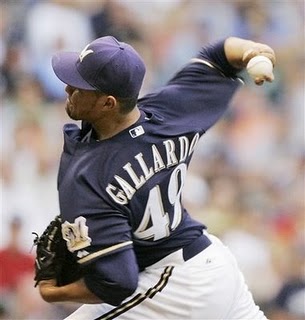
Yesterday Milwaukee inked 24-year old Yovanni Gallardo to a five-year deal worth a minimum of $30.1 million and potentially as much as $42.5 million.  The deal could keep Gallardo a Brewer through 2015 if the club so chooses.  The deal is really quite novel in that it provides both the Brewers and Gallardo a number of incentives, such as parameters regarding which teams Gallardo could potentially be traded to as well as bonuses based on Cy Young voting.  While Cy Young voting is a rather subjective way of distributing payment, the clause at least provides the Brewers some level of merit-based control on their checkbook.  Compared to the contracts awarded to a few of Gallardo’s peers such as Justin Verlander, Tim Lincecum, Felix Hernandez, and Matt Cain, Jon Lester, and Zack Greinke this deal comes off looking rather genius for the Brewers.  The question, though, lies in whether or not Gallardo can justify being considered a peer of these elite young righties.

Last year Gallardo cracked the 200-strikeout milestone for the first time in his career while making 30 starts for the first time as well.  Considering that he was coming off a season shortened by knee surgery in 2008, 2009 was a significant step in the right direction.  He still failed to reach the 200-IP plateau, but in many ways I consider that a good thing for the Brewers considering they were fully aware that they would ultimately miss the playoffs relatively early in the season.  Why not manage their young ace conservatively if he is basically just practicing for next year?

How about his stuff?  The wrap on Gallardo since he was a flame-throwing yet erratic high schooler has been that he lacks a developed third pitch.  I’m not sure that remains the case.  He still tends to favor his fastball (95+ whenever he needs it)/curve (at least plus, sometimes plus-plus) duo, but his changeup has made considerable strides since Gallardo reached the Bigs in 2007.  Still, he does not use it enough.  Gallardo’s high ¾ release point and carry on his fastball, when coupled with Miller’s short porch, tend to drive a lot of balls to the seats, but that same carry allows Gallardo to pitch at the letters a little more often, especially to righties, in order to generate strike 3.

Delivery?  It sounds like Milwaukee extensively analyzed Gallardo’s delivery to determine if anything about it would lead to career-threatening injuries later on.  From the sounds of it, Gallardo checked out nicely.  Personally, I think he fights to create a downward plane more than someone with his build and athleticism should, – primarily by using his front side to “climb” – but that same athleticism probably allows him the necessary leeway he needs to do it.

So why am I not convinced?  Gallardo is not efficient.  His K/BB is the worst of the pitchers I mentioned earlier as potential peers, he has thrown the fewest innings, and he has had a major surgery already.  Still, with the way his contract is structured, the Brewers have provided themselves with a situation that will provide Gallardo incentive for finding ways to solve these problems.  I think he has the stuff, athleticism and organizational support to really make a run at a few Cy Young Awards, and that would help both Yovanni and the Brewers.

The Umpire’s Opinions is News-Worthy Now?

April 11, 2010

joewest

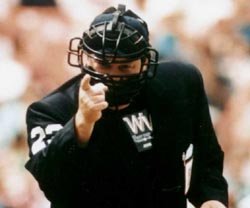
Following a thrilling opening series between the Yankees and Red Sox earlier this week, umpire crew chief for the series, Joe West, blasted the two organizations for playing a little sluggishly, even making the suggestion that there perhaps is a positive correlation between ability and rate of play.  While everyone realizes that this was simply a case of an elderly, grumpy, obese man not wanting to stand up for an extra hour given his strenuous 3-hour work days, what I don’t understand is why anyone even cares.  Let’s be real.  Is there any more easily replaceable job in the game?  We are talking about an umpire here.

This scenario harkens back to the 90’s when umpires first began to deal with MLB’s attempts to standardize the game’s officiating.  When Questec provided a realistic and reasonable measurement of an umpire’s ability to accurately gauge balls and strikes, and slow-motion video replay allowed the same level of evaluation with outs and safes, the game began to look a little differently.  The on-base revolution throughout the sport was only possible once umpires were forced to call a more standardized strike zone.  Well, a lot of umpires got upset and quit.  Even West helped organize a mass resignation in response to bargaining disputes with MLB late in the decade.

I guess I just don’t understand a Major League umpire’s complaint about anything.  I realize that umpires must pass examinations over the rules as well as practical examinations, but it’s not like these tests are the MCAT, or even the GRE for that matter.  I’m not saying I know every single word of the rulebook, but what I am saying is that absolutely everyone could if they really tried to.  Furthermore, these guys get to watch the game from the best seat in the house: the field itself.  Come on now.  That is so sweet.  Complaining about a 3 ½ -hr game?  Every other fan there, and umpires are really just interactive fans, is ecstatic about just being at the field and watching a little more of the game…especially when it’s Yanks/Sox in the first series of the season.  I think there is a small country’s worth of folks who would wait in line to do Joe West’s job voluntarily.

Are Offensive Signals Necessary?

April 7, 2010

bad

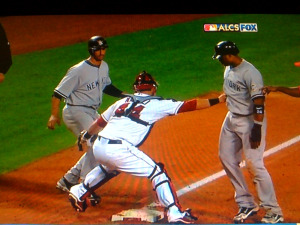
In a telephone conversation with Griff the other night, I was stunned when he told me that his C-Teamers missed a whopping 19 signals in double-dip.  Immediately I wondered why Griff was giving his hitters 19 signals over two games in the first place.  I considered that we were talking about young players developing in a system, and obviously a necessity for that development is knowledge of the club’s signals.  Still, this scenario reopened an internal debate that I have had since I first realized how foolish any and all hit-and-runs are.  Are signals from base coaches a necessary component of the game, or are they simply another piece of the game’s antiquity?

Last summer, I coached third with basically three signals and no indicators.  Two of the signals were green-light-types, and the other was the take sign which was simply me raising my index finger.  Everyone in the stadium knew when we were bunting because I basically yelled to the hitter to bunt.  We bunted very, very sparingly.  Our runners knew who had the green to go and who didn’t, so I basically did not give signs across the diamond.  Guys who could drag knew when to drag because I told them when good times were.  Obviously we did not have an hit-and-run sign because forcing a hitter to swing at whatever the pitcher throws is a bad way to prevent outs.

Was our offense in any way lacking because we did not have sophisticated signals?  Was it inhibited by the fact that we had no secret strategies for run creation?  First, what is each offensive player’s objective at the plate?  To get on base.  No player needs to be reminded of this by a coach.  What about sacrifice bunting?  This is 2010.  How about stealing bases?  Utilizing a simple green light allows the player the freedom to gauge his own chances while ensuring that he does so in a reasonable situation.  What good can come from sophisticated signals?  I guess there are times when a delayed steal or get-picked sign could be advantageous.  Answer me this, though: would yelling across the diamond at a runner to get picked change the outcome?  Probably not.  More importantly, does the limited frequency of plays such as these justify using practice time for them?  Of course not.

Signs can’t possibly hurt.  The problem, however, arises when players forget what the real goal is because they are too busy hitting-and-running or leaving early.  Hitters are there to reach base.  Runners are there to touch home.  OBP is the primary predictor we know of for run creation.  Hitters hopefully don’t need a signal for getting on base.  Varying from this default setting, therefore, is likely only to reduce run production.  By that line of reasoning elaborate signals should only be given when trying to score fewer times.