The Golden Sombrero Baseball Blog | MLB, Fantasy, College & High School Baseball News

Steppin’ Up To The Plate

May 24, 2010

I was talking to Dee the other day about something that I find to be one of the coolest parts of the game of baseball and its inherently individualistic nature, walk-up intro music.  There is no other team sport in which every player on the field gets so many exclusive moments.  A Hall of Fame NFL lineman could go his entire career without ever hearing his name over the stadium loudspeakers, yet even bottom rung Major Leaguers get three to four chances on average to strut out into the spotlight.  Even high school varsity teams throw on players’ own personal pump-up tunes on their way to the plate.  I didn’t play baseball long enough to get to walk out in front of a cheering stadium to a song of my choosing; the closest I have to compare is whatever I put on my IPod before a big ski run, but I totally understand the motivation of music and think it has a particularly interesting place in the game people come here to read about.

In my research on the topic I came across an article published Sunday in the Sacramento Bee that beat me to it, pretty much summing up everything I wanted to say about the topic along with a lot of big league insight that I would not be able to provide.  It’s really worth checking out, and big ups to back to back Cy Younger Timmy “Dirty Hippy” Lincecum on selecting The Doors’ Break on Through.  You are now firmly cemented as my favorite active player (more on that later). Another interesting bit I came across actually talked to the music people behind the scenes for all 30 MLB teams and got the skinny on all of them.  So I’m going to save myself a lot of time on this one and get straight to what I wanted to do with this piece in the first place.  I know all the guys that write on here have at some point walked out to their own intro music, along with most of the people who are reading here on a regular basis, and I’d love to hear what you guys’ thoughts are on it.  What did you walk out to and why?  If you’ve never had the pleasure of walking up to the plate to cheering fans and your own musical motivation, think for a minute that you’re in the on-deck circle of your favorite stadium and your team needs a big hit.  What’s it gonna be?  I want to hear from you on this one, Golden Sombrero Nation.

Responses:

Dee: the three walk-up songs i remember using were shook ones, gun ballad by the pharaohs (paz’s verse), and the whoa instrumental from bad boy. i really thought all of those beats were just heavy and brought me to the competitive and focused state of mind i needed to be in. i have heard some of the guys i go to dental school with, who also happened to play in college, say a lot of shit about players who use hip-hop as their walk-up jam like that we are all fake thugs and wankstas. it’s not like a could not have found a great punk rock piece that i would have loved. the problem is that even 3-chord punk songs demand more than the 5 or 6 seconds it takes to walk from the circle to the box. all of those hip-hop tracks i mentioned used samples that were only around 4 seconds and then looped. i really feel like battle rap is the way to go with walk-up songs.

Mark Wilcox: At Grynul, I walked out to a beat mixed by Griff and Hodges a few summers ago when we were drinking beer and watching Chris dominate his guitar. Apart from it being a pretty dark and intimidating beat, I liked it for the memory it conjured. Having a cold one with friends will forever be a favorite pastime; I could relax and think about how cool it was that I was there when that little piece of intellectual property was created. Plus I knew no one else in the world walked out to that shit. Confidence and comfort were the reasons I chose my walk out music.

Wee Willie Who?

May 23, 2010

As nothing more than a casual baseball fan that doesn’t play fantasy, I have always been more fascinated with all-time records and idiosyncrasies than the statistical minutiae most of you pore over regularly.  I would rather find Babe Ruth’s highest combined total of home runs hit and hot dogs consumed in a single game than hear about Pujols’ OPS for the month of May.  I make my way through Wikipedia, page after page, delving deeper into the obscurities of our national pastime with every click of my mouse.  Knowing more about mind-altering substances than I probably do about baseball, I find the fact that Dock Ellis threw a no-hitter on acid to be arguably the most impressive feat in baseball, if not all sports, history.  I learn and subsequently forget useless baseball trivia habitually, but last summer I came across something I felt compelled to remember and share with as many people as possible.  This was something so remarkable that when given the chance, I felt that I had no choice but to inform an entire nation of gilded-Mexican-hat-wearers.

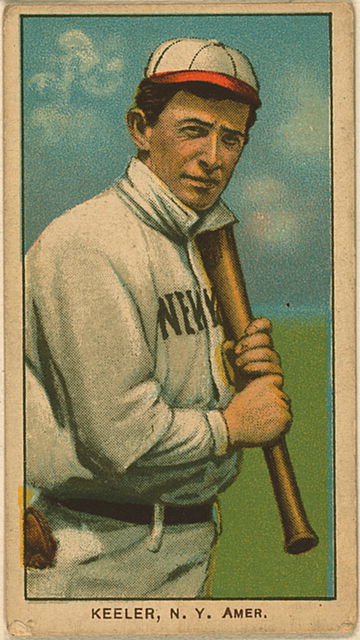
While investigating the mysterious figures that stand atop Major League Baseball’s all-time career batting average list (Dan Brouthers of the Boston Beaneaters is in the top 10, really?!), I discovered a man who I believe to be the most influential baseball player you’ve probably never heard of, Wee Willie Keeler.  Now, if you are in fact already privy to the accomplishments and influence of Mr. Wee Willie, please stop reading this and notify me immediately, I want to personally congratulate you for your studiousness and depth of knowledge regarding baseball history.  Since I assume most of you are still reading, allow me to elaborate.  Standing a shrimpy 5’4” and weighing in at just a paltry 140 pounds, William Henry Keeler made his professional debut playing right field for the New York Giants in 1892.  Wee Willie reportedly used only a 30” bat, and with that diminutive stick the pocket-size player hit safely 2,932 times over his career for a lifetime batting average of .341.  Wee Willie won the NL Batting Title in 1897 with a career best .424, tops in single-season history for a leftie and 8th best all-time, and then won it once again in 98.  He also had eight straight seasons with 200+ hits, a mark tied by Pete Rose and broken only last year by Mr. Consistent, Ichiro Suzuki, who had his ninth straight 200+ hit season in 2009.  Keep in mind, however, that Wee Willie never broke 600 AB’s during his streak.  And, his 44 game single-season hit streak is second only to Joe DiMaggio, with 56.  While all this is impressive, there are an astounding number of hitters who compiled incredible statistics during the dead-ball era in all categories except home runs, of course.  No, it isn’t statistics that you need to know about Wee Willie Keeler; it’s the way he played the game that crafted his indelible legacy.

Physically outmatched due to his slight stature, Wee Willie developed a number of techniques to become the game’s greatest place-hitter.  He once described his strategy to a reporter in five simple words, “Hit ‘em where they ain’t,” advice I still remember hearing from my little league coach shortly before being benched for either hitting ‘em where they were or more likely not hitting ‘em at all.  His fifth year in the league Wee Willie was traded to the Baltimore Orioles, where under manager Ned Hanlon, he and his teammates epitomized what is known today as inside baseball, more commonly referred to as small-ball.  Yes, much of the strategy during this time focused on manufacturing runs through speed and smart base running, but Keeler and his Orioles took it to another level.  The term “Baltimore Chop,” used to describe a ball hit hard off the dirt in front of home plate and high into the air, is directly attributable to this team.  While this now typically happens only by accident, the Baltimore Chop was such a focal point of Keeler and the Orioles’ strategy that the groundskeeper mixed hard clay into the packed dirt in front of home plate to provide them higher bounces.  Using this extra hang time, Wee Willie actually once legged out a double on a Baltimore Chop.

Wee Willie was also a remarkable bunter.  Honus Wagner once said about him, “Keeler could bunt any time he chose,” and he was right.  In his 1898 NL Batting Title campaign, only 10 of Wee Willie’s 216 hits went for extra bases.  There are no records for how many of those 206 singles resulted from bunts, but I believe it is safe to say Mr. Keeler was more than adept at getting on base without using power.  And it was this propensity for bunts that caused the league officials to reexamine the rulebook.  Wee Willie could foul off bunted balls almost indefinitely and was solely responsible for the rule change that now results in a batter being called out if he fouls off a bunt with two strikes.  This might not seem like a big deal, but in the 5th inning of the Mariners game against the Padres on Thursday, the M’s shortstop Josh Wilson did exactly that with two runners on base and I bet he would’ve been cursing Wee Willie on his walk back to the dugout had he known the legend’s adroit bat control was responsible for his being called out.

In today’s age of hitter friendly parks and moon shot bombs, it is easy to forget about the little guys that paved the way for the game we know today.  Even Hall of Famer George Brett asked, “Is he the guy they named the cookie after? Wee Willie Keebler?” after being told by a reporter he tied Keeler for 20th place on the all-time hits list.  But what Wee Willie lacked in size, he made up for with highly-skilled batsmenship and baserunning.  As Ted Williams once said, “he was small in size but he was huge with the bat.”  This combined with his impact on both the strategies and rules of baseball still to this day should make you want to go out and inform someone less knowledgeable than yourself about the wondrous career of the one and only Wee Willie Keeler.

All Eyes on Grinnell: Pioneers from across the globe reunited through Midwest Conference baseball

May 22, 2010

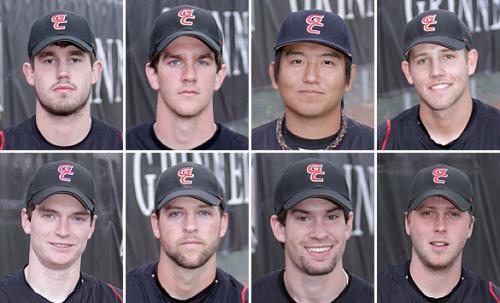
Last weekend, I had the privilege of attending the 2010 Midwest Conference Baseball Tournament and calling the action for Midwest Conference Television all tournament long.  The whole weekend was one of the best times I’ve had since I graduated from Grinnell two years and three days ago.  And while it was great to be able to sit in the press box again after all these years while doing play-by-play for a baseball game for the first time ever, what really made the weekend special was the union of Pioneer baseball past and present.

The tournament got off to a rough start for the Pioneers.  The Ripon Redhawks, who had dominated the Midwest Conference Tournament in recent years with a 36-18 mark in tournament play, easily the best in the conference, pounded out seventeen hits in an 11-4 victory to move to the winner’s bracket.  Right fielder Nate Paul led the effort for the Redhawks, pounding out a singles, two doubles and a bomb in support of Redhawk ace Kurt Roeder, who was certainly short of dominant, but easily pitched well enough to get the victory, going the distance and giving up four runs on seven hits in the victory.  All-Midwest Conference South Division first-teamers Greg Suryn ’11, Mike Goldfein ’12 and Nate Pierce ’10 all went deep for the Pioneers, but those runs were all Grinnell could muster in Game 1, as they moved to the loser’s bracket for the fifth time in their five Midwest Conference Tournament appearances.

After the St. Norbert Green Knights defeated Illinois College, then proceeded to fall to the Redhawks, it was time for Pioneers and Blueboys in game two.  The Pioneers swept the Blueboys in the season series and were trying to do something they had never done before: finish 5-0 against one team in a season.  They tabbed ace Ben Pope ’12 as their starter in the must-win game, and while he surrendered twelve hits and six runs in easily his poorest start of the year, he kept his composure and did not give up the big inning until a four-run seventh, when the Pioneers already had a comfortable nine-run lead.  Dugan Knoll ’12 came on in relief to throw a perfect eighth and closer Chad Christoff ’10 tossed a scoreless ninth to preserve the victory and send the Pioneers to day two of the tournament for just the second time in the history of the program after an 11-6 win.  Grinnell’s considerable offense in game two was highlighted by home runs from Paden Roder ’10 and Mike Nodzenski ’12, along with Suryn’s second bomb of the tournament, equaling his regular-season total.

In game three, Coach Tim Hollibaugh made a rather unconventional move, sending Mike Bogard ’12, who had thrown just five innings the entire season, to the hill in what amounted to the most important game in the history of Grinnell College baseball.  Bogard did not disappoint, stifling a powerful St. Norbert offense for six full innings, giving up ten baserunners but only two runs before turning things over to Ryan Harris ’10, who rebounded from a difficult start against the Redhawks to slam the door on the Green Knights.  Harris recorded the final nine outs to record the save, allowing just one hit and retiring St. Norbert’s Tony Jandron, the nation’s leading hitter at .538, on a 1-2-3 double play with the bases loaded and nobody out.  That turned out to be the last at-bat in Jandron’s college career, as he was on deck representing the tying run when Harris knocked down a line drive with two outs in the ninth, then recovered and threw on to first to send the Pioneers to the Championship Round for the first time in the history of the program.  Roder went deep one last time to set both the single-season(12) and career record(23) for most home runs by a Grinnellian, and Goldfein went 4-for-5 as the Pioneers jumped out to a 4-0 first-inning lead and never looked back in the 5-2 victory.

That win placed the Pioneers in a rematch with Ripon for the championship.  Pioneer starter Andrew Myers ’12 pitched capably, giving up three earned runs in four innings of work, but in the end the Pioneer bullpen could not contain a powerful Ripon offense, as the Redhawks repeated their 17-hit effort in defeating the Pioneers 13-5.  Grinnell had its chance in the sixth, when Nodzenski missed a grand slam by less than three feet, which would have put the Pioneers ahead 7-5, and instead had to settle for a sacrifice fly to make the score 5-4 Redhawks.  Things looked good for the Pioneers even then, with Ben Pope available for three innings of work, but Grinnell would get no closer as the Redhawks scored eight runs over the final three innings to put the game out of reach.  Chad Takabuki ’10 led the Pioneers offensively in his final game in a Grinnell uniform with three hits, but Ripon starter Jason Wierschke and reliever Steven Blader were able to hold the Pioneers to two earned runs on only nine hits, all singles.  Zach Bayreuther committed four errors for the Redhawks in their clinching game, but the Pioneers could not take advantage as the Redhawks claimed the eighteenth conference title in program history, while Grinnell will enter next season still looking for its first.

Even though the Pioneers were unable to secure the elusive conference title, the tournament was still a great event to cap off the year.  In an unprecedented show of support that one would be hard-pressed to find at most other schools Grinnell’s size, alumni traveled from all across the country to witness the Pioneers’ run at history.

From the east coast, Mark Wilcox ’09 (Baltimore, MD) and myself, Justin Abramson ’08 (Washington, DC) made the trip, though not without incident, barely arriving in time for the first pitch after missing a connecting flight at Chicago O’Hare.  Coming to our rescue were former Pioneers Kevin Byrne ’06, James Bird ’07, Andrew Colver ’07 and Joe Reth, who drove us from their hometown Chicago to the tournament just in time for the pregame ceremonies.  The four of them make up the nucleus of the Pioneer alumni baseball team, the Chicago Pioneers, who began their 30-game season last week with a 2-1 loss.  Joining in the festivities all the way from the west coast was Ben Mendoza ’09 (Portland, OR), whose suggestion of a Dunkin’ Donuts trip on the way to Grinnell was critical to keeping spirits high throughout the journey.

Elsewhere, Mike Rosenbaum ’08 and Julia Meisler ’09 (St. Louis, MO) made the long drive, leaving their homes at 12:30 AM the day of the tournament and traveling all through the night to witness the Midwest Conference Tournament firsthand.  Rick Berdelle ’09 (Clarendon Hills, IL) also drove in to watch the Pioneers and former rotation co-anchor Harris take their shot at history.  And all of this does not even count the support from Pioneer alumni still in Iowa, including Peter Leo ’06 (West Des Moines), brothers Mike Maloney ’06 and Brett Maloney ’09 (Des Moines) and Jim Malewitz ’09 (Iowa City), who joined me in the booth and provided excellent color commentary for our viewers on MWCTV, which included among others, Daniel Dee Clark ’08 (Dallas, TX), Sam Eaton ’07 (Austin, TX) and, from across the pond, Gary Kahn ’09 (Ostrava, Czech Republic).

The weekend culminated with the end-of season baseball party, where Pioneer alumni and students gathered at The Titty Bar, home to Roder, Takabuki and J.P. Prouty ’10, among others, for one last night of drinking in honor of Grinnell College baseball.  For the alumni in the crowd, it undoubtedly provided a welcome reminder of what a wonderful place Grinnell College is and can be, especially when one is surrounded by good friends, beer and baseball.

On Sunday morning, the Pioneers of the present woke up to prepare for final exams as they wrap up Hell Week in Grinnell.  Also waking up after the final baseball event of the year were the Pioneers of seasons past, who headed back to their lives, wherever they may be.  Mendoza heads back to Portland, where he lives with longtime girlfriend Gabriela Maldonado-Bell ’09. Byrne drives home to his wife, Lauren Meredith ’06, and the next day he heads back to his job at AllState Insurance.  Wilcox, once called Max Walcott during his time as a Pioneer catcher, now goes back to being Mr. Wilcox as he returns to his high school chemistry classroom in Baltimore.  Malewitz makes the one-hour drive down to Iowa City, where he’ll be finishing up his first year in journalism school at the University of Iowa, while Colver, Reth and Bird resume their own lives and jobs as they look forward to the Chicago Pioneers’ next game and, of course, rooting on the Chicago Blackhawks in the NHL playoffs. Rosenbaum and Meisler head back home to St. Louis, where they look to extend their stay atop the standings in the Denslow Cup.

And finally, I, too, return to life after Grinnell, where I work as an analyst (actually, as of yesterday, a Senior Analyst) at the Advisory Board Company in Washington, DC.  Once known as Young Towel, the voice of Pioneer athletics, I step out of the broadcasting booth for perhaps the final time and return to my life as Justin Abramson, a man who sits behind a desk in an M-Street office building looking at Excel spreadsheets for a living.

One week later, it’s life as usual for this Pioneer alum, as it is for all Pioneer baseball alumni across the country and the world.  But for one weekend, the Pioneer baseball community came together in pursuit of a dream.  And although the dream wasn’t realized this year for the Grinnell College baseball team, it was a weekend that this writer will never, ever forget.  So keep the dream alive, Pioneers.  The ghosts of Pioneer baseball past will always be with you.

Recent Trade Involvement in the Denslow Cup

May 22, 2010

Jim got engaged!  To a terrific young lady I might add.  Congratulations, buddy!  We’re really proud and excited for you.  Two more engagement shout-outs: first one for our buddy, Kevin (Kev Kong) Wilcox; second one for my dental school classmate/friend and cadaver dissecting partner, Val Sanchez.  Very fun things.

Before I get going with this post, I want to apologize for not posting anything lately.  My finals week lasted about 15 days/nights and was a truly painful experience for everyone involved.  I still am awaiting confirmation that I passed my last two exams, but I did not need to do that well on them to make it to 2nd year.  I don’t think when I began dental school or even when I was applying that I had any idea what it would actually be like.  Grinnell is a challenging undergraduate institution that consistently ranks among the most extensive in the country in terms of workload.  It did not remotely compare to what was expected of each student at Baylor.  They say the first year of professional school is the most challenging of any student’s career.  I really hope that is the case.

Moving on.  I have tried not to write much about fantasy on this blog because I am fearful of disclosing information that has helped me succeed in previous to my competitors.  The blog comes first now, though, so hopefully none of what I disclose is seen as particularly novel.

This post will center on some recent trades I have completed in my 16-team 7 x 7 (AVG, OBP, SLUG, HR, SB, R, RBI x IP, W, SV, K, ERA, WHIP, K/BB) league that I play in with my friends, many of whom write for the Sombrero.  Before I begin I should mention that I tend to give the team I drafted a month or so of a chance for two primary reasons.  First, it takes approximately 100 plate appearances or so to produce a meaningful set of results capable of evaluation.  Second, this evaluation should help determine a reevaluation of the predraft rankings implicit within are new projections and expectations.  This reevaluation should generate some inefficiencies and potential bargain deals throughout any league.  Hopefully a month into the season every one of your players are playing over-their-heads and producing at unsustainably high levels.  This will inflate their values to the point that they are capable of fetching players ranked considerably higher in the predraft rankings.  A month into the season the rankings that should be taken the most seriously remain those produced prior to the draft because they are based in the most extensive and reliable numbers.  Some players are streaky, and some streak/slump oscillations express periods of a month or longer.  For these reasons, I target May as the month in which I need to work the hardest in fantasy.  This unfortunately coincides with finals and has been hindered more than usual this year.  Nevertheless I have made a few moves that I think will really help my squad, the Heights Knights (named after my 8th grade basketball team), find their stride and hopefully begin to climb in the standings.

CLAR traded Kevin Youkilis, Bos 3B to A-holes
CLAR traded Nate McLouth, Atl OF to A-holes
CLAR traded Kevin Slowey, Min SP to A-holes
MVW traded David Wright, NYM 3B to Knights
MVW dropped David DeJesus, KC OF to Free Agency
MVW dropped Nick Hundley, SD C to Free Agency

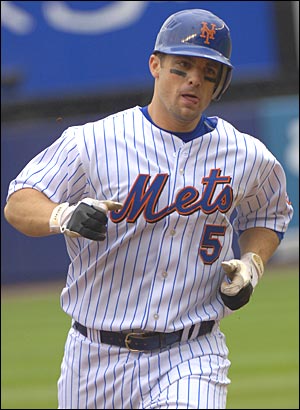
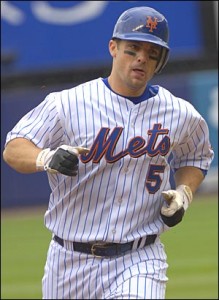
This trade took place in early May and heavily reflects my love for David Wright and very little else.  Simply put, I lost this trade.  Youkilis plays for a better team in a better yard, makes contact more often and has better control of the strike zone, probably more power, is more consistent, and, most importantly, will be an easier guy to move later on.  This final reason is a product of the fact that as the season progresses, Wright’s strikeout totals will likely seem more astronomic by the day.  The Mets are a pathetic organization.  I blame their management and front office entirely for David’s recent and ongoing struggles with contact.  That’s a different subject for a different day, though.  Back to the trade.  Slowey’s command is second to none, and even though he lacks a put-away pitch or above average anything, his ability to locate makes him a serviceable two or exceptional three in any rotation.  In a league like ours that uses IP as a category, Slowey is a horse and will always outperform his 5×5 ranking.  McLouth has not looked like the all-star he was in 2008 because he is not making contact often enough.  He will continue to lose playing time as long as he fails to put the ball in play, but, when near his best, McLouth makes Melky Cabrera look like the minor league journeyman he should be.

Eunuch (MVW) beat me on this trade, but I have David, my favorite player, and I am much happier moving forward now as a result.

TOWL traded Nick Markakis, Bal OF to Knights
CLAR traded Yovani Gallardo, Mil SP to Corporate Towls

This trade was mostly a reflection of our cap on starts.  Essentially three starters should be able to reach the cap (100), and I had five at the time.  Gallardo was my highest ranked according to ESPN, but in our league should have been dropped extensively due to his notoriously high pitch counts and less-than-ace-caliber walk totals.  In standard formats, these are virtually meaningless, but in our league make Yo a 4-category contributor in a 14-category format.

Markakis has been one of my targets since 2006.  His ability to both differentiate balls and strikes as well as center the baseball make him lethal in formats such as ours that utilize both average and OBP categories despite having just 15 to 20-bomb power.  Because OBP is not included in the standard format, Markakis is far more valuable in the Cup than he is according to ESPN.

Budz dropped Kris Medlen, Atl RP to Free Agency
Budz dropped J.J. Putz, CWS RP to Free Agency
Budz traded Billy Butler, KC 1B to Knights
CLAR traded Todd Helton, Col 1B to ChronicL’s
CLAR traded Josh Willingham, Was OF to ChronicL’s
CLAR traded Matt Lindstrom, Hou RP to ChronicL’s

Ty9 traded Carlos Lee, Hou OF to Knights
CLAR traded Billy Butler, KC 1B to POO

These trades happened within hours of each other, so I will treat them as one mega deal in which I move Helton, Willingham, and Lindstrom for Carlos Lee.  A trade like this is only possible if you really know the other managers in the league.  My first trading partner in this deal was Griff.  Griff is after a first-place finish this year, and I know it.  He has produced increasingly higher finishes each year and made it into the top-5 last season for the first time.  In a 16-team league, saves are a big deal.  Not only are there only 30 closers at any time but also a 0 in any category means a lot more when one team is getting 16 and the average team is snagging 8 or 9 from that category.  I find it very hard to envision a first place team getting last or even close to last in the saves category.  A single stable closer (30 saves) for the entire season is probably enough to avoid a catastrophically low saves total, and closers are hoarded in our league as a result.  The effects of this hoarding are an enhanced demand and a reduced supply of saves.  Griff recognized that the longer he waited, the less the return and the higher the cost.  By a stroke of luck, Alfredo Simon, the new Orioles closer was available as well as Manny Corpas making Lindstrom somewhat expendable.

Willingham is another guy who is worth more in our league than in a standard league because of his skill at reaching base, but what some folks have been slow to accept is the quality of the heart of the Nationals order.  Hitting behind Adam Dunn should provide Hammer with a shot at 100 RBI’s.  He has a chance this season to be an all-star and is especially valuable in a platoon.

Todd Helton again is more valuable in our league due to his combination of average and on-base skills.  Jason Giambi is a ridiculous distraction and almost comical nowadays, but he should be eliminated shortly I suspect due to the imminent season-ending injury that surely accompanies 39-year old, fat, steroid abusers.  Griff actually got Helton at a time when his value may be somewhat deflated due to his slow start, and in general this trade is looking as though I came away the loser.

However, I knew if I could just snag Butler that Ty9, a lifelong and diehard Royals fan, would probably give me Carlos Lee in exchange.  Lee has been getting a lot of bad publicity recently because of his slow start, but the guy can take every square inch of the zone 450 ft.  I saw his slow start as an obvious opportunity to buy low on a guy that has a 3-year mean OPS over .880 and a 5-year average of 31 dongs/season.

Everyone other Tyrone won this one.

Bob dropped Mike Adams, SD RP to Free Agency
CLAR traded David Ortiz, Bos DH to of Shelley
CLAR traded Chris Coghlan, Fla OF to of Shelley
Bob traded Carlos Pena, TB 1B to Knights

As noted earlier, I have a tendency to fall in love with certain players.  Carlos is one of those guys for me.  I have never had him on my team.  He is clearly underperforming right now, but has shown the ability to stay inside and above the ball with good lower body action in the last week or so against good arms.  The ball Gardner took away was an excellent swing, and the next night Carlos went deep twice.  I love him and rolled out the red carpet this morning for him.

I’m a Coghlan believer.  I think his mechanics at the plate allow him to handle almost all pitches even though they probably are good for no more than fifteen jacks/season.  As everyone has always known about Coghlan, his skills play better at 2B than at a COF spot.  Not going to happen with Uggla on 40-jack pace.  Still, Coghlan should be around a .300 hitter the rest of the way while walking at a respectable clip.

Papi is so tough to evaluate right now.  Sometimes he looks as good as ever, and sometimes he looks like he could go 0-for a beer league game.  This suggests that Papi is guessing and cheating his hands at the plate to compensate for either reduced pitch deciphering abilities, reduced bat speed, injury, or a combination of the three.  I suspect that I may have moved him at the perfect time, and while I have normally been a fan of Papi, the failed PED test was a big turnoff for me.  Considering I plucked him off of waivers a week before this deal, it was easy to pull the trigger.

I am very satisfied with these trades and the way my team is looking.  This has been one of my more successful Mays, and, with the addition of luck, health, and a few more quality moves, it should put me in position to challenge for my first title.

The current Knights:

C Carlos Ruiz
1B Carlos Pena
2B Dustin Pedroia
3B David Wright
SS Hanley Ramirez
OF Michael Bourn
OF Nick Markakis
OF Carlos Lee
UTIL Adam Dunn
Bench Jim Thome
Bench
P Cole Hamels
P Alfredo Simon
P Manuel Corpas
P Aaron Heilman
P J.J. Putz
P Carlos Villanueva
Bench Scott Baker
Bench Jeff Niemann
Bench Ted Lilly
Bench Ervin Santana
DL Mike GonzalezDL15

Audio from my appearance on B-Squared Show

May 19, 2010

Thanks to Jordan and and Brian of the B-Squared Show on 312sports.com for having me on the air today.  They do a great job every single day and I had a blast talking baseball with them!

Here is the audio segment from my appearance on today’s show:

Mike Rosenbaum on the B-Squared Show