Devin Mesoraco | The Golden Sombrero Baseball Blog | MLB, Fantasy, College & High School Baseball News

Top 50 Prospects Recap: Nos. 11-50

After a monster 2011 season, Arenado jumps from No. 44 to No. 21

Just as we did prior to the start of the 2011 season, The Golden Sombrero is currently unveiling our Top 50 Prospects.  Due to the promotion of many of baseball’s finest prospects over the course of last season, our new list features a slew of new names thanks to strong performances across various minor league levels.  Only time will tell whether this new crop of prospects will match the hype and success of last season’s, but one thing is certain – they are the future of baseball.  Before we crack the Top 10, however, here is a quick recap of the players we’ve highlighted thus far, and where they were ranked headed into the 2011 season:

50. Francisco Lindor, SS, Cleveland Indians – Pre-2011 Rank: N/R

49. Christian Yelich, OF, Miami Marlins – Pre-2011 Rank: N/R

48.  Joseph Wieland, RHP, San Diego Padres – Pre-2011 Rank: N/R

47. Jarred Cosart, RHP, Houston Astros – Pre-2011 Rank: N/R

46. Michael Choice, OF, Oakland Athletics – Pre-2011 Rank: N/R

45. Matt Harvey, RHP, New York Mets – Pre-2011 Rank: N/R

44. Sonny Gray, RHP, Oakland Athletics – Pre-2011 Rank: N/R

43. Zack Cox, 3B, St. Louis Cardinals, — Pre-2011 Rank: N/R

42. Yasmani Grandal, C, Cincinnati Reds – Pre-2011 Rank: N/R

41. Zack Wheeler, RHP, New York Mets – Pre-2011 Rank: N/R

40. Hak-Ju Lee, SS, Tampa Bay Rays – Pre-2011 Rank: N/R

39. Taijuan Walker, RHP, Seattle Mariners – Pre-2011 Rank: N/R

38. Wil Myers, OF, Kansas City Royals – Pre-2011 Rank: 15

37. Will Middlebrooks, 3B, Boston Red Sox – Pre-2011 Rank: N/R

36. Brett Jackson, OF, Chicago Cubs – Pre-2011 Ranks: 43

35. Carlos Martinez, RHP, St. Louis Cardinals – Pre-2011 Rank: N/R

34. Gary Brown, OF, San Francisco Giants – Pre-2011 Rank: N/R

33. Randall Delgado, RHP, Atlanta Braves – Pre-2011 Rank: N/R

32. Starling Marte, OF, Pittsburgh Pirates – Pre-2011 Rank: N/R

31. Robbie Erlin, LHP, San Diego Padres – Pre-2011 Rank: N/R

30. Arodys Vizcaino, RHP, Atlanta Braves – Pre-2011 Rank: N/R

29. Jonathan Singleton, 1B/OF, Houston Astros – Pre-2011 Rank: 37

28. Jake Odorizzi, RHP, Kansas City Royals – Pre-2011 Rank: 35

27. Travis d’Arnaud, C, Toronto Blue Jays – Pre-2011 Rank: N/R

26. Manny Banuelos, LHP, New York Yankees – Pre-2011 Rank: N/R

25. Miguel Sano, 3B, Minnesota Twins – Pre-2011 Rank: N/R

24. Josh Bell, OF, Pittsburgh Pirates – Pre-2011 Rank: N/A

23. Martin Perez, LHP, Texas Rangers – Pre-2011 Rank: 28

22. Drew Pomeranz, LHP, Colorado Rockies – Pre-2011 Rank: N/R

21. Nolan Arenado, 3B, Colorado Rockies – Pre-2011 Rank: 44

20. Archie Bradley, RHP, Arizona Diamondbacks – Pre-2011 Rank: N/A

19. Anthony Rizzo, 1B, Chicago Cubs – Pre-2011 Rank: N/R

18. Tyler Skaggs, LHP, Arizona Diamondbacks – Pre-2011 Rank: N/R

17. Devin Mesoraco, C, San Diego Padres – Pre-2011 Rank: 27

16. Bubba Starling, OF, Kansas City Royals – Pre-2011 Rank: N/A

15. Jarrod Parker, RHP, Oakland Athletics – Pre-2011 Rank: 8

14. Jacob Turner, RHP, Detroit Tigers – Pre-2011 Rank: 19

13. Jurickson Profar, SS, Texas Rangers – Pre-2011 Rank: N/R

12. Jameson Taillon, RHP, Pittsburgh Pirates – Pre-2011 Rank: 14

11. Danny Hultzen, LHP, Seattle Mariners – Pre-2011 Rank: N/A
Today’s Prospect Landscape: Hitters vs. Pitchers

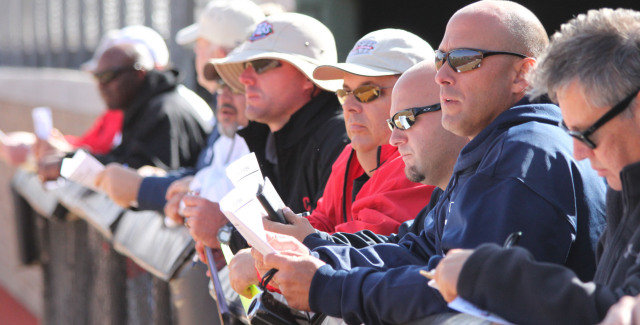
When a reader of The Sombrero commented on our write-up of Bubba Starling, it became apparent that implicit within our rankings, we were making a claim regarding the entire prospect landscape.  After a little reflection about how we could both be somewhat down on Starling and also rank him as high as we did, it was obvious that we were boosting hitters to levels that they might not quite deserve relative to the pitchers they were ranked alongside.

For instance, Tyler Skaggs and Archie Bradley are found adjacent to Anthony Rizzo and Devin Mesoraco in our rankings.  Skaggs and Bradley both project as #2 arms at worst.  Both are very young as well and have obvious paths to Big League action.  Skaggs might even be a member of the 2012 defending NL West Champion rotation in Phoenix.  Bradley should breeze through the Minors and wind up in a Major League rotation within three years, barring injury of course.  There is simply nothing in the way of these two aces becoming very good Major League contributors on a championship caliber club.  That’s not to say it’s by any means a done deal or even highly likely that this will be the case.

However, the idea is that there are no reasons to expect these two arms to fail in their ascent.  Mesoraco and Rizzo are older than both of the pitchers, both are large-bodied guys who likely are inflexible in terms of positioning, and both have already failed in Major League auditions, although the samples were small and both were rushed to some extent.  Nevertheless, both players are assumed to begin 2012 in Major League uniforms even if Rizzo is not shipped somewhere between now and then.  It’s no secret that we are quite high on both hitters and even higher on Starling, but there are serious flaws apparent in each case, and it is certainly conceivable that they may never succeed in the Show.  Rizzo is a below-the-ball hitter who approaches the hitting zone using a nonlinear approach that takes entirely too much time to barrel up on pitches on the inner half with decent pace.  Additionally, Rizzo plays first base with minimal chance of successfully sliding to a more valuable defensive spot.  The Padres even brought back Yonder Alonso in the Latos deal, effectively dropping Rizzo to second or third on the depth chart at 1B.  Mesoraco has less noticeable flaws, but he still has been injury prone and at-best will probably cap at under 500 plate appearances in a season, a huge reason that the Royals slid Myers away from the dish and the Nats did the same with Harper.

Basically, within the top 20 prospects as well as within the top 50, there is far more to like about the pitchers and far less flaws that might keep them from Big League success.  Even within the top 10, which again features more pitchers than hitters, we really only see Harper with no obvious flaws or roadblocks that might or should keep him from an all-star career.  We see injury, poor stats, and lack of positional flexibility or ability to even be average on D in each case except Harper’s.  Yet with our pitchers we see nothing but elite stuff, elite command, elite makeup, and obvious paths to innings.  Don’t get me wrong, the hitters are elite prospects and deservingly are considered among the top prospects in the game, but why if the pitchers are simply better?

An obvious disparity exists between hitting and pitching prospects collectively.  Pitchers are ahead of hitters by a lot.  What’s more, hitters tend to reach their peak years earlier than pitchers and, therefore, should be ready to contribute at the Major League level before pitchers of the same age.  How should we adjust the values that we apply to prospects in light of this?

In the case of pitchers, it is far easier to assign grades to pitches than it is to, say, hit tool.  Evaluating hit tool requires at least several looks and is far easier to do when a player is facing quality pitching.  Brandon Nimmo went in the first round, but slapping grades on his skills and makeup was far tougher to do than it is for someone like Bradley, who has reached triple digits with his fastball.  Additionally, as professionals, pitching prospects, specifically rotation guys, pitchers only take the rock every fifth or sixth day leaving most of the week to train physically in a relatively low-stress environment.  This has likely never before been such a massive advantage for pitchers simply because of the way PED abuse is policed today.

Entire workouts must be totally altered to accommodate the grueling season and average day of a professional or even collegiate athlete.  Pitchers have a great deal more time to train athletically at high intensity in season than hitters do.  Naturally, we should expect pitchers to be ahead of hitters more so today than ever before if for no other reason than that pitchers should be athletically better conditioned than hitters since hitters (and pitchers) face far greater difficulty abusing drugs than they ever have before.

The NCAA has done professional baseball very few favors, but the incentive for pitchers to enter professional baseball at younger ages is greater than that for hitters and always has been.  As was the case with Rendon and even Harper, the two best offensive prospects in the game who retain rookie status, a hitter must be frequently evaluated and is usually required to display his skills at top showcases and tournaments with and against top clubs and schools…or go to college where that happens nearly every game in top conferences.  Prep pitchers who feature mid-90’s heat will draw cross checkers nearly every start and truly are far less required to show it off against quality opponents.  A 60 fastball is a 60 fastball whether throwing it to Griffey or throwing it to a geriatric patient.  What is a 60 hit tool, though?  Implicit within that grade is a level of consistency that is not necessarily required in the same way with regards to fastball scores.

Additionally, when pitchers are evaluated, the system is far easier to apply.  Fastball velocity? Fastball activity?  Fastball command?  Secondary stuff?  Size? Mechanics? Makeup?  It’s very easy to understand how valuable each of these is relative to each other.  Few successful pitchers can last long in the game if they can’t pitch off of their fastballs due to a lack of pace, action, or command.  Clubs tolerate a lack in effective secondary stuff for years, but can a team tolerate a lack of hit tool in young hitters?  “Not really” should be the answer, but it is far more challenging to ensure that the top hit tools or even potential top hit tools are evaluated as accurately during amateur years.  In addition, clubs tolerate pathetic hitters in exchange for stellar up-the-middle defense.  Jose Iglesias was in many top prospect lists a year ago despite using a wet towel for a bat.  He has virtually no chance of long-term employment as a Major Leaguer at anything more than the minimum because glove-first middle guys simply come cheaply due to a far greater supply than demand.  And yet he still made onto many lists including our own.

The point is that a total reevaluation is required when ranking prospects.  The most important tool in baseball is the hit tool.  It is more important than every other offensive tool by no small margin and more valuable than any pitching tool including fastball velocity.  Consider Robbie Erlin.  While we were quite aggressive with our ranking of Erlin, it had very little to do with his fastball velocity, which is not all that impressive.  Erlin, however, commands his stuff better than any other young pitcher in the game in our opinion and is perfect for his home yard.  Good luck to any hitter who is planning to make a career out of hitting who lacks an average hit tool.  Selling out for pull power still requires the ability to barrel up on mistakes, a tough skill to master if barreling up has proven difficult in the past.  And yet so few players in the Minor League landscape today possess impact hitting ability, let alone middle-of-the-order ability, that it has shifted the balance strongly in favor of pitchers.

Arlo and I attempted to account for this in The Sombrero’s rankings, which is why you see Rizzo and Mesoraco next to Skaggs and Bradley and why you’ll see Machado and Montero next to Gerrit Cole and Julio Teheran.  Which of these do you think we are more confident will achieve Major League success?  Obviously the pitchers, but we think the quality of position players is declining at the Major League level in large part due to the inevitable response of harsher penalties on drug abuse and greater ability to detect when players are abusing PEDs.  With this comes more opportunity for high intensity training for pitchers in season and therefore better results, especially as the season drags on and off-days become more and more necessary.  Baseball is, however, a game of scoring and preventing runs with equivalent value to the team’s collective effort to accomplish both, because a run for is the same as a run against.  Resultantly, we should not find ourselves with a top 10 that includes 9 pitchers and Bryce Harper.  We should more or less have equal amounts of hitters and pitchers.  With today’s prospect landscape, in order to accomplish this a drastic reevaluation of the weights of tools is necessary.

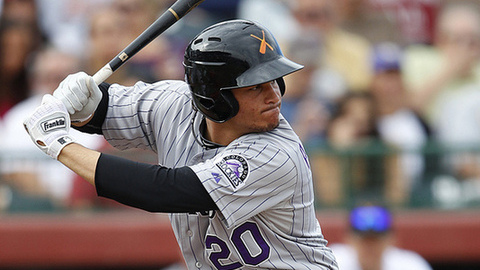
Top 50 Prospects: #17- Devin Mesoraco

#17 Devin Mesoraco

Cincinnati Reds

DOB: 6/19/1988

Previous Rank: 27

ETA: 2011

It’s hard to believe that a guy like Yasmani Grandal could somehow become dispensable (not to mention Yonder Alonso), but that is exactly what happened when the Reds sent both guys to San Diego for Mat Latos.  The primary reasons that deal makes sense for the Reds is No. 1: Joey Votto, and No: 2, Devin Mesoraco.

Mesoraco slashed .289/.371/.484 for Louisville and then was called up for 50 at-bats with Cincinnati.  He went deep 15 times in Triple-A, walks at a decent clip, and projects for way more power than he currently displays.  Perhaps even more important, though, is that Mesoraco possesses the tools to be an average catcher in the Show.  He is an average receiver as well as thrower, and should be the Opening Day starter for the Reds in 2012 , hitting in the middle of the order by 2014 alongside Jay Bruce and Votto.

Year Age Tm Lg Lev G PA AB 2B 3B HR RBI SB CS BA
2007 19 Reds GULF Rk 40 155 137 4 0 1 8 2 0 .219
2008 20 Dayton MIDW A 83 334 306 13 1 9 42 2 3 .261
2009 21 Sarasota FLOR A+ 92 357 312 22 1 8 37 0 1 .228
2010 22 3 Teams 3 Lgs AA-A+-AAA 113 451 397 25 5 26 75 3 3 .302
2010 22 Lynchburg CARL A+ 43 181 158 11 2 10 31 2 2 .335
2010 22 Carolina SOUL AA 56 212 187 11 3 13 31 1 0 .294
2010 22 Louisville IL AAA 14 58 52 3 0 3 13 0 1 .231
2011 23 Louisville IL AAA 120 499 436 36 2 15 71 1 1 .289
5 Seasons 448 1796 1588 100 9 59 233 8 8 .269
AAA (2 seasons) AAA 134 557 488 39 2 18 84 1 2 .283
A+ (2 seasons) A+ 135 538 470 33 3 18 68 2 3 .264
A (1 season) A 83 334 306 13 1 9 42 2 3 .261
AA (1 season) AA 56 212 187 11 3 13 31 1 0 .294
Rk (1 season) Rk 40 155 137 4 0 1 8 2 0 .219
Provided by Baseball-Reference.com: View Original Table
Generated 1/2/2012.
Year Age Tm Lg Lev G AB HR RBI BB SO BA OBP SLG OPS TB
2007 19 Reds GULF Rk 40 137 1 8 15 26 .219 .310 .270 .580 37
2008 20 Dayton MIDW A 83 306 9 42 20 64 .261 .311 .399 .710 122
2009 21 Sarasota FLOR A+ 92 312 8 37 35 76 .228 .311 .381 .692 119
2010 22 3 Teams 3 Lgs AA-A+-AAA 113 397 26 75 43 80 .302 .377 .587 .964 233
2010 22 Lynchburg CARL A+ 43 158 10 31 19 29 .335 .414 .620 1.035 98
2010 22 Carolina SOUL AA 56 187 13 31 18 37 .294 .363 .594 .957 111
2010 22 Louisville IL AAA 14 52 3 13 6 14 .231 .310 .462 .772 24
2011 23 Louisville IL AAA 120 436 15 71 52 83 .289 .371 .484 .855 211
5 Seasons 448 1588 59 233 165 329 .269 .344 .455 .799 722
AAA (2 seasons) AAA 134 488 18 84 58 97 .283 .364 .482 .846 235
A+ (2 seasons) A+ 135 470 18 68 54 105 .264 .346 .462 .807 217
A (1 season) A 83 306 9 42 20 64 .261 .311 .399 .710 122
AA (1 season) AA 56 187 13 31 18 37 .294 .363 .594 .957 111
Rk (1 season) Rk 40 137 1 8 15 26 .219 .310 .270 .580 37
Provided by Baseball-Reference.com: View Original Table
Generated 1/2/2012.
Year Age Tm G PA AB 2B HR RBI BB SO BA OBP SLG OPS TB
2007 19 CIN-min 40 155 137 4 1 8 15 26 .219 .310 .270 .580 37
2008 20 CIN-min 83 334 306 13 9 42 20 64 .261 .311 .399 .710 122
2009 21 CIN-min 92 357 312 22 8 37 35 76 .228 .311 .381 .692 119
2010 22 CIN-min 113 451 397 25 26 75 43 80 .302 .377 .587 .964 233
2011 23 CIN-min 120 499 436 36 15 71 52 83 .289 .371 .484 .855 211
2011 23 CIN 18 53 50 3 2 6 3 10 .180 .226 .360 .586 18
1 Season 18 53 50 3 2 6 3 10 .180 .226 .360 .586 18
162 Game Avg. 162 477 450 27 18 54 27 90 .180 .226 .360 .586 162
Provided by Baseball-Reference.com: View Original Table
Generated 1/2/2012.

Grandal is built like a brick wall, so it’s tough for him to get his 220-pound frame moving.  That is just about the only knock on him, though. Devin Mesoraco is one of the finest hitting prospects in the game, and he does an average job on the other side of the ball at a premium position.


Top 50 Prospects Update: Lawrie, Perez, Mesoraco, Kipnis and Britton

With a quarter of the MLB season in the books, and some of the baseball’s best prospects now suiting up for their respective big league squads, it’s time to reflect on the performances of our Top 50 Prospects.  Today we look at 29-25, which includes: Brett Lawrie, Martin Perez, Devin Mesoraco, Jason Kipnis and Zach Britton.

29. Brett Lawrie, 2B/3B, Toronto Blue Jays

Triple-A: .342/.401/.638, 16 2B, 3 3B, 12 HR, 39 RBI, 16 BB, 39 K, 10-for-11 SB

28. Martin Perez, LHP, Texas Rangers

Double-A: 1-0, CG, SHO, 2.31 ERA, 46.2 IP, 23 BB, 48 K, 1.286 WHIP, 0.2 HR/9

27. Devin Mesoraco, C, Cincinnati Reds

Triple-A: .288/.371/.473, 12 2B, 5 HR, 22 RBI, 18 BB, 32 K

26. Jason Kipnis, 2B, Cleveland Indians

Triple-A: .292/.368/.497, 10 2B, 4 3B, 5 HR, 29 RBI, 20 BB, 31 K, 8-for-8 SB

25. Zach Britton, LHP, Baltimore Orioles

MLB: 5-2, 2.35 ERA, 65 IP, 21 BB, 35 K, 1.123 WHIP

Poll: 2011 Minor League Player of the Year

The Sombrero’s No. 2 prospect: Mike Trout

Now that we have unveiled all of our Top 50 Prospects, we thought it would be interesting to see what all of our readers think.  Therefore, we are holding a pre-season poll to gauge everyone’s thoughts regarding the potential 2011 Minor League Player of the Year.  Now, you may look at this list and wonder why so many of baseball’s best prospects have been omitted.  Well, it was intentional.  We have structured our ballot to focus on the players who we believe will spend the majority of the season, if not the entire thing, in the minors.

Voting Rules:

– Each person is allowed two votes

– If you select ‘other’ as one of your choices, please mention the player in mind in the comments section below, and if willing, provide an explanation.

– All votes will be locked at the start of the 2011 MLB and MiLB seasons

[poll id=”2″]