Prospects/Rookies | The Golden Sombrero Baseball Blog | MLB, Fantasy, College & High School Baseball News

Posts belonging to Category Prospects/Rookies


2012 MLB Draft Preview: Kyle Zimmer

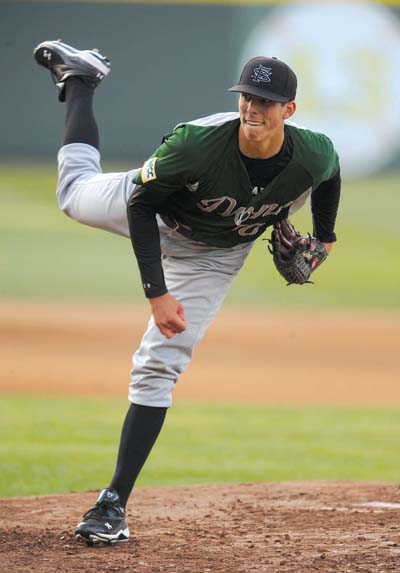
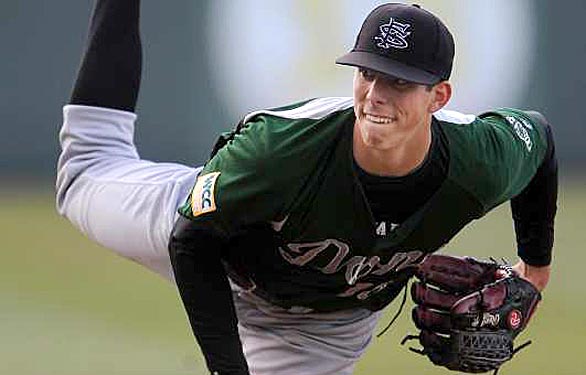
In a previous post I commended San Francisco’s Kyle Zimmer for his standout career both as a student and as an athlete and suggested that he also will fall in the first half of round 1 come June, so I felt as though I should follow that up with a brief scouting report.

Zimmer has a prototypical pitcher’s frame at 6-foot-4 with lengthy limbs.  He is an excellent athlete and often receives better grades for athleticism than for anything else, a terrific sign given the fact that he has had to learn pitching on the fly.  He did not go to the University of San Francisco to pitch but rather as an infielder, but his arm is so strong that eventually he was bound to wind up on a mound even as simply an experiment.

Zimmer has added a lot of extension and length to his delivery and is far more solid in back than he was early in his pitching career, exactly what one expects from a converted infielder or catcher.  Quality deliveries require enough length to provide the time necessary to reach a repeatable release point from a healthful slot.  Zimmer definitely has a delivery now that allows him to do that.  He has been up to 99 mph this spring already and could throw up a triple-digit readout at any time.  With a potentially triple-plus fastball and some polish to his delivery, he immediately shoots into the one-one conversation.

His secondary stuff is behind the fastball, but not nearly as far as it could be given how little time he has spent on the mound thus far.  His curveball (we are only considering the sharper and quicker version even though he has used a loopier one in the past as well) already is a 50 pitch, and his changeup, while fringy now, has shown enough promise to assume that it will always be useable and will always be improving.

He commands the ball well to both sides of the plate, and his numbers back up his projectability.  He has filled out a lot in his time with USF (around 220 lbs. now), but he probably still has some development left in him as well.  His changeup has already looked better in his spring starts than it did on the Cape, and he has used his tighter bender more frequently as well.  All of this shows Zimmer’s propensity to listen and react to criticism.  Zimmer’s makeup is off of the charts, and I like him a lot more than other righties in the 1-1 conversation right now.


Prospect Buzz: Kyle Zimmer, Victor Roache, David Dahl, and more…

  • There’s been a growing buzz surrounding University of San Francisco RHP Kyle Zimmer, as he’s asserted his name into the No. 1 overall discussion.  In his first couple starts of the season, his command of four pitches has been great while consistently bringing it in the upper-90s.  John Kilma of Baseball Prospect Report – formerly known as Baseball Beginnings – details what he likes about Zimmer and provides some personal video of the right-hander.
  • In the back-end of a double header on Sunday, Georgia Southern right fielder Victor Roache broke his wrist while diving for a ball and is expected to miss the remainder of the 2012 season.  Roache, who is ranked by Baseball America as the No. 9 prospect on their draft board, was coming off a monster offensive season in which he slashed .326/.428/.778 with 30 home runs.  Prior to the injury, he was hitting .412/.600/.765 with two home runs.
  • Andrew Pentis of MLB.com wrote a great article on Trevor Bauer and his quest to be the perfect blend of a power and finesse pitcher.  Bauer apparently has nine (yes, nine) pitches, each one specifically designed for a given scenario and/or count.
  • After watching endless video and reading a host of scouting reports, a player I like more and more everyday is David Dahl.  I love his setup at the plate as well as his bat path and balance to the point of contact – it’s pretty.  All the tools are there and everything he does on the baseball field looks natural.  Conor Glassey of Baseball America recently posted a first-hand video of Dahl recorded this past summer.  Baseball America also named him a 2012 First Team Preseason High School All-American.
  • The great John Sickels of Minor League Ball has finally released his Top 120 prospects for the 2012 season.  In my personal opinion, his list is always one of the best and this year is no different.
  • If you’ve enjoyed Dee’s articles on scouting philosophy and the evolution of the prospect landscape, then be sure to check out Nathaniel Stoltz’s “There’s No Such Thing as a First Base Prospect” at Seedlings to Stars.  Stoltz and the rest of the S2S staff have done an impressive job since launching last May, and I find myself reading it daily.
  • Over at FanGraphs, Mark Anderson compares Pirates pitching prospects Gerrit Cole and Jameson Taillon.  He examines their respective mechanics and arsenal as well as their overall command and mound presence.  However, I’ll let you find out who he ultimately prefers.

Brett Wallace’s Thighs: The Eighth Wonder of the World

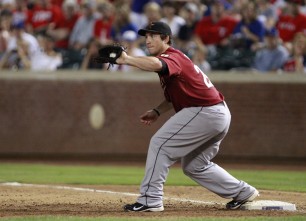
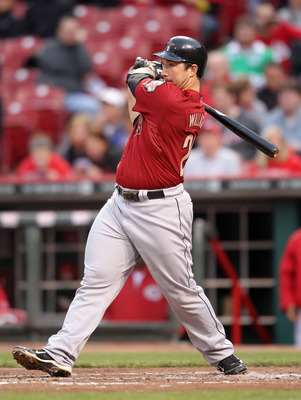
Some little-known facts about Brett Wallace and his massive thighs:

  • With certain breeds of dogs, you can get an idea of how big they will be based upon the size of their paws as a puppy.  At two-years-old, Wallace’s thighs suggested a career as a corner infielder.
  • Brett Wallace’s thighs have thighs.
  • With those tree trunks, all of his baseball pants are naturally pro-flared.
  • In 2010, Wallace was traded twice due to his unsightliness in khakis.
  • Wallace has never sat in the middle seat on an airplane.
  • He once tried on a pair of skinny jeans.
  • He once got stuck in a pair of skinny jeans.
  • He’s never been considered top heavy.
  • His lower half was the inspiration behind EvoShield’s first products.
  • Brett Wallace can out-leg press Yoenis Cespedes in his sleep.

Wow.

Spring Training Prospect Invitations: New York Mets

Matt Harvey

As Spring Training rapidly approaches and speculation surrounding the future of baseball’s brightest prospects spreads like wildfire, The Golden Sombrero will highlight some of the notable and intriguing Spring Training invitees from each organization.

Cesar Puello*, OF:  Signed out of the Dominican Republic as a 17-year-old, Puello is a toolsy outfielder with power potential.  Between his two seasons in Rookie ball (2008 and 2009), Puello slashed .300/.363/.398 with 22 extra-base hits and 28 stolen bases.  Playing for Low-A Savannah in 2010, the right-handed hitter slashed .292/.375/.359 and swiped 45 bags in 55 attempts.  Even though Puello improved his power production at High-A St. Lucie in 2011, he also saw some of his weaknesses exploited.  In 441 at-bats, he posted career-bests in triples (five), home runs (10), RBI (50), and total bases (175).  However, Puello fanned 103 times compared to only 18 walks due to poor pitch recognition and count manipulation.  He’ll likely never hit for a great average, but his power/speed combo does project well at the big league level – as evidenced by the Mets decision to add him to the 40-man roster.  He has the potential to be the Mets’ starting right-fielder at some point in 2013, but will have to refine both his offensive approach and ability as a base-stealer at Double-A in 2012.

Jeurys Familia*, RHP:  After making a strong professional debut in the GCL in 2008 and following it up by earning Mets minor league pitcher of the year honors in 2009, Familia had an off-year in 2010 at High-A (5.58 ERA, 1.58 WHIP in 121 innings).  One encouraging aspect of his otherwise disappointing season, the 22-year-old Familia fanned 137 hitters – though he walked 74.  Since then he has somewhat regained his form as the 6-foot-3 right-hander posted a 3.49 ERA and 96/35 K/BB ratio after a promotion to Double-A in 2011.  Familia has always featured an above-average fastball that sits in the mid-90s and reaches the upper-90s, as well as a mediocre breaking ball and change up.  Neither pitch has to be exceptional; but definitely good enough complement his fastball and be thrown in fastball counts.

Familia’s ceiling will continue to be determined by his command, which has been consistently iffy.  Despite working primarily as a starter in the minors, his cleanest path to the Major League might be as a high-leverage reliever, possibly even closer.  Out of the bullpen, his fastball will likely sit towards the upper-90s, which should inherently improve both of his offspeed pitches.  Already on the team’s 40-man roster, will definitely make his MLB debut in 2012.  The only question is whether it will be as a starter or reliever.

Matt Den Dekker, OF:  Unlike Puello, den Dekker is more of a fringe outfield prospect.  In his first professional season in 2010, den Dekker posted a slash line of .336/.396/.459 with 17 doubles over 122 at-bats between the GCL and Low-A.  He responded well to a promotion to High-A to begin the 2011 season, batting .296 with 33 extra-base hits and 12 stolen bases in 302 at-bats.  Den Dekker didn’t fare as well after a mid-season promotion to Double-A, though, as his slash line dropped to .235/.312/.426 while posting a 91/27 K/BB ratio.  However, he did tally another 27 extra-base hits (including 11 home runs) while once again swiping 12 bags.  Although he took a step in the right direction hitting for more power, the left-handed hitting den Dekker doesn’t project as a Major League power threat.  He will also need to cut down on his strikeouts (156 in 539 at-bats in 2011) in order to progress through the Mets’ weak system.  Den Dekker projects as a defensively savvy outfielder who will hit enough doubles to make him serviceable as a reserve.  But given the state of the Mets’ outfield – and lack of genuine outfield prospects – his arrival in the Major Leagues may happen ahead of schedule.  For the time being, den Dekker seems destined for another crack at Double-A to begin to the 2012 season.

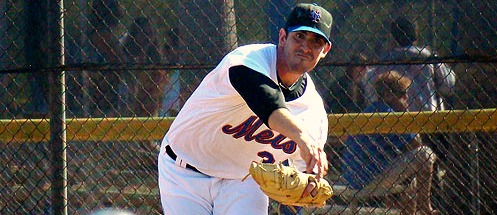
Matt Harvey, RHP: Ranked by The Golden Sombrero as the No. 45 prospect in baseball headed into the 2012 season, Harvey was the clear No. 1 prospect in the Mets’ organization until Zack Wheeler was obtained for Carlos Beltran in late July.  A first-round selection by the Mets out of North Carolina in 2010, Harvey breezed through the Florida State league (High-A), posting an 8-2 record, 2.37 ERA, and 92/24 K/BB ratio over 76 innings.  After a promotion to Double-A Binghamton, Harvey struggled initially but finished the season strong with five wins and 50 strikeouts over his final 47 innings.

The right-hander’s fastball usually works in the mid-90s but has been clocked as high as 97-98 mph, and more importantly, is sustainable late into games.  His other plus pitch, a hard, late-breaking slider, is a genuine out pitch that plays off of his well-located heater.  Harvey also features a big breaking ball and change up, although the latter lacks feel and is the least advanced of his offspeed offerings.

At 6-foot-4, 210-pounds, the 22-year-old is built for innings.  Although Harvey currently may be one of the five best starters in the organization, it’s highly unlikely that he’ll begin the season in the Major League rotation.  However, he’s not too far away and should definitely crack the rotation at some point this season, possibly even before the All-Star break.

*On team’s 40-man roster


Want to discuss prospects with Mike? Be sure to follow him on Twitter: @GoldenSombrero

Baseball’s Unique Place in College Athletics: Academics

As opening weekend of NCAA baseball came and went, baseball fans, particularly those of the amateur and collegiate ranks, were once again swept up in the joy of spring and a return to normalcy.  We have been without the game since the end of the Arizona Fall League in many ways.  Although there is no such thing as the off-season for us here at The Sombrero, the recruiting season just isn’t the same as the spring and summer seasons.

The premier series of the weekend saw Vanderbilt travel to Stanford where Mark Appel, arguably the top talent headed into the 2012 MLB Draft, deal on Friday night.  This series also featured the loaded 2011 Draft’s only unsigned 1st-rounder, Tyler Beede, toss his first collegiate pitch.  Both of these teams rank in the top-10 and are absolutely loaded talent-wise.  What they also are loaded with are entire rosters of players devoted to academic excellence.  This weekend also saw Duke travel to 13th-ranked Texas in a game that also featured nothing but standout student-athletes.  Next weekend Texas travels to Stanford where the same applies.  These teams come from prime-time athletic conferences and perform well in sports other than baseball, but consider the fact that last year’s Texas squad hosted a series against Brown, a school in which no player on the field was receiving athletic-based financial aid, and actually dropped a game to the Bears.  They’re the University of Texas.  Just imagine for a minute the 40 or so kids that the Longhorns football team might send to the hospital if the Bears were to travel to Austin for a football game.  This hypothetical scenario reflects the idea behind this piece.

Baseball is unique in the world of collegiate athletics in that it provides academically inclined players and institutions many if not all of the opportunities that those players and schools where athletics must come first are provided, which quite clearly is not the case across the collegiate sports landscape.

(more…)