Video: Jarrod Parker’s Major League Debut
 September 30, 2011
|
Posted by Mike Rosenbaum
September 30, 2011
|
Posted by Mike Rosenbaum
September 27, 2011
|
Posted by Mike Rosenbaum
September 30, 2011
|
Posted by Mike Rosenbaum
September 30, 2011
|
Posted by Mike Rosenbaum
September 27, 2011
|
Posted by Mike Rosenbaum
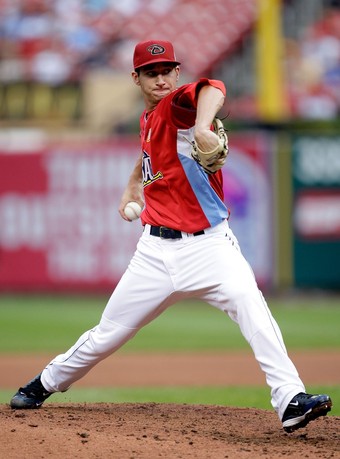
2011 has been a monumental year for MLB prospects. This season we have seen an inordinate amount of top-ranked prospects make their Major League Debuts, most of which have been celebrated here at the Sombrero.
On June 10 we celebrated Mike Moustakas Day; June 17: Dustin Ackley Day; July 8: Mike Trout Day; July 22: Jason Kipnis Day; August 5: Brett Lawrie Day; and most recently, Matt Moore Day on September 12.
Today we celebrate the debut of The Golden Sombrero’s No. 8 prospect, RHP Jarrod Parker.
Drafted by the Arizona Diamondbacks in first round (9th overall) of the 2007 draft, Parker validated his draft position by going 12-5 with a 3.44 ERA and 117/33 K/BB ratio over 118 inning for South Bend in 2008. He began the following season with High-A Visalia before earning a quick promotion to Double-A Mobile where he recorded a 0.95 ERA over four starts.
However, the 6-foot-1 right-hander was plagued by elbow problems and Tommy John surgery prematurely ended his season, while the subsequent rehabilitation forced him to miss the entire 2010 season.
With a brand new elbow, the 22-year-old has stayed healthy this season, and his numbers reflect such: 11-8 with a 3.79 ERA and 112/55 K/BB in 131 innings.
Parker’s fastball sits in the low- to mid-90s, and he has touched 96-97 mph on occasion. His slider, which was graded a plus pitch and served as his out pitch prior to surgery, remains a plus despite the fact that he’s thrown it considerably less. In it’s place, the Indiana native has shown an improved changeup – many consider it to be a plus now, too – and he also flashed a solid curveball.
With four above average pitches and mechanics that make pitching coaches uncontrollably drool, Parker figures to become a front-end starter (likely a two or three) for the Diamondbacks within the next couple years.
Parker’s debut tonight against the Los Angeles Dodgers will be fans first taste of the highly regarded prospect, as he hopefully makes his case to be part of the D-backs’ 2012 starting rotation.
September 27, 2011
|
Posted by Mike Rosenbaum

Top 1: Chris Parmelee struck out swinging against David Huff
Top 4: struck out swinging against Huff
Top 6: called out on strikes against David Huff
Top 7: struck out swinging against Zach Putnam
Final Line: 0-for-4, 4 K
Notes: Despite being selected by the Twins in the first-round of the 2006 draft, Parmelee didn’t have a breakout season until 2010 when he slashed .285/.356/.401 across three levels. After posting an .801 OPS this season for Double-A New Britain, the left-handed hitting first baseman has made the most of his chances since making his big league debut on September 6: In 80 plate-appearances, Parmelee has posted an .968 OPS that includes a 13/10 K/BB rate. That ratio became slightly skewed on Saturday, however, when he recorded the first golden sombrero of his career against the Tribe. If he wants to be the Twins’ first baseman of the future, he will have to show 20+ home run power across a full season – something that he’s yet to do.
Total 2011 Sombreros: 123
September 24, 2011
|
Posted by Daniel "Dee" Clark

With Moneyball opening this weekend nationwide, I have received several questions from friends and classmates about the movie since the cast is pretty loaded and the reviews so noteworthy. I calmly have explained to them that Moneyball is the most important piece of literature ever created. They quite obviously are skeptical and find such a claim laughable. This is Texas after all and I do live across the highway from SMU. I do firmly believe, though, that no book could have possibly influenced my life more profoundly than Moneyball did and continues to do.
I purchased Moneyball for my father as a Father’s Day gift shortly after it was released. I saw a book with a baseball on the cover that allegedly was about the economical side of the game. It sounded perfect for my dad who both loves baseball and reads the Wall Street Journal daily. He enjoyed it, but I think he resented it too and continues to do so somewhat today. When he was done with it, I read it. I couldn’t put it down. I was in high school and the books we read for school were what most would probably call classics. I thought they were exceedingly boring and for the most part, I just read Cliff’s Notes. Moneyball was quite possibly the first book I ever loved. I think I understood immediately that my father and I would never see the game the same way again, and because of it I’m not sure I really began growing up and being my own person until I read it.
Moneyball represents in certain ways the game’s steps into adulthood as well. The way the scouting side of the game is represented in the book reminds me of a screaming child who refuses to listen to reason and instead throws a tantrum. This is obviously a dramatized version of the way the situation during the early 2000s actually was, but I did not know any better at the time and I doubt many did. Nevertheless, Moneyball identified that the game had evolved and did so by pinpointing the exact time that outsiders took notice.
I have read Moneyball several times since then, and Whitney even agreed to read it to me after I graduated from Grinnell while we drove back to New Mexico from Iowa, stopping along the way for a buddy and teammate’s wedding.
Moneyball showed the baseball community and even those on the fringes of it that baseball players don’t have to look like Griffey or A-Rod. They can look like Pedroia. He won an MVP and might have gone undrafted without smart folks pointing out that “the good face” is a luxury with no bearing on whether or not someone can ball. Balling is about finding out how to maximize every single attribute each of us has. It’s not just the five tools and it for damn sure isn’t about being tall and lean. It’s about barreling up, playing clean, and taking a walk if it’s offered. More than any of that, though, it’s about understanding what makes a real, honest to God winner on the diamond and away from it.
The book opened the door to front offices and even the dugout to intellectual types who may not have signed a professional contract or even touched the diamond in an NCAA-sanctioned game. Beyond that, though, it encouraged and maybe even forced baseball types to listen to those who had not been educated within baseball culture. The revolution that Moneyball identified and displayed to the masses aided (maybe more so than anything else) us in realizing that there existed valuable and measurable attributes going virtually unnoticed by those who were paid to find them.
It’s not so much that Moneyball defined the revolution. It is more that it provided it with names, faces, and a narrative. It supplied the emotion and passion that were felt by so many as we began to understand what the implications of these new metrics really were. The way we evaluate everything has changed since then. For everyone at The Sombrero, its implications extend far beyond the diamond. Moneyball is about an ideology based in critical and objective evaluation of data used to guide our decisions and our emotions. Yeah, it taught me to take a walk, but it also taught me why I should. It taught us that as baseball players, fans, men, friends, and whatever else we might call ourselves, we have never learned enough. There is always ground to be gained and always a reason to know more than we do today. Moneyball meant that the game had a future to me. I would not be writing any of these words without what Michael Lewis and Billy Beane gave us.
September 22, 2011
|
Posted by Mike Rosenbaum
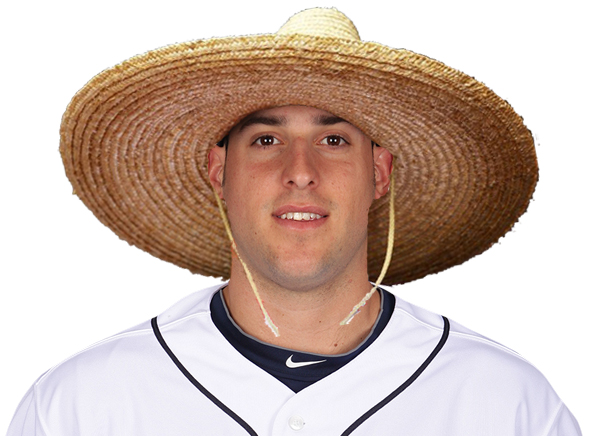
Top 3: Alex Liddi struck out swinging against Kevin Slowey
Top 6: struck out swinging against Slowey
Top 7: struck out swinging against Slowey
Top 9: called out on strikes against Scott Baker
Final Line: 0-for-4, 4 K
Notes: Really not too much to say about Liddi’s golden sombrero against Slowey and the Twins on Wednesday. It’s the sort of thing that will happen when you are a free-swinging call-up…just ask Paul Goldschmidt. For what it’s worth, the Italian-born third baseman has shown some pop: of his four hits in 24 at-bats, Liddi has doubled and jumped the yard twice. This year at Triple-A, he dropped 30 bombs and drove in 104 runs while fanning 170 times (559 at-bats).
Total 2011 Sombreros: 121
© Mike Rosenbaum/The Golden Sombrero 2010-2014 | Privacy Policy | Sitemap | Contact |








Recent Comments