MLB News | The Golden Sombrero Baseball Blog | MLB, Fantasy, College & High School Baseball News

Posts belonging to Category MLB News


Planting My Flag

Fantasy analysts are always talking about players that they are “planting their flags in” (Am I supposed to feel dirty when I type that?) each year.  I used to think this was a bad idea, as it might lead to poor draft day decisions.  Now that I am more seasoned I realize that we all develop an affinity for certain players each year.  I’m not talking your studs though.  Anybody can tell you to draft Albert Pujols, Ryan Braun, or Roy Halladay.  For me, planting your flag requires you to step out on a limb of sorts.  These are the players that you feel, for whatever reason, are going to be big hits for the upcoming season.  For this article, I want to take a look at three players in which my flag has been metaphorically planted.

Mike Morse:

Last week in my live-blogged mock draft I explained how excited I was about getting Morse on my squad.  I referenced this video clip, and talked about how much I liked his swing.  Well I decided to take it a step further and look to see what his numbers said.  The numbers that caught my eye were his increased line drive rate, coupled with his decreasing ground ball rate.  Match those with an 85% contact rate and I see no reason why he can’t sustain a BABIP similar to his 2011 average of .344.  I predict a .290 average, 30 jacks, 90 RBI, and 70 runs scored.

Bud Norris:

Yes, he pitches for the lowly Astros.  Yes, he probably won’t accumulate many wins.  But if you’re chasing wins as a fantasy strategy, this might not be the website for you.  Not only can you snag Bud late in drafts, you will be getting an amazing bargain when you do.  He lowered his walk total last year, while actually increasing his innings pitched by 33. His 2011 ERA of 3.77 matched perfectly with his xFIP of 3.73.  His k/9 rate sits right at 8.5, and with a swing and miss rate right around 30% I see potential for a true breakout year.  I think Bud finishes the year with 197 IP, 205 K’s, and an ERA of 3.78.

Yoenis Cespedes:

I know, I know, we haven’t even seen him face big league pitching yet.  And to be honest I have no statistical evidence to support this pick.  Sometimes though, you just have to go with your gut.  Blind faith is counter-intuitive to almost everything I believe, but I am also a fan of legalized gaming.  Thus, I have no problem taking a gamble on Cespedes.  I might even reach a few rounds early just to get him.  To win your fantasy league you have to hit at least one grand slam on an unknown player.  For me, this is the guy.  No prediction here.  Just going with my gut that he completely outperforms the value of the draft pick I get him for.

You can follow Griffin on Twitter- his handle is @sp_flips.  Feel free to support, harass, or share any thoughts you have and he will be sure to reply.

Draft Buzz: Giolito, Gausman, Appel, Jankowski, and more…

RHP Lucas Giolito, Harvard-Westlake (CA)

  • John Kilma of Baseball Prospect Report had another look at Lucas Giolito this past week and captured more video of the right-hander.  He didn’t touch 100 MPH as he allegedly did last week, but Kilma had him at 96-98 MPH from the stack in the first and 94-96 MPH in the third.  Kilma also states that Giolito is one of the two best 17-year-old pitchers that he’s personally scouted, the other being Felix Hernandez.
  • Over at FanGraphs, J.P. Breen examines 10 high school bats that figure to be an early selection in the 2012 draft in June.  The quality of prep outfield prospects this year is particularly impressive: Byron Buxton (GA), David Dahl (AL), Courtney Hawkins (TX), and Albert Almora (FL).
  • The great John Sickels of Minor League Ball completed a mock draft with Matt Garrioch and without spoiling all of the results, here is a quick glance at their top five overall: 1. Kevin Gausman (Astros); 2. Lucas Giolito (Twins); 3. Mike Zunino (Mariners); 4. Byron Buxton (Orioles); 5. Mark Appel (Royals)
  • Conor Glassey of Baseball America posted scouting notes and video of Stony Brook outfielder Travis Jankowski, who is currently No. 24 on their Top 100 draft board.  The video includes Jankowski’s pre-game batting practice as well as clips from a 3-for-5 performance against Eastern Carolina.  I love how quiet this kid is at the plate not to mention his ability to use the whole field.  I think I’m going to have to go check him out once it warms up a bit.

Want to discuss prospects with Mike or simply pass along a link? Then be sure to follow him on Twitter (@GoldenSombrero).

Spring Training Prospect Invitations: Milwaukee Brewers


Taylor Jungmann

With Spring Training finally upon us and speculation surrounding the future of baseball’s brightest prospects spreads like wildfire, The Golden Sombrero will highlight some of the notable and intriguing Spring Training invitees from each organization.

Wily Peralta*, RHP:  Widely considered to be the Brewers’ top prospect, Peralta was signed out of the Dominican Republic as a toolsy outfielder in 2005.  But after witnessing his raw arm strength, the 6-foot-2, 240-pounder was quickly transitioned to the bump.  After missing the 2007 due to Tommy John surgery, Peralta has progressed steadily since returning.

In his breakout season as a 21-year-old in 2010, Peralta posted an 8-6 record and 3.79 ERA with 104 strikeouts and 64 walks in 147.1 innings between High-A and Double-A.  He followed it up  by having his best minor league season to date in 2011.  Peralta went 9-7 with a 3.46 ERA, 117 strikeouts, and 48 walks over 119.2 innings at Double-A Huntsville.  His success garnered a late-season promotion to Triple-A where he went 2-0 with a 2.03 ERA and 1.032 WHIP in 31 innings.  Peralta also showed improved command in the hitter-friendly PCL, as he posted a 40/11 K/BB ratio.

Peralta pounds the strikezone with a four-seam and two-seam fastball, and typically sits in the low- to mid-90s – although he is capable of touching the upper-90s.  His best secondary pitch is a hard slider, which, when kept down in the zone, is a legitimate swing-and-miss pitch.  He also features a change up which has come along over the years due to his role as a starter, but at the moment probably only grades out as about a 50.

Although some believe he is best suited for a bullpen role, the Brewers have remained steadfast in their development of Peralta as a starter.  Therefore, it will likely take an injury to a member of the Brewers’ rotation for Peralta to get his shot.  While a strong spring will greatly improve his chances of breaking camp, it’s likely that Peralta will begin the 2012 season in Triple-A

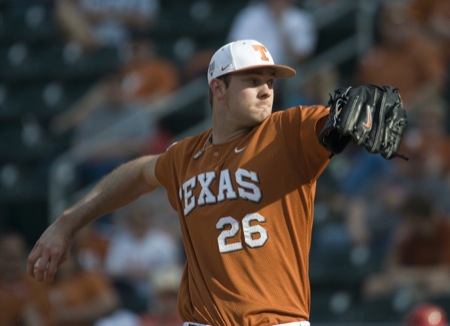
Taylor Jungmann, RHP:  Selected by the Brewers with the 12th overall pick in the 2011 draft, Jungmann had been one of the top collegiate pitchers since his freshman year at Texas.  At 6-foot-6, 220-pounds, the lanky right-hander throws each of his pitches on a downward plane and isn’t afraid to attack opposing hitters.  Although he can reach back for a 95-96 mph fastball, he typically works in the 92-94 range with late life.  His slider continues to improve – his size, arm slot, and arm speed have always generated above-average tilt – and is considered his best secondary offering.  Like most young pitchers, Jungmann was considered a power pitcher in college and therefore lacks an above-average change up.  However, it’s decent and could grade as a 60 in time.

Considering he signed at the last minute, Jungmann will get his first taste of professional baseball in 2012.  Given his collegiate experience, he’ll likely begin the season at High-A Brevard County – unless he wows the organization enough during Spring Training to begin at Double-A.  But keep your eye on Jungmann, if he progresses swimmingly, the right-hander could be on the fast track to the big leagues.

Jed Bradley, LHP:  The Brewers netted two potential front-end starters in Jungmann and Bradley.  Selected three picks after Jungmann with the 15th overall pick, Bradley was the second-best left-hander available in the 2011 draft.  At 6-foot-4, 225-pounds, Bradley’s size and collegiate experience project well, so I wouldn’t look too far into his getting knocked around in the Arizona Fall League.  When you’re the ace of your program, the collegiate season can become rather taxing.

His fastball typically sits in the low-90s but he’s been flashing 94-95s more and more which leads many scouts believe that could become his norm.  He also features a pretty nasty power-slider in the high-80s and a neutralizing change up.  His mechanics are smooth and allow him to locate each of his three pitches.  His and Jungmann’s minor league careers – neither of which should be lengthy – will be intertwined as Milwaukee plans for both players to arrive in the Show around the same time.

Caleb Gindl*, OF:  Drafted out of high school in the fifth round of the 2007 draft, Gindl has completed one minor league level per year and has a career line of .300/.378/.466 to show for it.  He enjoyed his best season for Triple-A Nashville in 2011, posting a .862 OPS with 23 doubles, 15 home runs, and a 93/63 K/BB in 472 at-bats.  Although those numbers are inflated due to the hitter-friendly PCL, they’re consistent with his production at every level and his approach at the plate continued to improve.

Gindl is a stocky, 5-foot-9, 205-pound outfielder with above-average arm strength and quiet athleticism. He played all three outfield positions last year in Triple-A – including 38 games in center field – but profiles as a corner guy in the majors due to his lack of power.  But with Ryan Braun and Corey Hart entrenched in their respective positions, Gindl is at best a fourth outfielder or left-handed hitting platoon option.  The Brewers protected the 23-year-old by adding him to their 40-man roster in November; however, they also added minor league teammate Logan Schafer who breezed through four levels in 2011, including eight games for Milwaukee at the end of the season.

Cody Scarpetta*, RHP:  When he’s on, Scarpetta has swing-and-miss stuff and two plus pitches in a mid-90s fastball and a big-time hammer.  But when he’s off…it’s ugly.  He falls out of sync with his mechanics, which results in control issues and painful ineffectiveness.  At Class-A Brevard County of the FSL in 2010, the 6-foot-3, 240-pound right-hander recorded a 3.87 ERA with 142 strikeouts and 67 walks over 128 innings.  Last season, his first full season at Double-A, Scarpetta went 8-5 with a 3.85 ERA and 98/61 K/B over 117 innings.  Still, it says something that he’s kept his ERA under 4.00 despite the control issues.

Scarpetta gives up far too many hits than he should considering his stuff, primarily because hitters sit on his fastball during his bouts of inconsistency.  The development of his change up will pay dividends for the right-hander and keep him in consideration for a starting role, but he hasn’t adapted it as quickly as scouts hoped.  If he works out some kinks and refines his command, Scarpetta could find himself in the Show quickly, although it would likely involve a bullpen role.

*on team’s 40-man roster

Want to discuss prospects with Mike? Follow him on Twitter (@GoldenSombrero) and join the discussion on our Facebook page.

Spring Training Prospect Invitations: New York Mets

Matt Harvey

As Spring Training rapidly approaches and speculation surrounding the future of baseball’s brightest prospects spreads like wildfire, The Golden Sombrero will highlight some of the notable and intriguing Spring Training invitees from each organization.

Cesar Puello*, OF:  Signed out of the Dominican Republic as a 17-year-old, Puello is a toolsy outfielder with power potential.  Between his two seasons in Rookie ball (2008 and 2009), Puello slashed .300/.363/.398 with 22 extra-base hits and 28 stolen bases.  Playing for Low-A Savannah in 2010, the right-handed hitter slashed .292/.375/.359 and swiped 45 bags in 55 attempts.  Even though Puello improved his power production at High-A St. Lucie in 2011, he also saw some of his weaknesses exploited.  In 441 at-bats, he posted career-bests in triples (five), home runs (10), RBI (50), and total bases (175).  However, Puello fanned 103 times compared to only 18 walks due to poor pitch recognition and count manipulation.  He’ll likely never hit for a great average, but his power/speed combo does project well at the big league level – as evidenced by the Mets decision to add him to the 40-man roster.  He has the potential to be the Mets’ starting right-fielder at some point in 2013, but will have to refine both his offensive approach and ability as a base-stealer at Double-A in 2012.

Jeurys Familia*, RHP:  After making a strong professional debut in the GCL in 2008 and following it up by earning Mets minor league pitcher of the year honors in 2009, Familia had an off-year in 2010 at High-A (5.58 ERA, 1.58 WHIP in 121 innings).  One encouraging aspect of his otherwise disappointing season, the 22-year-old Familia fanned 137 hitters – though he walked 74.  Since then he has somewhat regained his form as the 6-foot-3 right-hander posted a 3.49 ERA and 96/35 K/BB ratio after a promotion to Double-A in 2011.  Familia has always featured an above-average fastball that sits in the mid-90s and reaches the upper-90s, as well as a mediocre breaking ball and change up.  Neither pitch has to be exceptional; but definitely good enough complement his fastball and be thrown in fastball counts.

Familia’s ceiling will continue to be determined by his command, which has been consistently iffy.  Despite working primarily as a starter in the minors, his cleanest path to the Major League might be as a high-leverage reliever, possibly even closer.  Out of the bullpen, his fastball will likely sit towards the upper-90s, which should inherently improve both of his offspeed pitches.  Already on the team’s 40-man roster, will definitely make his MLB debut in 2012.  The only question is whether it will be as a starter or reliever.

Matt Den Dekker, OF:  Unlike Puello, den Dekker is more of a fringe outfield prospect.  In his first professional season in 2010, den Dekker posted a slash line of .336/.396/.459 with 17 doubles over 122 at-bats between the GCL and Low-A.  He responded well to a promotion to High-A to begin the 2011 season, batting .296 with 33 extra-base hits and 12 stolen bases in 302 at-bats.  Den Dekker didn’t fare as well after a mid-season promotion to Double-A, though, as his slash line dropped to .235/.312/.426 while posting a 91/27 K/BB ratio.  However, he did tally another 27 extra-base hits (including 11 home runs) while once again swiping 12 bags.  Although he took a step in the right direction hitting for more power, the left-handed hitting den Dekker doesn’t project as a Major League power threat.  He will also need to cut down on his strikeouts (156 in 539 at-bats in 2011) in order to progress through the Mets’ weak system.  Den Dekker projects as a defensively savvy outfielder who will hit enough doubles to make him serviceable as a reserve.  But given the state of the Mets’ outfield – and lack of genuine outfield prospects – his arrival in the Major Leagues may happen ahead of schedule.  For the time being, den Dekker seems destined for another crack at Double-A to begin to the 2012 season.

Matt Harvey, RHP: Ranked by The Golden Sombrero as the No. 45 prospect in baseball headed into the 2012 season, Harvey was the clear No. 1 prospect in the Mets’ organization until Zack Wheeler was obtained for Carlos Beltran in late July.  A first-round selection by the Mets out of North Carolina in 2010, Harvey breezed through the Florida State league (High-A), posting an 8-2 record, 2.37 ERA, and 92/24 K/BB ratio over 76 innings.  After a promotion to Double-A Binghamton, Harvey struggled initially but finished the season strong with five wins and 50 strikeouts over his final 47 innings.

The right-hander’s fastball usually works in the mid-90s but has been clocked as high as 97-98 mph, and more importantly, is sustainable late into games.  His other plus pitch, a hard, late-breaking slider, is a genuine out pitch that plays off of his well-located heater.  Harvey also features a big breaking ball and change up, although the latter lacks feel and is the least advanced of his offspeed offerings.

At 6-foot-4, 210-pounds, the 22-year-old is built for innings.  Although Harvey currently may be one of the five best starters in the organization, it’s highly unlikely that he’ll begin the season in the Major League rotation.  However, he’s not too far away and should definitely crack the rotation at some point this season, possibly even before the All-Star break.

*On team’s 40-man roster


Want to discuss prospects with Mike? Be sure to follow him on Twitter: @GoldenSombrero

Spring Training Prospect Invitations: Colorado Rockies

As Spring Training rapidly approaches and speculation surrounding the future of baseball’s brightest prospects spreads like wildfire, The Golden Sombrero will highlight some of the notable and intriguing Spring Training invitees from each organization.

Christian Friedrich*, LHP:  After the Rockies drafted Friedrich with the 25th overall pick in the 2008 draft, he posted a 6-5 record with a 2.41 ERA, 1.145 WHIP, 159 strikeouts and 43 walks over 119.2 innings in 2009.  However, he has struggled to repeat that success and has battled a series of injuries over the last two seasons.  The 6-foot-4 left-hander features a low- to mid-90s fastball (usually low-90s since overcoming elbow issues) and a below-average change up, but his best pitch has always been his 12-to-6 curve – an absolute hammer.  Having grown up in the Chicagoland area around the same time as Friedrich, I had the opportunity to see him throw several bullpens, and his hook was one of the best I’ve ever seen. Friedrich’s mechanics and arm-speed still suggest a moderately-high ceiling, which is probably why he holds a spot on the Rockies’ 40-man roster.  Barring a setback in Spring Training, Friedrich will likely begin the 2012 season in Triple-A with a chance for a late-season call-up.

Nolan Arenado, 3B:  Ranked by The Golden Sombrero as the No. 21 prospect in baseball headed into the 2012 season, Arenado had a monster 2011 campaign for High-A Modesto.  The Rockies’ 2009 second-round draft pick slashed .298/.349/.487 with 32 doubles, 20 home runs, and a whopping 122 RBI in 517 at-bats.  Arenado also made strides in his plate discipline and approach, evidenced by his 53/47 K/BB ratio.  Although the results have always been there, scouts have been skeptical of his power potential due to his extremely level bat path.  However, after a subtle alteration to his swing, Arenado’s power emerged last season and is here to say.  His ability to square up the ball and generate extension after contact has always been exceptional.  His defense at the hot corner also improved in 2011, but he’ll never be anything more than an average defensive third baseman.  Arenado will likely begin the 2012 season in Double-A, but if he continues to rake – and considering the Rockies’ lack of a true third baseman – it’ll be hard to deny him a late-season call-up.

Chad Bettis, RHP:  Much like Arenado, Bettis had a breakout season for Modesto in 2011.  The 6-foot-1 right-hander went 12-5 with a 3.34 ERA, 184 strikeouts, and 45 walks in 170 innings and earned Class A California League pitcher of the year honors.  Given his height and arm strength, Bettis’ consistency and durability in 2011 is encouraging.  His arsenal is highlighted by two plus pitches: a fastball that sits in the mid-90s and touches the upper-90s, and a tight, hard-breaking slider.  Bettis also features both a curveball and change up, but neither pitch is particularly advanced and needs considerable development.  At the moment, he projects as a No. 3 or No. 4 starter – the development of his secondary offerings this season will dictate his ceiling as a starter.  Bettis should begin the 2012 season in Double-A, but given his plus heater and slider, he could find himself in the Rockies’ bullpen at some point in 2012.

Tim Wheeler, OF:  Arguably the most promising of the slew of toolsy Rockies’ outfielders, Wheeler batted .287 with 28 doubles, six triples, 33 home runs, 86 RBI, and 21 stolen bases.  However, he struck out 142 times in 561 at-bats compared to 59 walks.  Since entering the minor leagues in 2009, the left-handed hitting Wheeler has struggled with keeping his front-side closed at the plate and therefore has a tendency to swing more with his upper body instead of using quick wrists.  At 6-foot-4, 205-pounds, Wheeler possesses excellent athleticism that is on display at all times.  His defense and arm profile well as a big league right fielder, but his bat will ultimately be the determining factor.  Beyond his strikeout tendencies, the main knock against Wheeler has been his inability to hit left-handed pitching.  If that can improve that in Triple-A, Wheeler has a legitimate shot to make his MLB debut in 2012.

Kent Matthes, OF:  Coming off a season in which he slashed .334/.378/.642 with 39 doubles, 23 home runs, and 95 RBI for Modesto, the 6-foot-2 outfielder has the potential to emerge as one of the Rockies’ top prospects in 2012.  Like Arenado, Matthes has a linear bat path that results in ringing doubles and home runs that might as well have gone through the wall rather than over.  He can turn around the best of fastballs, though he will need to improve his offspeed pitch recognition to be a power hitter at the next level.  While his speed is average at best for a right fielder, Matthes possesses a plus arm that should compensate for any defensive inferiority.  A fourth round draft pick in 2009 draft out of Alabama, Matthes missed portions of the 2009 and 2010 seasons with injuries, so a strong follow-up showing in Double-A in 2012 could significantly boost his stock.