The Golden Sombrero Baseball Blog | MLB, Fantasy, College & High School Baseball News

Why Farmington Deserves Hosting Rights at the Connie Mack World Series


Recently a small New Mexican newspaper interviewed a highly celebrated and recently graduated (from an affluent private high school) New Mexican baseball player, who was chosen as a pick-up player from a regional tournament after his club team took it’s second loss in a Connie Mack regional tourney.  The player, who is signed at perhaps the premier university in the premier conference in all of NCAA baseball and who had arguably the nation’s highest bat-tool grading in the 2012 draft class (at least I thought so), was quoted at length and offered several controversial opinions regarding the host team rights of the Connie Mack World Series held annually in Farmington, New Mexico.  Those opinions basically can be summarized by the assertion that baseball players, coaches, administrators, and fans from Albuquerque and the surrounding metro area do not feel as though the CMWS hosting rights should be accessed solely through winning Farmington’s city CM league.  In other words, Albuquerque should be in the tournament that crowns the host for seemingly no other reason than relative geographical proximity to Ricketts Park and the assumption that, due to their win-loss record this summer, they are capable of fulfilling the host role in a superior fashion than whatever team won the Farmington tournament.  In the last few years, that event has been won by the Strike Zone Cardinals who have gone on to numerous wins in the CMWS against several premier clubs from across the nation.  In fact, the host representative has wins in each of the last four CMWS, while the winner of the New Mexico state CM tourney has never qualified for the World Series.

Still, win-loss record, quality of roster in terms of both commitment/drafted list and high school stats, strength of schedule, event invitations, or reputation hardly represents what the host team is expected to be each year.  The Connie Mack World Series is the third oldest annual amateur baseball event in the world to use the same host city (48 years) and the oldest for high school-aged players.  The quality of baseball is as good as it gets.  Ken Griffey Jr. played here.  Manny Ramirez played here.  Barry Larkin, Zack Greinke, Chris Carpenter, Cameron Maybin, Eric Hosmer, Todd Van Poppel, Joe Benson, Stephen Drew, Micah Owings, Gordan Beckham, Manny Machado, Dylan Bundy, Archie Bradley, and a freakishly long list of players who have gone on to unbelievable accomplishments within the game of baseball and beyond played here.  In light of those names and the hundreds of professionals left off the list, the suggestion that even the finest team in New Mexico baseball history, the Albuquerque Heat of the early part of the 2000s which featured multiple Big Leaguers and was comprised of many players from consecutive nationally No. 1-ranked HS teams, would deserve a berth in the event purely because they happened to think they might be capable of defeating the best club from Farmington is considerably arrogant and a little silly.  The Heat had more respect than that, though.  They went to the regional, played hard, were defeated, and went on with their lives and baseball careers without complaining about the structure of local Connie Mack leagues.

What’s more, the notion that the community of Farmington, which has hosted the CMWS for nearly half of a century, would willingly support a team from what would be considered simply another metropolitan baseball academy is preposterous.  The value of the host team’s place in the CMWS field is both motivation and reward for the community of Farmington.  The host team provides the city a reasonable team to root for in the tourney every year.  My guess is that there are even more Midland Redskins fans in Farmington than exist in Cincinnati and perhaps as many Dallas (DBAT) Mustangs fans as well.  The East Cobb Yankees, despite not qualifying for the event in recent years, have a tremendous following too.  No team fills the stands like the host team, though, and the atmosphere at Ricketts when the host team is in a close game is uniquely tense and the entire city feels it.  To think that this degree of support is somehow not unique for Farmington’s team and could in fact be the case for teams from any other town in New Mexico is simply incorrect.  The very notion defies the logistical fact that the seats at Ricketts are bought decades in advance and passed from generation to generation by Farmington families.

The city of Farmington and in particular its young baseball players are fortunate beyond words that the Connie Mack World Series is held at Ricketts annually.  However, this good fortune works both ways.  The CMWS is just as lucky to have Farmington as its host.  While the community benefits greatly from the revenue generated by the event every year, the real reward is the opportunity to cheer on the city’s players as they challenge the country’s best amateur talent, winning a better than could reasonably be expected share of its games.  Additionally, since many of the players comprising the host team are graduated seniors soon to be departing to whatever school they may be taking their baseball talent; it is a perfectly staged farewell for these young men.  The Connie Mack World Series belongs to Farmington.  It does not belong to New Mexico, and thusly, the winner of Farmington’s league, and only the winner of this league, deserves the right to host so long as the event is held at Ricketts.
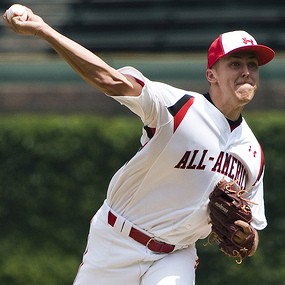
DBAT: 20% of the 2012 Connie Mack World Series Field?

As the Connie Mack South Plains Regional concluded Sunday evening at TCU, the DBAT Mustangs squad advanced to yet another Connie Mack World Series.  The same thing happened last year, but in less of a landslide.  This year’s march to victory was reminiscent of the domination that Carpenter’s Mustangs squad displayed prior to the creation of DBAT.  DBAT is the premier amateur baseball academy in the world and has the most sophisticated infrastructure, tournament/showcase access, and funds of any similar company throughout amateur baseball.  ABD in California, Midland in Cincinnati, and Top Tier in Chicago as well as many others worldwide provide players (customers) with access to facilities, coaching, evaluation, tournament and showcase entries, equipment, and teammates.  No company does this as well as DBAT in large part because the DFW area has other rival clubs capable of providing consistent quality opponents year round to the DBAT squads.

The state of Texas also has over a dozen Division I universities with the DFW metro claiming three of their own.  Carpenter recognized that academies like DBAT were very much the future, and in the late 90’s he decided to merge his Mustangs team that he had cultivated for decades with the business-minded DBAT.  This move not only has allowed those involved with DBAT to profit financially but also ensures that DBAT fields the best team(s) in Texas every year, as Houston, Austin, San Antonio, and El Paso have yet to unify their city’s amateur talent in as complete a fashion.

Well, for fans of amateur baseball outside the DFW metro and in, the Connie Mack World Series represents the finest collection of amateur baseball teams each season.  The AABC adequately divides the nation into regions based largely on geography with each regional tournament feeding into the CMWS every year.  For this reason, the CMWS field is always quite impressive because there is hardly any room for bias as is always the case with invitational events.

In 2006, however, the CMWS expanded its field to 10 teams with the addition of two spots for teams winning qualifiers.  Since then those qualifiers have migrated geographically with 2012’s held in Tempe and Flemington, NJ.  A DBAT group won the Tempe event in rather thrilling fashion, and many would debate that the qualifier events are at least as challenging as a regional tournament simply due to the volume of teams receiving invites.  The qualifiers typically have over 20 entries, all representing prestigious academies throughout the country as well as Canada and Puerto Rico on occasion.

The fact that the CMWS is going to feature two teams from the same academy must be viewed as the worst-case consequence of the qualifier tourneys.  Imagine a CMWS title game between DBAT and DBAT.  Why not just split town early and have a live BP session back in Dallas with L-screens and a roll cage?  DBAT is hardly to blame, though.  The very nature of the qualifier tournaments is anti-Connie Mack.  The qualifiers more closely resemble typical recruiting events like those held by Baseball Factory or Perfect Game as opposed to the state and local league structures required by conventional AABC rules.  Only through those leagues do teams have access to regional events, and only through those do teams have access to the CMWS.

Eight teams is not a large enough field of participants, though, which was the size of the CMWS field prior to the introduction of the qualifying events.  The problems with a 10-team double-elimination tourney are the requisite byes, which begin in the second round and possibly don’t end until championship night, and the tremendous bias associated with a potential champion that potentially drew more byes than the teams they defeated along the way. So why not 12 or 16 teams? That would eliminate the byes but still be a small enough number not to weaken the quality of the field of participants.  But we still have the problem with multiple teams from the same academy qualifying.  That problem is eliminated if we simply increase the number of regional tournaments from 7 to 11 or 15 and ditch the qualifiers.

The fact that Colorado plays in the same regional event as Louisiana is silly to begin with.  The local economy in Farmington would benefit considerably from a larger and longer CMWS.  The host family tradition might need to be modified or replaced with something new, but Farmington’s hotels are rarely if ever full.  It has been argued that the host families make the tournament, and I agree to an extent, but for the CMWS to keep pace with rival events, baseball must come first and must be the key determinant in progressing the tournament.  The fact that in 2012 the second best club from an academy might win the CMWS is a dangerous step in the wrong direction even if it is DBAT.

Video: Cubs’ Albert Almora Homers in First Professional Game

On Monday, the Chicago Cubs’ top draft pick, OF Albert Almora, made his professional debut for the Rookie-level AZL Cubs. Playing alongside recent import Jorge Soler, who launched his first professional home run on Sunday, the center fielder jumped the yard in the fifth inning and finished the game 1-for-3.

As you can see in the video, it wasn’t a cheap bomb:


Must-Watch Video: Giancarlo Stanton’s 2006 HS Football Highlight Reel


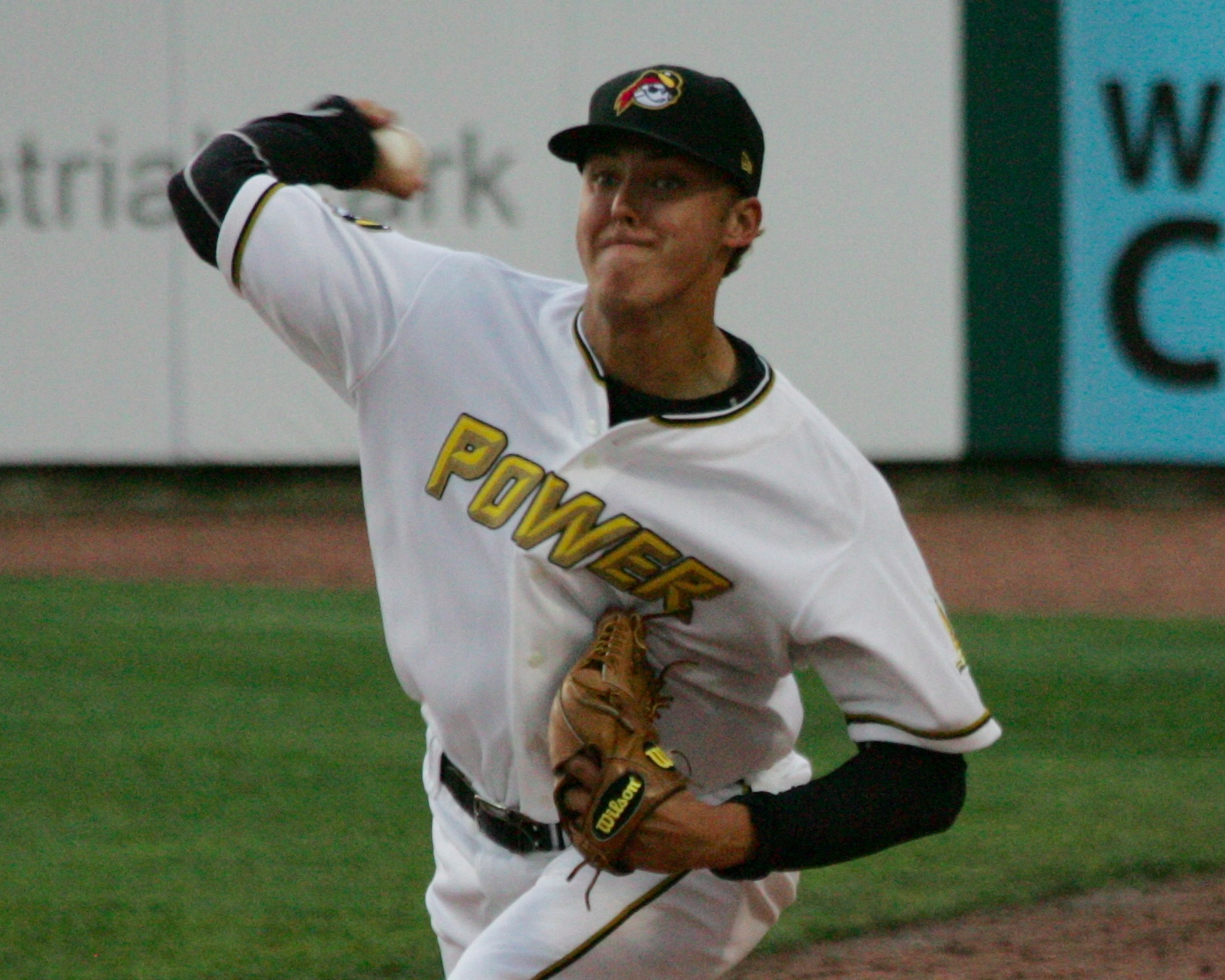
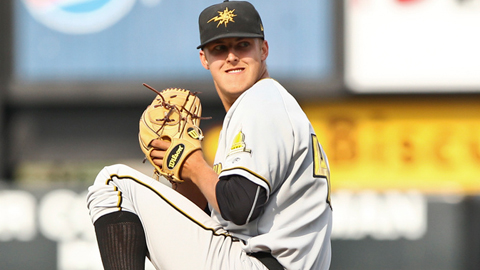
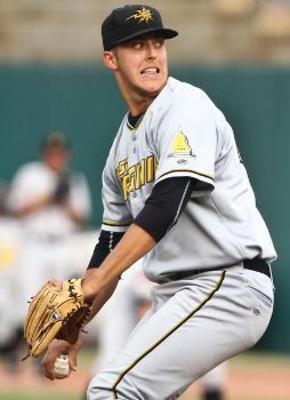
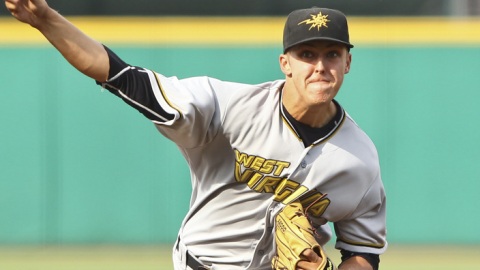
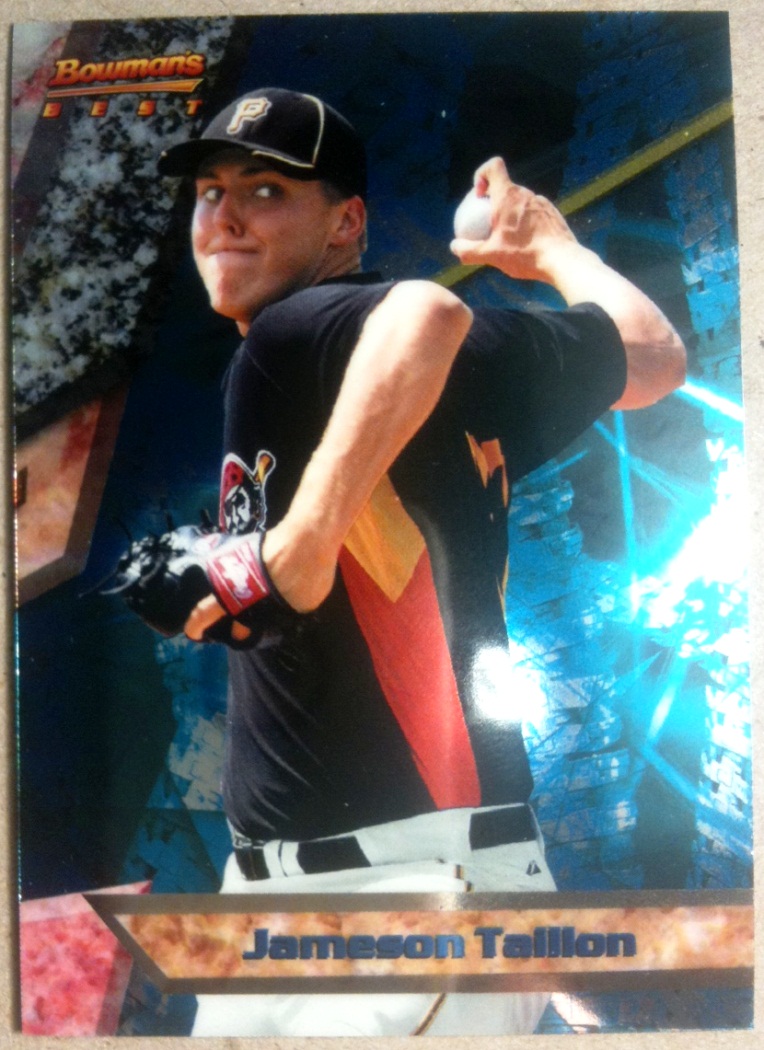
The Many (Hideous) Faces of Jameson Taillon

Jameson Taillon: Pirates’ pitching prospect; looks as though he’s always trying to pass a long overdue bowl movement.

Don’t believe me? Well, see for yourself:

It began in high school…

A night after eating his weight at P.F. Chang’s…

Fighting a pre-pitch eruption…

About to give birth…

To twins…

Prior to a DL stint for torn UCL, asshole…

A face so hideous it had to be captured on a baseball card…