Tim Lincecum | The Golden Sombrero Baseball Blog | MLB, Fantasy, College & High School Baseball News

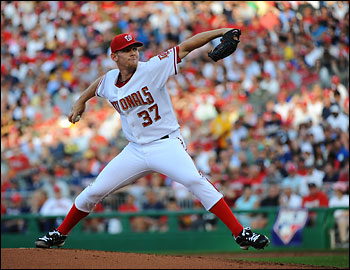
National Holiday: Strasburg Dazzles in Washington Debut

It’s official.  Baseball is back in the nation’s capital.

A casual fan might point out that no, baseball actually returned to Washington in April of 2005, when the Nationals played their first game in DC after 36 years as the Montreal Expos.  Others might say that it came on March 30, 2008, when they played their first game at Nationals Park, a 3-2 win over the Braves on Opening Night that ended with a walk-off home run off the bat of Ryan Zimmerman. And those fans might have had a point before last night.  But on June 8, 2010, that all changed as former number-one draft pick Stephen Strasburg made his major league debut.

(more…)

In Mile-High City, it’s all about the U: Rockies’ Jimenez poised to become franchise’s first twenty-game winner

June 1, 2010

“With the one hundred fourth pick of the 2010 Denslow Cup Draft, the Capital City Corporate Towls select Ubaldo Jimenez, Starting Pitcher, Colorado Rockies.” These words (which would have been uttered by Denslow Cup commissioner Robbie Unsell had we done an in-person draft but were instead simply printed on a screen) have launched my Capital City Corporate Towls into the world of fantasy baseball relevance for the first time since the team’s championship run back in 2007.  And why not?  Jimenez this year has been the best pitcher in baseball and after two months, has to be the favorite to win the NL Cy Young in a league that includes Roy Halladay and Tim Lincecum, whom Ubaldo just outdueled in his latest gem. The Rockies are 10-1 when Ubaldo takes the hill and 17-23 when he doesn’t, and they’ll count on him to continue his dominant season atop their rotation if they’re to have any hope of making the playoffs.  His ten wins, 0.90 WHIP and microscopic 0.78 ERA all lead the Majors by a comfortable margin. Before moving on, it is important to compare these numbers to the historical pitching performance of the Rockies, a franchise whose struggles from the mound are well-documented, particularly in the pre-humidor era of hitter-friendly Coors Field.  A few statistics jump out immediately:

(more…)

Steppin’ Up To The Plate

May 24, 2010

I was talking to Dee the other day about something that I find to be one of the coolest parts of the game of baseball and its inherently individualistic nature, walk-up intro music.  There is no other team sport in which every player on the field gets so many exclusive moments.  A Hall of Fame NFL lineman could go his entire career without ever hearing his name over the stadium loudspeakers, yet even bottom rung Major Leaguers get three to four chances on average to strut out into the spotlight.  Even high school varsity teams throw on players’ own personal pump-up tunes on their way to the plate.  I didn’t play baseball long enough to get to walk out in front of a cheering stadium to a song of my choosing; the closest I have to compare is whatever I put on my IPod before a big ski run, but I totally understand the motivation of music and think it has a particularly interesting place in the game people come here to read about.

In my research on the topic I came across an article published Sunday in the Sacramento Bee that beat me to it, pretty much summing up everything I wanted to say about the topic along with a lot of big league insight that I would not be able to provide.  It’s really worth checking out, and big ups to back to back Cy Younger Timmy “Dirty Hippy” Lincecum on selecting The Doors’ Break on Through.  You are now firmly cemented as my favorite active player (more on that later). Another interesting bit I came across actually talked to the music people behind the scenes for all 30 MLB teams and got the skinny on all of them.  So I’m going to save myself a lot of time on this one and get straight to what I wanted to do with this piece in the first place.  I know all the guys that write on here have at some point walked out to their own intro music, along with most of the people who are reading here on a regular basis, and I’d love to hear what you guys’ thoughts are on it.  What did you walk out to and why?  If you’ve never had the pleasure of walking up to the plate to cheering fans and your own musical motivation, think for a minute that you’re in the on-deck circle of your favorite stadium and your team needs a big hit.  What’s it gonna be?  I want to hear from you on this one, Golden Sombrero Nation.

Responses:

Dee: the three walk-up songs i remember using were shook ones, gun ballad by the pharaohs (paz’s verse), and the whoa instrumental from bad boy. i really thought all of those beats were just heavy and brought me to the competitive and focused state of mind i needed to be in. i have heard some of the guys i go to dental school with, who also happened to play in college, say a lot of shit about players who use hip-hop as their walk-up jam like that we are all fake thugs and wankstas. it’s not like a could not have found a great punk rock piece that i would have loved. the problem is that even 3-chord punk songs demand more than the 5 or 6 seconds it takes to walk from the circle to the box. all of those hip-hop tracks i mentioned used samples that were only around 4 seconds and then looped. i really feel like battle rap is the way to go with walk-up songs.

Mark Wilcox: At Grynul, I walked out to a beat mixed by Griff and Hodges a few summers ago when we were drinking beer and watching Chris dominate his guitar. Apart from it being a pretty dark and intimidating beat, I liked it for the memory it conjured. Having a cold one with friends will forever be a favorite pastime; I could relax and think about how cool it was that I was there when that little piece of intellectual property was created. Plus I knew no one else in the world walked out to that shit. Confidence and comfort were the reasons I chose my walk out music.

Gallardo a Steal?

April 11, 2010

gallardo

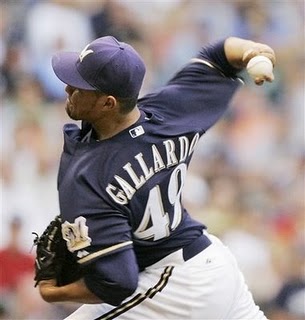
Yesterday Milwaukee inked 24-year old Yovanni Gallardo to a five-year deal worth a minimum of $30.1 million and potentially as much as $42.5 million.  The deal could keep Gallardo a Brewer through 2015 if the club so chooses.  The deal is really quite novel in that it provides both the Brewers and Gallardo a number of incentives, such as parameters regarding which teams Gallardo could potentially be traded to as well as bonuses based on Cy Young voting.  While Cy Young voting is a rather subjective way of distributing payment, the clause at least provides the Brewers some level of merit-based control on their checkbook.  Compared to the contracts awarded to a few of Gallardo’s peers such as Justin Verlander, Tim Lincecum, Felix Hernandez, and Matt Cain, Jon Lester, and Zack Greinke this deal comes off looking rather genius for the Brewers.  The question, though, lies in whether or not Gallardo can justify being considered a peer of these elite young righties.

Last year Gallardo cracked the 200-strikeout milestone for the first time in his career while making 30 starts for the first time as well.  Considering that he was coming off a season shortened by knee surgery in 2008, 2009 was a significant step in the right direction.  He still failed to reach the 200-IP plateau, but in many ways I consider that a good thing for the Brewers considering they were fully aware that they would ultimately miss the playoffs relatively early in the season.  Why not manage their young ace conservatively if he is basically just practicing for next year?

How about his stuff?  The wrap on Gallardo since he was a flame-throwing yet erratic high schooler has been that he lacks a developed third pitch.  I’m not sure that remains the case.  He still tends to favor his fastball (95+ whenever he needs it)/curve (at least plus, sometimes plus-plus) duo, but his changeup has made considerable strides since Gallardo reached the Bigs in 2007.  Still, he does not use it enough.  Gallardo’s high ¾ release point and carry on his fastball, when coupled with Miller’s short porch, tend to drive a lot of balls to the seats, but that same carry allows Gallardo to pitch at the letters a little more often, especially to righties, in order to generate strike 3.

Delivery?  It sounds like Milwaukee extensively analyzed Gallardo’s delivery to determine if anything about it would lead to career-threatening injuries later on.  From the sounds of it, Gallardo checked out nicely.  Personally, I think he fights to create a downward plane more than someone with his build and athleticism should, – primarily by using his front side to “climb” – but that same athleticism probably allows him the necessary leeway he needs to do it.

So why am I not convinced?  Gallardo is not efficient.  His K/BB is the worst of the pitchers I mentioned earlier as potential peers, he has thrown the fewest innings, and he has had a major surgery already.  Still, with the way his contract is structured, the Brewers have provided themselves with a situation that will provide Gallardo incentive for finding ways to solve these problems.  I think he has the stuff, athleticism and organizational support to really make a run at a few Cy Young Awards, and that would help both Yovanni and the Brewers.