Stephen Strasburg | The Golden Sombrero Baseball Blog | MLB, Fantasy, College & High School Baseball News

Are We There Yet? Troubled Franchice Finally Has Help On The Way: A Washington Nationals Season Preview

April 3, 2010

zim

Baseball here in the nation’s capital has been rather difficult to watch at times.  Since I arrived in the District of Columbia on June 5, 2008, the woebegone Nationals have compiled a record of 93-169, good for an anemic .355 winning percentage.  To put that in perspective, No team has posted a poorer mark in a single season since the Royals lost 106 games in 2005.  But with a couple of established veterans anchoring the lineup, some intelligent personnel moves from GM Mike Rizzo and an increasing amount of young talent down on the farm, there may be a glimmer of hope for this franchise, which has languished in baseball’s second division since it moved to the District in 2005.
Offense
In 2009, the Nationals were the tenth-best offense in the National League, posting a respectable 4.4 runs per game.  For 2010, the Opening Day lineup will look something like this:

1. Nyjer Morgan CF
2. Ian Desmond SS
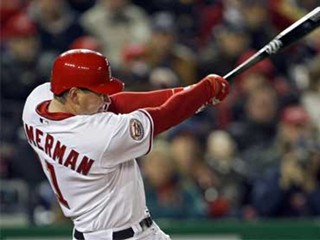
3. Ryan Zimmerman 3B
4. Adam Dunn 1B
5. Josh Willingham LF
6. Adam Kennedy 2B
7. Ivan Rodriguez C
8. Willie Harris RF

Nyjer Morgan replaces the since-released Elijah Dukes in the outfield to begin 2010.  Morgan, a midseason acquisition in 2009, was a very pleasant surprise in the second half of the season and looks to continue his hot hitting and base-stealing in 2010.  Rookie Ian Desmond, who beat out eight-million-dollar utility man Christian Guzman for the starting shortstop job, looks to provide youth, energy and the ability to actually take a pitch or two here and there to the second spot in the lineup.  If those two can generate some production at the top of the order, they can certainly make things exciting on the basepaths.
However, with a core of Ryan Zimmerman, Adam Dunn and Josh Willingham hitting behind them (95 home runs among the three last year), they may not have to.  Zimmerman, who racked up a thirty-game hitting streak on his way to an all-star game nomination in 2009, is just entering his prime and could easily have his best season yet at the hot corner.  Dunn moves over to first base full-time after resembling a statue in the outfield last year, and Willingham, who did not have a starting job locked down at this time in 2009, looks to make a significant contribution to the team early given more at-bats in an everyday role.  While this tandem may not be counted among the best in the game, they can score runs and score them in a hurry.
At second base, Adam Kennedy takes over for 2009 opening day starter Anderson Hernandez. While this is certainly an upgrade, it may be asking too much of Kennedy to repeat his 20-steal, 11-home run season of a year ago.  Some regression to the mean is in order here, but Kennedy is certainly an improvement over Nationals second basemen of the past.  Ivan Rodriguez will be the everyday catcher until Jesus Flores is healthy again—Rodriguez’s best days at the plate are well behind him, but his ability to work with a very young pitching staff and provide solid defense behind the plate will be a welcome addition to the franchise.  Rounding out the order will be a rather-unimpressive tandem of Willie Harris and Willy Taveras, who looks to return to the form he showed for the Rockies in 2007, when he helped lead the franchise to its first-ever National League championship.  If young prospect Justin Maxwell can impress early in Triple-A Syracuse, look for him to get a chance to prove himself in right—the Nationals hope that he can be their future at the position.
Overall, the Nationals lineup does not look like that of the worst team in baseball.  Expect them to improve on their mediocre 2009 run production and score enough runs to keep themselves in more games than in recent memory.
Pitching
There is plenty of room for concern in the starting rotation.  While there’s no question that young Stephen Strasburg is one of the five best Nationals starters right now, the team decided to have him begin the season in Double-A to further his development.  Chien-Ming Wang and phenom Jordan Zimmermann wait in the wings as well, but up with the big club will be Opening Day starter John Lannan, Jason Marquis, Craig Stammen, Livan Hernandez and Garrett Mock.
Lannan, who takes the ball on Opening Day for the second consecutive season, is a workmanlike performer, who managed an ERA under 4 in 2009 but struck out just 89 hitters in over 200 innings.  While Lannan is capable of keeping the walks to a minimum, his heavily defense-reliant style was a bad combination with the Nationals’ porous defense, which committed a league-worst 143 errors.
Marquis, fresh off a 15-win season and an All-Star game nomination with the Rockies a year ago, has garnered high expectations coming into camp this season, but has struggled mightily in camp.  Couple this with a rough second half of 2009 (just one win after August 19) and there is plenty of room for questions here.  Last year, Marquis became the first player in MLB history to reach the playoffs in ten consecutive seasons (his entire career) while playing for at least three teams over that span.  Expect that streak to end this season, and expect Marquis’s win total to fall significantly short of the fifteen he posted in the Mile High City.
Stammen’s strong spring led to his being handed the #3 spot in the rotation, but his 5.11 ERA and a K/9 rate of less than four means an adventure every time he gets the ball.  Hernandez, an aging workhorse who came to camp as a non-roster invitee, has put up the best numbers of his career as a National, but would be the first likely candidate to be released following a promotion of either Strasburg or Wang.  Mock was regarded as a rather strange choice as fifth starter, considering that lefty Scott Olsen had the better spring overall and improved throughout, but Mock and his 3-10 record and 5.72 ERA from 2009 will be taking the ball every fifth day—for now at least.
The Nationals, however, have even bigger concerns in the bullpen.  Veteran Matt Capps anchors the crew after coming over from Pittsburgh.  He looks to improve on a disastrous 2009 after counting himself among the league’s middle-of-the-pack closers in 2007 and 2008.  The Nats will need him to shut the door considerably more often than he did last year if they want any sort of respectability.  Capps will be joined by Sean Burnett, Tyler Clippard, one-time closer Mike MacDougal and new arrival Brian Bruney, who figures to be the primary set-up man.  Questions abound regarding this ramshackle collection of hurlers, and top prospect Drew Storen figures to step in sooner or later.  Until that time, however, the Nationals could find themselves giving away far more late leads than they would like.  Expect this developing group to struggle in 2010.
Overall
While hope springs eternal for the Nationals in the form of Zimmermann, Strasburg and Storen, and the 3-4-5 tandem of Zimmerman, Dunn and Willingham can be counted on for a good chunk of RBIs this season, 2010 won’t be the Nationals’ year.  There are simply too many questions—namely at the back end of the rotation, in right field and in middle relief, not to mention a full slate of games against the defending NL Champion Phillies and the wild-card favorite Braves.  Expect some improvement from 2010, but also expect Bob Marley’s “Three Little Birds” (played at the ballpark after every Nationals loss) to fill the air this summer on South Capitol Street.
This fan’s prediction: a 68-94 record and another last-place finish in the NL East.  However, things are looking up for this franchise with its developing stars and its no-longer-barren farm system.  The Nationals won’t be playing in October, but sooner rather than later, Bob Marley’s presence at Nationals Park will diminish and Nationals fans may be able to finally say that everything’s going to be all right here in DC.
Until that time, however, this fan will continue to enjoy having a major league baseball team just a five-dollar ticket and a ten-minute Metro ride away.  Because no matter who you are, no matter whom you root for and no matter where you live, last-place baseball is infinitely better than none at all.
The Next Ryan Braun?

March 26 , 2010

After spending a couple of weeks with Stephen Strasburg this spring, Nyjer Morgan decided to nickname him, “Jesus.”  It seems nowadays like every organization, especially those in dire need of a savior, tout their young prospects as though they will one day absolutely be middle-of-the-order smashers with Ozzie’s skills at whatever positions they play or frontline aces in the Roy Halladay mold.  Consider these names: Dominic Brown, Justin Smoak, Buster Posey, Desmond Jennings, Brian Matusz, Yonder Alonso, Dustin Ackley, Aroldis Chapman, Jason Heyward, etc.  Any club in baseball would/should want any and all of these players.  Remember these names, however, Cameron Maybin, Alex Gordon, Brandon Wood, Delmon Young, Fernando Martinez, Homer Bailey, etc?  It’s easy to understand what drives such lofty expectations with young talent.  When was the last time the Yankees put a decent amount of stock into what any rookie might accomplish?  Joba does not count.  Desperate and poorly funded teams tend to spend a lot more time praying than those who can so easily write massive checks.  It’s almost as though the first mention of a talented player’s careful development and steady promotion leads to Ryan Braun-esque expectations.  Ryan Braun is obviously not on the second list nor do I truly think any player in the minors will one day be as good as Braun is now.  Justin Upton may grow into a similar type of player.  Maybe.  Of all the prospects mentioned, there are three who I think will be all-stars within 5 years.  The others are destined for mediocrity for one reason or another.  Strasburg is in a different class altogether.  He will be Josh Beckett.  We won’t consider him.

The three of interest are Buster Posey, Desmond Jennings, and Jason Heyward.  Why these three?  They walk and make contact.  Both Jennings and Heyward walked as many times as they fanned last season, and Posey was not far off.  These players all possess outstanding athleticism, but in baseball all that truly translates to when young is the ability to learn positions quickly in order to get to the big squad sooner.  Exceptional talent means something different in baseball.  This is not the NFL.  Morons who can run fast and jump high do not necessarily translate into all-stars.  Athleticism never hurts, but it only goes so far in understanding what to expect from rookies.  In 2007 the folks at Baseball America, right before Braun exploded onto the National League scene, ranked Cameron Maybin 20 places ahead of Ryan Braun.  How could they have missed by so much?  Simple.  Bad teams and bad scouts place way, way too much stock into athleticism.  Baseball America is certainly quite reputable, but they tend to see the game as it was and not so much as what it is and what it could be.  Would Cameron Maybin have a better NFL career than Ryan Braun? Likely.  So what?  Big fastballs and fast 60’s mean nothing in the minor leagues and the big leagues.  What does?  Baserunners.  Posey, Heyward, and Jennings already know how to do the most important thing in sports.  Getting on base.  Strasburg already knows how to prevent this.  His fastball/slider combo is dazzling, but the single aspect of his collegiate stats that stand out the most is his otherworldly K/BB ratio.  For baseball purposes, it may make more sense to simply consider it infinity and move on.  Sign them all up now.  Or wait if you have no interest in winning (Braves and Rays).  Either way, when these players do begin their big league careers (Posey’s dozen or so AB’s in September excluded) they will continue to do the things they did in the minors.  Play baseball with the realization that first base is the new plate.

I told a friend in lab today that I would talk a little about the Rangers in my next post since I’m living in Dallas now.  As I don’t want to give the impression that I have anything serious against Baseball America, I will make mention of the fact that they have given Texas the top organizational review for the second consecutive season.  They are absolutely right on in doing so.  Texas has talent in every position, and for the most part it tends to be young.  Their farm system is as stocked as any in the game except possibly Tampa.  All this being said, they are essentially a lineup of question marks.  I project it to look something like this whenever Ron Washington gets off the cocaine and moves Nelson Cruz up in the order.

  1. Julio Borbon
  2. Michael Young
  3. Josh Hamilton
  4. Vladimir Guerrero
  5. Ian Kinsler
  6. Nelson Cruz
  7. Chris Davis
  8. Elvis Andrus
  9. Jarrod Saltalamacchia/Taylor Teagarden

It should look like this:

  1. Michael Young
  2. Josh Hamilton
  3. Ian Kinsler
  4. Nelson Cruz
  5. Vladimir Guerrero
  6. Chris Davis
  7. Elvis Andrus
  8. Catcher
  9. Julio Borbon

There is injury risk top to bottom here, and not very many of these guys have truly demonstrated the ability to get on base all that frequently, but they have ungodly thump here and easily the best lineup in the AL West.  The rotation is worse, but why would a team build around arms in Arlington?  Even so, young guys like Neftali Feliz and Derek Holland possess considerable upside, and Martin Perez, likely the best pitching prospect the Rangers have had this decade, is not too far away from arrival.  These guys catch the ball very well, and the addition of Borbon in center will only prevent more runs.  The Mariners made a lot of improvements this winter, and the Angels are still the team to beat, but I personally think the West will be very tight, and I expect these three teams to be very active in the trading market in June and July.  I think the Rangers have a slight edge if everyone is healthy.  Maybe by a game or two.

I just want to give a shout to young Grinnellian rightfielder, Paden Roder.  His slashes right now read .440/.559/.840.  The Ivy League-bound senior has had quite a career for the Pioneers.  Let’s wish Paden and the other Pioneers a strong finish in Florida free of injuries and full of sun and W’s.

R.I.P Ted Denslow

March 23 , 2010

baseketball

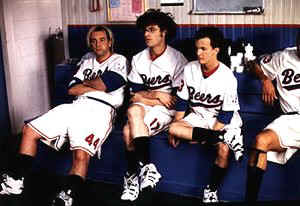
Ted Denslow, deceased former owner of the Milwaukee Beers baseketball club, fought to prevent unionization, free agency, and corporate tie-ins from contaminating his league.  In the process he allowed his players to develop the brotherhood and camaraderie that can only come through shared experiences together on the field of battle, as both friends and foes.

Every March I am blessed to participate in a fantasy draft with a mixture of childhood friends, ex-college team/roommates, and a couple of the owner’s girlfriends (they must really love us).  This is the league’s 6th season and my 5th year participating.  In the last five years, the league has evolved considerably with some owners retiring, others taking their places, and all of our lives evolving with the league.  When the league was in its infancy, some of the current owners were underclassmen in high school while others were approaching undergraduate graduation day.  A lot has changed since those early days of our league, and most of the owners now are college graduates and embarking on new adventures both professionally and personally.  One owner is married.  Another has left the country to attend something called the Royal Veterinary Academy, and our newest member recently began a post-baccalaureate pre-med program in St Louis where she lives with one of the league’s original owners.  The champions from the past four seasons now reside in London, Washington D.C., Iowa, and Chicago.  The Iowan was born and raised in Honolulu, and I suspect he will return there upon his graduation in May.  Who wouldn’t want to return to tropical paradise?

I consider myself incredibly fortunate to have fantasy baseball in my life.  When I tried explaining to my fellow student dentists how I could take an afternoon out of a Saturday to drop all of my studies (we had a big physiology test Monday) to play fake sports, I began with how much time and effort goes into preparing for the draft and how important it was that I am comfortable with the draft kit.  We use ESPN, and the folks there seem to alter it annually.  My classmates naturally questioned what I win if my team were to come in first.  I enthusiastically replied “Albert Pujols in 2011!”  They were expecting some monetary sum.  I began telling them that none of the owners actually have any money, which was my default response in yesteryear.  That is no longer even the case.   I had forgotten that some of the owners do indeed have positive income.  This dialogue reminded me of what I love the absolute most about fantasy: the opportunity to continue to share something I love with many of the people I love with who I otherwise might lose touch due to jobs, families, or distance.  While I may lose track of some of the other league owners from October through February, I have March through September to catch up with them and reinforce the friendships that were built away from the laptop, smartphone, and television.

Don’t get me wrong, I truly do prepare for the draft.  I currently own Ron Shandler’s Baseball Forecaster for this season as well as the two prior to this one and Rotoworld’s guide.  I have a very firm grasp on their discrepancies and reasoning behind their projections.  I find Shandler to be very convincing, but I can understand why others might prefer Rotoworld’s style.  I read Hardball Times, Baseball America, and espn.com every day.  The point is that I care if I win.  A lot.  I never have before, but have also never finished outside the top 4.  I check my team a minimum of 15 times daily during the season, but I tend to behave compulsively.  Five would probably be sufficient.  Either way, I believe that some day I will win.  Maybe it will happen this fall.

Win or lose.  First or last.  It really matters little in predicting what I will be doing next March.  Now that our 2010 draft is finalized and the season is set to begin, I have a six-month roller coaster to ride into October.  When I exit the coaster, I will bid farewell to the Denslow Cup 2010 and the other owners for the winter.  I will then begin preparing for the upcoming draft, like I have done for the last five years and intend to do for the next fifty.  I can’t wait to pick the conversation back up.  My bet is it will begin right where it left off five months prior.

You know, I think to some extent that’s what Mr. Denslow wanted out of his league too.

Alright.  Now let’s discuss some real baseball.  One of the biggest question marks of the spring – and it seems like there are a few more than usual this March – has been hovering around the campus of the College of Southern Nevada where 17-year old Bryce Harper is leading the school in every meaningful offensive statistic while handing the bulk of the team’s backstop duties and spending a handful innings in the outfield and at third.  It took the phenom just two weeks to move himself into the JUCO’s cleanup role on offense.  With a line of .413/.505/.875 (as of March 13th) to go along with his six stolen bases and sub-2.00 pop-to-pop time, Harper is in the process of justifying the media hype that began when he graced the cover of Sports Illustrated and was touted as little less than a messianic figure soon to be a household name.   While most players his age are fighting to make their varsity high school teams, Bryce Harper is working to solidify his status as the consensus number one prospect headed into this June’s MLB amateur draft.  Is he doing that?

This is not a question anyone would even have to answer had Harper not dropped out of Las Vegas High School in hopes of beginning his professional career a year early.  MLB demands that dropouts sit out a year before they can be drafted.  Harper’s route to the draft is unprecedented but indeed justified given his virtual lock on a team’s top pick.  The question is whether or not that pick will be the Nationals’ first overall pick.  Imagine this: Stephen Strasburg tossing to Bryce Harper in 4 years.  Some scouts have voiced concern over Harper’s unorthodox hitting mechanics, which likely leads to his rather large collection of strikeouts.  He currently has 19 through 80 AB’s.  Scouts may use Harper’s 16 walks to suggest that he has some understanding of the strike zone as well as his justifiable immaturity relative to the 19, 20, and 21-year old pitchers he is facing at Southern Nevada.  While the strikeouts are worrisome, his power is jaw-dropping.  Already with a HR rate of one in every 10 AB’s, Harper’s power will only grow as his body matures and he spends more time in a gym.  He is currently regarded as the number one power option in the draft ahead of UT-Arlington’s Michael Choice, the collegiate junior who led Team USA in slugging percentage last summer.  Choice currently outweighs Harper by twenty pounds and is approximately four years older as well.  Always with players like Harper, signability questions arise.  Given the $15.1 million dollars that Strasburg was awarded in last year’s draft, Harper’s wishes still likely be even greater.  Given his age, he probably has more room to bargain than any American born player in history, which only equates to an even higher price tag.  Driving up his cost even further is the fact that Harper is represented by Scott Boras.

Another question surrounding Harper is what position he will play in the big leagues.  Like all players of Harper’s mold, the risk of spending big money on a player likely to accrue less than 500 AB’s per season can scare scouts and front offices, especially given that lower body injuries are much more common with catchers.  Additionally confusing is the speed Harper possesses that would ultimately be wasted behind the plate.  Harper is not the first talent to face these issues. The Giants have been barraged this spring with questions regarding where Buster Posey will eventually log the most innings as a big leaguer.  In an utterly baffling move, the Giants signed the aging Bengie Molina to receive the majority of pitches this season while Posey again proves his worth in the high minors.  Fans and media have suggested that Posey should slide over to another position on defense to get his massive bat in the lineup, but the value of a slugging catcher has forced them to deny such possibilities.  Harper may follow a similar path to the big leagues full of positional and time-of-arrival question marks.While a great deal of uncertainty remains with Bryce Harper, one thing is certain.  It seems impossible that a team like the Nationals would pass on the potential superstardom of a player with Harper’s endless upside.  Unfortunately for them, it also seems impossible that an organization that has never finished about .500 could spend in the neighborhood of $20 million on a player so far from big league arrival.  Don’t be surprised if Harper falls out of the top few picks in June.  When he does, however, realize that he is not falling because he is anything other than the premier offensive prospect ever.  Despite the strikeouts, Bryce Harper has the athletic tools and, at least superficially, the drive to win to justify this claim.  At his current homerun rate, he may break a number of records at Southern Nevada this spring.  Barring injury, come this June, he likely will break another record: that for amateur price tag.

How about a little fantasy news?  Since Joe Nathan is likely out for the year, word around front offices is that the Twins are actively pursuing a number of seasoned late-inning veteran aces.  Among those mentioned are Toronto’s Jason Frasor, San Diego’s Heath Bell, and a couple of guys from within including (unfortunately) Francisco Liriano.  Let’s address Frasor first.  Last season with the Jays, Frasor posted essentially a 1 WHIP and a 1:1 K/IP.  These are very comparable to the Mo Riveras and Joe Nathans of the closing ranks.  Bell was also elite, but has more strikeout stuff (not by much).  The Blue Jays and Padres are both deeply entrenched in the rebuilding phase, and neither team will be relevant in their respective divisions for the foreseeable future.  The Twins, however, absolutely must be relevant and must at the very minimum challenge for their divisional title.  The opening of Target Field and the contract negotiations with Mr. Twin, Joe Mauer, mean that games cannot be blown in the 9th this season.  So who should fantasy owners be picking up off of free agency or trading for in deep mixed leagues?  With Frasor and Bell already atop their current clubs’ bullpen depth charts, these players are likely owned in all leagues.  In San Diego, a very intriguing young hurler named Mike Adams deserves some consideration by all owners needing saves.  Last season Adams posted a 0.74 WHIP while striking out nearly 3 times as many guys as he walked with a K/9 of nearly 9.  So he pretty much checked off all the categories we care about.  Monitor what the Padres do with Bell all season, because as soon as his dealing becomes imminent – and it will – Adams needs to be owned.  Toronto’s situation is less certain.  Yeah, they signed Kevin Gregg this winter, but should we care?  Gregg, as flyballer, is often at the mercy of the environment he is throwing in.  He had a decent level of success in Miami because the Marlins play on a football field, but Gregg’s subsurface numbers last season were better than a casual glance would suggest.  Personally, I anticipate him getting the nod in Toronto if Frasor is traded over Scott Downs.  Downs is frankly a better pitcher than Gregg statistically, but his handedness and lack of ninth inning track record make him more of a darkhorse to accumulate any noticeable number of saves this year.  I hate that we have to even consider this, because the Twins have other good late inning options in Jon Rauch, Matt Guerrier, and Pat Neshek (if he is healthy and happy), but the idiots in the Twin Cities have actually suggested using Liriano in a bullpen role.  Liriano was spectacular this winter and may be the Cy Young of the Grapefruit League.  Why not let young pitchers heal from TJS at their own pace?  No wonder these guys built a stadium outside in the Arctic.  Anyway, just pray this doesn’t come to fruition, not because of fantasy value, but because Liriano is so exciting and Minnesota needs a true ace in a year that Minnesota just needs.

Spring Training stuff.  Strasburg was sent down.  No surprise here.  Just wait, though.  From what we saw from him this March, he is the real deal and will immediately become the ace the Nats need.  The Braves have mentioned the possibility of using newly acquired Melky Cabrera at the top of the order occasionally while moving Nate McLouth out of the role and into something resembling a weighted platoon situation.  Melky has proven one thing since becoming a big leaguer: he has a great chance to hit fungo grounders once his career as a AAAA player ends.  Literally half the balls he hit last season were GB’s.  This guy sucks.  That being said, I have to give some love to the Braves for the deal that sent the harmless hitter to Atlanta because it also brought lefty bullpen arm, Mike Dunn, over.  Mike Dunn went to high school about 3 minutes from where I live, and I always have love for clubs that give my old teammates/rivals opportunities.  Dunn would have stood a tougher chance of making the big squad with the Yanks.  Now the Braves have two young New Mexicans throwing for them (the other being 24-year old 4th rounder, James Parr).  Other New Mexicans standing a chance to make some noise this season are Moriarty High grad, Kyle Blanks, and Carlsbad High grad, Cody Ross.  Both of these players have already had varying degrees of success at the big league level, and both look like they may have some nice careers ahead of them, especially if they can both make contact a little more frequently.

I got to visit a new venue last night.  I was able to catch a game between Dallas Baptist and Lafayette at Patriot Field in Dallas.  The venue was very sweet, especially for a smaller college.  Baptist thumped Lafayette, but that was to be expected from the perennial D2 powers.

Back home in Farmington a potential meeting between rivals and annual state title front-runners FHS and Piedra Vista was thwarted when PV was unable to top Monument. Colorado’s Fruita High.  This is disappointing.  Neither Farmington squad – both of which are under new management – has looked terribly sharp this spring.  Expect that to change come April and May as both squads return a lot of talent and experience.

Grinnell College is on their way to Vero Beach for their annual spring break trip.  We all wish them luck.  They will suit up against Amherst tomorrow in what’s sure to be an all-out nerdfest.  Maybe afterward the two teams can go toe to toe in a spelling bee or science fair.  Sophomore and reigning co-Midwest Conference player of the year, Mike Nodzenski, has been a little banged up this March.  Word on the street is that he may have been injured during a team-building exercise that may or may not have involved combat.  Here’s to Nodz’s speedy recovery and another great season for him and the Pioneers.