Mike Adams | The Golden Sombrero Baseball Blog | MLB, Fantasy, College & High School Baseball News

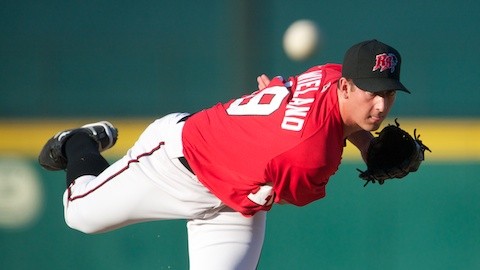
Top 50 Prospects: #48 – Joseph Wieland

#48 Joseph Wieland

San Diego Padres

DOB: 1/21/90

Previously Ranked: N/A

ETA: 2012

Joe Wieland was part of the deal that sent Mike Adams to Texas, and considering how valuable Adams was to the bullpen in both San Diego and Texas, Wieland is obviously viewed as a future Big League contributor.  We at The Sombrero will go a step further.  Wieland will be a top of the rotation arm for years.  We are talking a solid two in the Show.

His stuff isn’t as imposing as other arms that will crack our top 50, but his command is outrageously good.  He walked 21 guys over 150 innings in 2011 for Christ’s sake.  The strikeout totals were nearly one per inning, and he did a solid job keeping the ball in the yard as well.

Year Age Tm Lg Lev Aff W L ERA G GS CG SHO IP BB SO
2008 18 Rangers ARIZ Rk TEX 5 1 1.44 13 7 0 0 43.2 8 41
2009 19 Hickory SALL A TEX 4 6 5.31 19 18 0 0 83.0 24 73
2010 20 2 Teams 2 Lgs A-A+ TEX 11 7 4.07 26 25 2 1 148.0 25 133
2010 20 Hickory SALL A TEX 7 4 3.34 15 15 2 1 89.0 15 71
2010 20 Bakersfield CALL A+ TEX 4 3 5.19 11 10 0 0 59.0 10 62
2011 21 3 Teams 2 Lgs A+-AA TEX,SDP 13 4 1.97 26 25 2 2 155.2 21 150
2011 21 Myrtle Beach CARL A+ TEX 6 3 2.10 14 13 1 1 85.2 4 96
2011 21 Frisco TL AA TEX 4 0 1.23 7 7 1 1 44.0 11 36
2011 21 San Antonio TL AA SDP 3 1 2.77 5 5 0 0 26.0 6 18
4 Seasons 33 18 3.28 84 75 4 3 430.1 78 397
A (2 seasons) A 11 10 4.29 34 33 2 1 172.0 39 144
AA (1 season) AA 7 1 1.80 12 12 1 1 70.0 17 54
A+ (2 seasons) A+ 10 6 3.36 25 23 1 1 144.2 14 158
Rk (1 season) Rk 5 1 1.44 13 7 0 0 43.2 8 41
Provided by Baseball-Reference.com: View Original Table
Generated 11/7/2011.
Year Age Tm Lg Lev Aff ERA IP WHIP H/9 HR/9 BB/9 SO/9 SO/BB
2008 18 Rangers ARIZ Rk TEX 1.44 43.2 0.916 6.6 0.4 1.6 8.5 5.13
2009 19 Hickory SALL A TEX 5.31 83.0 1.518 11.1 0.8 2.6 7.9 3.04
2010 20 2 Teams 2 Lgs A-A+ TEX 4.07 148.0 1.189 9.2 0.6 1.5 8.1 5.32
2010 20 Hickory SALL A TEX 3.34 89.0 1.112 8.5 0.4 1.5 7.2 4.73
2010 20 Bakersfield CALL A+ TEX 5.19 59.0 1.305 10.2 0.9 1.5 9.5 6.20
2011 21 3 Teams 2 Lgs A+-AA TEX,SDP 1.97 155.2 1.009 7.9 0.5 1.2 8.7 7.14
2011 21 Myrtle Beach CARL A+ TEX 2.10 85.2 0.957 8.2 0.7 0.4 10.1 24.00
2011 21 Frisco TL AA TEX 1.23 44.0 1.045 7.2 0.4 2.2 7.4 3.27
2011 21 San Antonio TL AA SDP 2.77 26.0 1.115 8.0 0.0 2.1 6.2 3.00
4 Seasons 3.28 430.1 1.160 8.8 0.6 1.6 8.3 5.09
A (2 seasons) A 4.29 172.0 1.308 9.7 0.6 2.0 7.5 3.69
AA (1 season) AA 1.80 70.0 1.071 7.5 0.3 2.2 6.9 3.18
A+ (2 seasons) A+ 3.36 144.2 1.099 9.0 0.8 0.9 9.8 11.29
Rk (1 season) Rk 1.44 43.2 0.916 6.6 0.4 1.6 8.5 5.13
Provided by Baseball-Reference.com: View Original Table
Generated 11/7/2011.

Wieland should start the year in San Antonio, but he should move quickly to Triple-A.  There is a very real chance he cracks the rotation in San Diego by the end of 2012.  His fastball reaches 93, and his breaking ball is of the 12-6 variety with quality shape.  Both pitches are solid average to above on their own, but Wieland’s command plays each pitch into the 55-60 range.  His changeup is not used as often, but it has decent fade and should be a solid 50 pitch.  Wieland has an athletic 6-foot-3 frame and very clean and easy mechanics that should allow him to stay reasonably healthy.  This is not an ace arm, but it is the kind of No. 2 that every team wants.


Recent Trade Involvement in the Denslow Cup

May 22, 2010

Jim got engaged!  To a terrific young lady I might add.  Congratulations, buddy!  We’re really proud and excited for you.  Two more engagement shout-outs: first one for our buddy, Kevin (Kev Kong) Wilcox; second one for my dental school classmate/friend and cadaver dissecting partner, Val Sanchez.  Very fun things.

Before I get going with this post, I want to apologize for not posting anything lately.  My finals week lasted about 15 days/nights and was a truly painful experience for everyone involved.  I still am awaiting confirmation that I passed my last two exams, but I did not need to do that well on them to make it to 2nd year.  I don’t think when I began dental school or even when I was applying that I had any idea what it would actually be like.  Grinnell is a challenging undergraduate institution that consistently ranks among the most extensive in the country in terms of workload.  It did not remotely compare to what was expected of each student at Baylor.  They say the first year of professional school is the most challenging of any student’s career.  I really hope that is the case.

Moving on.  I have tried not to write much about fantasy on this blog because I am fearful of disclosing information that has helped me succeed in previous to my competitors.  The blog comes first now, though, so hopefully none of what I disclose is seen as particularly novel.

This post will center on some recent trades I have completed in my 16-team 7 x 7 (AVG, OBP, SLUG, HR, SB, R, RBI x IP, W, SV, K, ERA, WHIP, K/BB) league that I play in with my friends, many of whom write for the Sombrero.  Before I begin I should mention that I tend to give the team I drafted a month or so of a chance for two primary reasons.  First, it takes approximately 100 plate appearances or so to produce a meaningful set of results capable of evaluation.  Second, this evaluation should help determine a reevaluation of the predraft rankings implicit within are new projections and expectations.  This reevaluation should generate some inefficiencies and potential bargain deals throughout any league.  Hopefully a month into the season every one of your players are playing over-their-heads and producing at unsustainably high levels.  This will inflate their values to the point that they are capable of fetching players ranked considerably higher in the predraft rankings.  A month into the season the rankings that should be taken the most seriously remain those produced prior to the draft because they are based in the most extensive and reliable numbers.  Some players are streaky, and some streak/slump oscillations express periods of a month or longer.  For these reasons, I target May as the month in which I need to work the hardest in fantasy.  This unfortunately coincides with finals and has been hindered more than usual this year.  Nevertheless I have made a few moves that I think will really help my squad, the Heights Knights (named after my 8th grade basketball team), find their stride and hopefully begin to climb in the standings.

CLAR traded Kevin Youkilis, Bos 3B to A-holes
CLAR traded Nate McLouth, Atl OF to A-holes
CLAR traded Kevin Slowey, Min SP to A-holes
MVW traded David Wright, NYM 3B to Knights
MVW dropped David DeJesus, KC OF to Free Agency
MVW dropped Nick Hundley, SD C to Free Agency

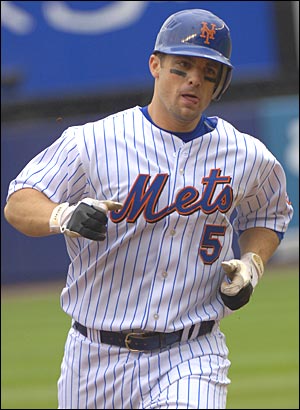
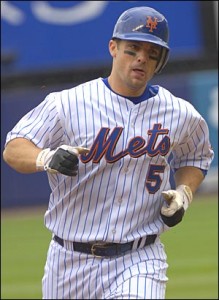
This trade took place in early May and heavily reflects my love for David Wright and very little else.  Simply put, I lost this trade.  Youkilis plays for a better team in a better yard, makes contact more often and has better control of the strike zone, probably more power, is more consistent, and, most importantly, will be an easier guy to move later on.  This final reason is a product of the fact that as the season progresses, Wright’s strikeout totals will likely seem more astronomic by the day.  The Mets are a pathetic organization.  I blame their management and front office entirely for David’s recent and ongoing struggles with contact.  That’s a different subject for a different day, though.  Back to the trade.  Slowey’s command is second to none, and even though he lacks a put-away pitch or above average anything, his ability to locate makes him a serviceable two or exceptional three in any rotation.  In a league like ours that uses IP as a category, Slowey is a horse and will always outperform his 5×5 ranking.  McLouth has not looked like the all-star he was in 2008 because he is not making contact often enough.  He will continue to lose playing time as long as he fails to put the ball in play, but, when near his best, McLouth makes Melky Cabrera look like the minor league journeyman he should be.

Eunuch (MVW) beat me on this trade, but I have David, my favorite player, and I am much happier moving forward now as a result.

TOWL traded Nick Markakis, Bal OF to Knights
CLAR traded Yovani Gallardo, Mil SP to Corporate Towls

This trade was mostly a reflection of our cap on starts.  Essentially three starters should be able to reach the cap (100), and I had five at the time.  Gallardo was my highest ranked according to ESPN, but in our league should have been dropped extensively due to his notoriously high pitch counts and less-than-ace-caliber walk totals.  In standard formats, these are virtually meaningless, but in our league make Yo a 4-category contributor in a 14-category format.

Markakis has been one of my targets since 2006.  His ability to both differentiate balls and strikes as well as center the baseball make him lethal in formats such as ours that utilize both average and OBP categories despite having just 15 to 20-bomb power.  Because OBP is not included in the standard format, Markakis is far more valuable in the Cup than he is according to ESPN.

Budz dropped Kris Medlen, Atl RP to Free Agency
Budz dropped J.J. Putz, CWS RP to Free Agency
Budz traded Billy Butler, KC 1B to Knights
CLAR traded Todd Helton, Col 1B to ChronicL’s
CLAR traded Josh Willingham, Was OF to ChronicL’s
CLAR traded Matt Lindstrom, Hou RP to ChronicL’s

Ty9 traded Carlos Lee, Hou OF to Knights
CLAR traded Billy Butler, KC 1B to POO

These trades happened within hours of each other, so I will treat them as one mega deal in which I move Helton, Willingham, and Lindstrom for Carlos Lee.  A trade like this is only possible if you really know the other managers in the league.  My first trading partner in this deal was Griff.  Griff is after a first-place finish this year, and I know it.  He has produced increasingly higher finishes each year and made it into the top-5 last season for the first time.  In a 16-team league, saves are a big deal.  Not only are there only 30 closers at any time but also a 0 in any category means a lot more when one team is getting 16 and the average team is snagging 8 or 9 from that category.  I find it very hard to envision a first place team getting last or even close to last in the saves category.  A single stable closer (30 saves) for the entire season is probably enough to avoid a catastrophically low saves total, and closers are hoarded in our league as a result.  The effects of this hoarding are an enhanced demand and a reduced supply of saves.  Griff recognized that the longer he waited, the less the return and the higher the cost.  By a stroke of luck, Alfredo Simon, the new Orioles closer was available as well as Manny Corpas making Lindstrom somewhat expendable.

Willingham is another guy who is worth more in our league than in a standard league because of his skill at reaching base, but what some folks have been slow to accept is the quality of the heart of the Nationals order.  Hitting behind Adam Dunn should provide Hammer with a shot at 100 RBI’s.  He has a chance this season to be an all-star and is especially valuable in a platoon.

Todd Helton again is more valuable in our league due to his combination of average and on-base skills.  Jason Giambi is a ridiculous distraction and almost comical nowadays, but he should be eliminated shortly I suspect due to the imminent season-ending injury that surely accompanies 39-year old, fat, steroid abusers.  Griff actually got Helton at a time when his value may be somewhat deflated due to his slow start, and in general this trade is looking as though I came away the loser.

However, I knew if I could just snag Butler that Ty9, a lifelong and diehard Royals fan, would probably give me Carlos Lee in exchange.  Lee has been getting a lot of bad publicity recently because of his slow start, but the guy can take every square inch of the zone 450 ft.  I saw his slow start as an obvious opportunity to buy low on a guy that has a 3-year mean OPS over .880 and a 5-year average of 31 dongs/season.

Everyone other Tyrone won this one.

Bob dropped Mike Adams, SD RP to Free Agency
CLAR traded David Ortiz, Bos DH to of Shelley
CLAR traded Chris Coghlan, Fla OF to of Shelley
Bob traded Carlos Pena, TB 1B to Knights

As noted earlier, I have a tendency to fall in love with certain players.  Carlos is one of those guys for me.  I have never had him on my team.  He is clearly underperforming right now, but has shown the ability to stay inside and above the ball with good lower body action in the last week or so against good arms.  The ball Gardner took away was an excellent swing, and the next night Carlos went deep twice.  I love him and rolled out the red carpet this morning for him.

I’m a Coghlan believer.  I think his mechanics at the plate allow him to handle almost all pitches even though they probably are good for no more than fifteen jacks/season.  As everyone has always known about Coghlan, his skills play better at 2B than at a COF spot.  Not going to happen with Uggla on 40-jack pace.  Still, Coghlan should be around a .300 hitter the rest of the way while walking at a respectable clip.

Papi is so tough to evaluate right now.  Sometimes he looks as good as ever, and sometimes he looks like he could go 0-for a beer league game.  This suggests that Papi is guessing and cheating his hands at the plate to compensate for either reduced pitch deciphering abilities, reduced bat speed, injury, or a combination of the three.  I suspect that I may have moved him at the perfect time, and while I have normally been a fan of Papi, the failed PED test was a big turnoff for me.  Considering I plucked him off of waivers a week before this deal, it was easy to pull the trigger.

I am very satisfied with these trades and the way my team is looking.  This has been one of my more successful Mays, and, with the addition of luck, health, and a few more quality moves, it should put me in position to challenge for my first title.

The current Knights:

C Carlos Ruiz
1B Carlos Pena
2B Dustin Pedroia
3B David Wright
SS Hanley Ramirez
OF Michael Bourn
OF Nick Markakis
OF Carlos Lee
UTIL Adam Dunn
Bench Jim Thome
Bench
P Cole Hamels
P Alfredo Simon
P Manuel Corpas
P Aaron Heilman
P J.J. Putz
P Carlos Villanueva
Bench Scott Baker
Bench Jeff Niemann
Bench Ted Lilly
Bench Ervin Santana
DL Mike GonzalezDL15

Finding Value in Relief Pitchers

March 29 , 2010

mrhappy

Regardless of which fantasy references you frequent, I’m sure that you have been beaten upside the head with theories as to how to draft relief pitching.  I have both read and experimented with advice that has ranged from the conservative, waiting until the 3rd round to draft the best available closer, to the experimental, “I won’t pay for relief pitching/saves.”  While I must admit that I don’t subscribe to either of these strategies in full, I have found the latter to be the most efficient, exciting and rewarding.  Daniel “Dee” Clark, a fellow blogger on the site, is about as strong of an advocate of this philosophy as any fantasy enthusiast I have read.  For three consecutive years he has excelled in our league due to his knowledge of the game, it’s players and their statistical relevance.  Each year he has compiled a lethal offense under the belief that there will always be an array of relief pitchers that, at the end of the year, will have been more valuable than the game’s top closers; in layman’s terms, relief pitching is far too unpredictable.  Every season, Major League Baseball is riddled with controversy surrounding the security of closers(see Brad Lidge circa 2008 & 2009).  The excessive scrutiny on “closers” really only yields one positive result, the emergence of fresh, young arms that have been anxiously awaiting their opportunity to shove it down hitters’ throats(see Andrew Bailey, Leo Nunez circa 2009).  With the 2010 season a mere week away, it’s important to note several talented, young guns who appear to be in line to produce huge years for their organizations and fantasy owners alike.

Mike Adams, Padres –
2009 Statistics: 37 IP, 0-0, .73 ERA, .59 WHIP, 5.63 K/B
Why haven’t you heard about Mike Adams? Well, it’s most likely because he has literally been under the knife since 2006.  However, he reappeared towards the end of last year and was nothing short of nasty.  Barring another injury, he should accumulate a respectable amount of wins as it seems he will be trusted to keep games close before giving way to Heath Bell.  Should Bell(or Pocket Broxton as I like to call him) get traded this season, I would expect Adams to get the promotion over teammate Luke Gregerson.

Neftali Feliz, Rangers –
2009 Statistics:  31 IP, 1-0, 1.74 ERA, .68 WHIP, 4.88 K/BB
I don’t want to spoil it for you, but if you haven’t seen Mr. Happy pitch yet, you must, because he is dominant.  Whether the Rangers eventually use him as a starter or reliever, he will put up similar numbers to last year.  A coveted prospect of the organization, he responded nicely to being thrust into pressure situations at only 21 years of age.  If Frank Francisco either gets hurt or charged with another felony assault, look for Feliz to step in as closer.

Matt Thornton, White Sox –
2009 Statistics: 72.1 IP, 6-3, 4 SV, 2.74 ERA, 1.08 WHIP, 4.35 K/BB
Matt Thornton throws the most effortless 96-98MPH fastball I have ever seen.  The 6’5″ left hander has been one of the best set-up men in baseball over the past two seasons as indicated by his .198 BAVG in 2008 and .217 BAVG in 2009.  While it is important to note that he hasn’t exactly excelled in the closer role when given the opportunity(1 SV/6 SVO in 2008 and 4 SV/9 SVO in 2009), it definitely does not mean that he won’t be the front runner if Bobby Jenks gets hurt.

Daniel Bard, Red Sox –
2009 Statistics: 49.1 IP, 1-1, 1 SV, 3.65 ERA, 1.28 WHIP, 2.86 K/BB
If anything were to happen to Jonathon Papelbon, I don’t think the Red Sox would miss a beat.  Young, flame thrower Daniel Bard is their closer of the future.  With a high 90’s heater and a devastating slide piece, Bard has as bright of a future as any young pitcher in baseball.  Any control problems that worried fantasy owners last season are sure to wane with more experience and confidence.

Sergio Romo, Giants –
2009 Statistics: 34 IP, 6-3, 5 SV, 3.17 ERA, 1.07 WHIP, 3.73 K/BB
With so much focus on the Giants starting rotation, the excellent arms in their bullpen seem to be perennially overlooked.  After the All-Star break in 2009, Romo showed that he is the real deal and a fixture in the Giants bullpen.  He accumulated 6 wins and 5 saves in only 34 IP last season, which seems weak compared to his sheer dominance across the minor leagues.  Complimented by left hander Jeremy Affeldt, the Giants should have a great bridge to closer Brian Wilson this season.

Brandon League, Mariners –
2009 Statistics: 74.2 IP, 3-6, 4.58 ERA, 1.25 WHIP, 3.62 K/BB
You might as well just ignore his stats from last year because League is not the same pitcher.  With a new pitch added to his already potent arsenal, this is going to be League’s breakout season.  Although I repeatedly predicted his breakout seasons to happen while on the Blue Jays, it’s never too late for a guy with such great stuff(see Mike Adams above).  26 year olds League and teammate Mark Lowe are sure to be a deadly duo within the Mariner’s bullpen and worthy of consideration in deep fantasy leagues.  If incumbent closer David Aardsma were to hit the DL or revert to his wild tendencies, League should have no problem filling in.

Joba Chamberlain, Yankees –
2009 Statistics: DOES NOT MATTER
We have all seen what this guy can do as a reliever.  He is as dynamic and dominant as any closer in baseball and should get a chance if Mo’s fountain of youth runs dry.  While, I’m sure that a Mo injury would only ignite another season long debate on Joba’s importance as a starter or reliever, the guy will do whatever is asked of him day in, day out.  Look for Joba to have a monster season out of the Yankee bullpen.

Joey Devine, Athletics –
2009 Statistics: DNP(Tommy John surgery)
Before the emergence of Andrew Bailey, Devine was the closer on paper headed into the 2009 season.  However, his ongoing elbow troubles forced him to have Tommy John surgery and surrender his whole season.  One year later, Devine is said to be healthy and ready for the season where he will be setting up games for AL Rookie of the Year Andrew Bailey.  Devine’s closer like repertoire makes him the leading candidate to close for the A’s should anything happen Andrew Bailey.  Although, from what I have seen, Bailey looks like a pretty durable young hoss

R.I.P Ted Denslow

March 23 , 2010

baseketball

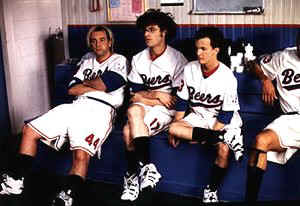
Ted Denslow, deceased former owner of the Milwaukee Beers baseketball club, fought to prevent unionization, free agency, and corporate tie-ins from contaminating his league.  In the process he allowed his players to develop the brotherhood and camaraderie that can only come through shared experiences together on the field of battle, as both friends and foes.

Every March I am blessed to participate in a fantasy draft with a mixture of childhood friends, ex-college team/roommates, and a couple of the owner’s girlfriends (they must really love us).  This is the league’s 6th season and my 5th year participating.  In the last five years, the league has evolved considerably with some owners retiring, others taking their places, and all of our lives evolving with the league.  When the league was in its infancy, some of the current owners were underclassmen in high school while others were approaching undergraduate graduation day.  A lot has changed since those early days of our league, and most of the owners now are college graduates and embarking on new adventures both professionally and personally.  One owner is married.  Another has left the country to attend something called the Royal Veterinary Academy, and our newest member recently began a post-baccalaureate pre-med program in St Louis where she lives with one of the league’s original owners.  The champions from the past four seasons now reside in London, Washington D.C., Iowa, and Chicago.  The Iowan was born and raised in Honolulu, and I suspect he will return there upon his graduation in May.  Who wouldn’t want to return to tropical paradise?

I consider myself incredibly fortunate to have fantasy baseball in my life.  When I tried explaining to my fellow student dentists how I could take an afternoon out of a Saturday to drop all of my studies (we had a big physiology test Monday) to play fake sports, I began with how much time and effort goes into preparing for the draft and how important it was that I am comfortable with the draft kit.  We use ESPN, and the folks there seem to alter it annually.  My classmates naturally questioned what I win if my team were to come in first.  I enthusiastically replied “Albert Pujols in 2011!”  They were expecting some monetary sum.  I began telling them that none of the owners actually have any money, which was my default response in yesteryear.  That is no longer even the case.   I had forgotten that some of the owners do indeed have positive income.  This dialogue reminded me of what I love the absolute most about fantasy: the opportunity to continue to share something I love with many of the people I love with who I otherwise might lose touch due to jobs, families, or distance.  While I may lose track of some of the other league owners from October through February, I have March through September to catch up with them and reinforce the friendships that were built away from the laptop, smartphone, and television.

Don’t get me wrong, I truly do prepare for the draft.  I currently own Ron Shandler’s Baseball Forecaster for this season as well as the two prior to this one and Rotoworld’s guide.  I have a very firm grasp on their discrepancies and reasoning behind their projections.  I find Shandler to be very convincing, but I can understand why others might prefer Rotoworld’s style.  I read Hardball Times, Baseball America, and espn.com every day.  The point is that I care if I win.  A lot.  I never have before, but have also never finished outside the top 4.  I check my team a minimum of 15 times daily during the season, but I tend to behave compulsively.  Five would probably be sufficient.  Either way, I believe that some day I will win.  Maybe it will happen this fall.

Win or lose.  First or last.  It really matters little in predicting what I will be doing next March.  Now that our 2010 draft is finalized and the season is set to begin, I have a six-month roller coaster to ride into October.  When I exit the coaster, I will bid farewell to the Denslow Cup 2010 and the other owners for the winter.  I will then begin preparing for the upcoming draft, like I have done for the last five years and intend to do for the next fifty.  I can’t wait to pick the conversation back up.  My bet is it will begin right where it left off five months prior.

You know, I think to some extent that’s what Mr. Denslow wanted out of his league too.

Alright.  Now let’s discuss some real baseball.  One of the biggest question marks of the spring – and it seems like there are a few more than usual this March – has been hovering around the campus of the College of Southern Nevada where 17-year old Bryce Harper is leading the school in every meaningful offensive statistic while handing the bulk of the team’s backstop duties and spending a handful innings in the outfield and at third.  It took the phenom just two weeks to move himself into the JUCO’s cleanup role on offense.  With a line of .413/.505/.875 (as of March 13th) to go along with his six stolen bases and sub-2.00 pop-to-pop time, Harper is in the process of justifying the media hype that began when he graced the cover of Sports Illustrated and was touted as little less than a messianic figure soon to be a household name.   While most players his age are fighting to make their varsity high school teams, Bryce Harper is working to solidify his status as the consensus number one prospect headed into this June’s MLB amateur draft.  Is he doing that?

This is not a question anyone would even have to answer had Harper not dropped out of Las Vegas High School in hopes of beginning his professional career a year early.  MLB demands that dropouts sit out a year before they can be drafted.  Harper’s route to the draft is unprecedented but indeed justified given his virtual lock on a team’s top pick.  The question is whether or not that pick will be the Nationals’ first overall pick.  Imagine this: Stephen Strasburg tossing to Bryce Harper in 4 years.  Some scouts have voiced concern over Harper’s unorthodox hitting mechanics, which likely leads to his rather large collection of strikeouts.  He currently has 19 through 80 AB’s.  Scouts may use Harper’s 16 walks to suggest that he has some understanding of the strike zone as well as his justifiable immaturity relative to the 19, 20, and 21-year old pitchers he is facing at Southern Nevada.  While the strikeouts are worrisome, his power is jaw-dropping.  Already with a HR rate of one in every 10 AB’s, Harper’s power will only grow as his body matures and he spends more time in a gym.  He is currently regarded as the number one power option in the draft ahead of UT-Arlington’s Michael Choice, the collegiate junior who led Team USA in slugging percentage last summer.  Choice currently outweighs Harper by twenty pounds and is approximately four years older as well.  Always with players like Harper, signability questions arise.  Given the $15.1 million dollars that Strasburg was awarded in last year’s draft, Harper’s wishes still likely be even greater.  Given his age, he probably has more room to bargain than any American born player in history, which only equates to an even higher price tag.  Driving up his cost even further is the fact that Harper is represented by Scott Boras.

Another question surrounding Harper is what position he will play in the big leagues.  Like all players of Harper’s mold, the risk of spending big money on a player likely to accrue less than 500 AB’s per season can scare scouts and front offices, especially given that lower body injuries are much more common with catchers.  Additionally confusing is the speed Harper possesses that would ultimately be wasted behind the plate.  Harper is not the first talent to face these issues. The Giants have been barraged this spring with questions regarding where Buster Posey will eventually log the most innings as a big leaguer.  In an utterly baffling move, the Giants signed the aging Bengie Molina to receive the majority of pitches this season while Posey again proves his worth in the high minors.  Fans and media have suggested that Posey should slide over to another position on defense to get his massive bat in the lineup, but the value of a slugging catcher has forced them to deny such possibilities.  Harper may follow a similar path to the big leagues full of positional and time-of-arrival question marks.While a great deal of uncertainty remains with Bryce Harper, one thing is certain.  It seems impossible that a team like the Nationals would pass on the potential superstardom of a player with Harper’s endless upside.  Unfortunately for them, it also seems impossible that an organization that has never finished about .500 could spend in the neighborhood of $20 million on a player so far from big league arrival.  Don’t be surprised if Harper falls out of the top few picks in June.  When he does, however, realize that he is not falling because he is anything other than the premier offensive prospect ever.  Despite the strikeouts, Bryce Harper has the athletic tools and, at least superficially, the drive to win to justify this claim.  At his current homerun rate, he may break a number of records at Southern Nevada this spring.  Barring injury, come this June, he likely will break another record: that for amateur price tag.

How about a little fantasy news?  Since Joe Nathan is likely out for the year, word around front offices is that the Twins are actively pursuing a number of seasoned late-inning veteran aces.  Among those mentioned are Toronto’s Jason Frasor, San Diego’s Heath Bell, and a couple of guys from within including (unfortunately) Francisco Liriano.  Let’s address Frasor first.  Last season with the Jays, Frasor posted essentially a 1 WHIP and a 1:1 K/IP.  These are very comparable to the Mo Riveras and Joe Nathans of the closing ranks.  Bell was also elite, but has more strikeout stuff (not by much).  The Blue Jays and Padres are both deeply entrenched in the rebuilding phase, and neither team will be relevant in their respective divisions for the foreseeable future.  The Twins, however, absolutely must be relevant and must at the very minimum challenge for their divisional title.  The opening of Target Field and the contract negotiations with Mr. Twin, Joe Mauer, mean that games cannot be blown in the 9th this season.  So who should fantasy owners be picking up off of free agency or trading for in deep mixed leagues?  With Frasor and Bell already atop their current clubs’ bullpen depth charts, these players are likely owned in all leagues.  In San Diego, a very intriguing young hurler named Mike Adams deserves some consideration by all owners needing saves.  Last season Adams posted a 0.74 WHIP while striking out nearly 3 times as many guys as he walked with a K/9 of nearly 9.  So he pretty much checked off all the categories we care about.  Monitor what the Padres do with Bell all season, because as soon as his dealing becomes imminent – and it will – Adams needs to be owned.  Toronto’s situation is less certain.  Yeah, they signed Kevin Gregg this winter, but should we care?  Gregg, as flyballer, is often at the mercy of the environment he is throwing in.  He had a decent level of success in Miami because the Marlins play on a football field, but Gregg’s subsurface numbers last season were better than a casual glance would suggest.  Personally, I anticipate him getting the nod in Toronto if Frasor is traded over Scott Downs.  Downs is frankly a better pitcher than Gregg statistically, but his handedness and lack of ninth inning track record make him more of a darkhorse to accumulate any noticeable number of saves this year.  I hate that we have to even consider this, because the Twins have other good late inning options in Jon Rauch, Matt Guerrier, and Pat Neshek (if he is healthy and happy), but the idiots in the Twin Cities have actually suggested using Liriano in a bullpen role.  Liriano was spectacular this winter and may be the Cy Young of the Grapefruit League.  Why not let young pitchers heal from TJS at their own pace?  No wonder these guys built a stadium outside in the Arctic.  Anyway, just pray this doesn’t come to fruition, not because of fantasy value, but because Liriano is so exciting and Minnesota needs a true ace in a year that Minnesota just needs.

Spring Training stuff.  Strasburg was sent down.  No surprise here.  Just wait, though.  From what we saw from him this March, he is the real deal and will immediately become the ace the Nats need.  The Braves have mentioned the possibility of using newly acquired Melky Cabrera at the top of the order occasionally while moving Nate McLouth out of the role and into something resembling a weighted platoon situation.  Melky has proven one thing since becoming a big leaguer: he has a great chance to hit fungo grounders once his career as a AAAA player ends.  Literally half the balls he hit last season were GB’s.  This guy sucks.  That being said, I have to give some love to the Braves for the deal that sent the harmless hitter to Atlanta because it also brought lefty bullpen arm, Mike Dunn, over.  Mike Dunn went to high school about 3 minutes from where I live, and I always have love for clubs that give my old teammates/rivals opportunities.  Dunn would have stood a tougher chance of making the big squad with the Yanks.  Now the Braves have two young New Mexicans throwing for them (the other being 24-year old 4th rounder, James Parr).  Other New Mexicans standing a chance to make some noise this season are Moriarty High grad, Kyle Blanks, and Carlsbad High grad, Cody Ross.  Both of these players have already had varying degrees of success at the big league level, and both look like they may have some nice careers ahead of them, especially if they can both make contact a little more frequently.

I got to visit a new venue last night.  I was able to catch a game between Dallas Baptist and Lafayette at Patriot Field in Dallas.  The venue was very sweet, especially for a smaller college.  Baptist thumped Lafayette, but that was to be expected from the perennial D2 powers.

Back home in Farmington a potential meeting between rivals and annual state title front-runners FHS and Piedra Vista was thwarted when PV was unable to top Monument. Colorado’s Fruita High.  This is disappointing.  Neither Farmington squad – both of which are under new management – has looked terribly sharp this spring.  Expect that to change come April and May as both squads return a lot of talent and experience.

Grinnell College is on their way to Vero Beach for their annual spring break trip.  We all wish them luck.  They will suit up against Amherst tomorrow in what’s sure to be an all-out nerdfest.  Maybe afterward the two teams can go toe to toe in a spelling bee or science fair.  Sophomore and reigning co-Midwest Conference player of the year, Mike Nodzenski, has been a little banged up this March.  Word on the street is that he may have been injured during a team-building exercise that may or may not have involved combat.  Here’s to Nodz’s speedy recovery and another great season for him and the Pioneers.