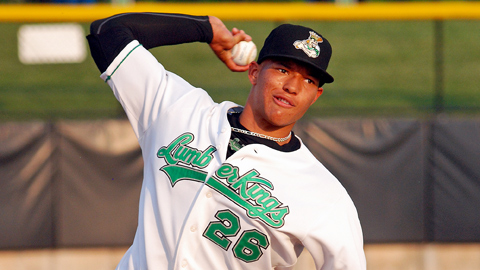
Walker was Seattle’s first pick in the 2010 draft, and the 6-foot-4 right-hander had a terrific first professional season in the Midwest League (A). He threw up a sub-3.00 ERA with 113 strikeouts against 39 walks. He only allowed four jacks in nearly 100 innings of work and has a chance to be a very fast mover in hopes of reaching the Bigs in time to join Felix Hernandez, Michael Pineda, and Danny Hultzen at Safeco.
Walker is extremely athletic with loads of projection and a fastball that reaches the high-90s. With a big downer curve that receives consistent plus to double-plus gradings, Walker already has at least two plus pitches. His changeup is way behind the other two pitches, but Walker is already making huge strides in terms of command and clearly seems to understand what it means to pitch. The addition of an average or better changeup could see Walker land in the Show by 2013 so long as he breezes through the high Minors like he has with Class A.
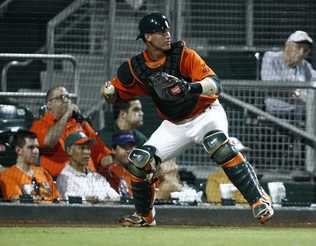
Grandal, a product of the Miami Hurricanes program, had a monstrous year behind the dish across three stops, culminating with four games in the International League to close the season out. He even has collected 12 at-bats in the Arizona Fall League. Grandal, a switch hitter, was selected 12th overall in 2010, and in his first full professional season in 2011 slashed .305/.401/.500 as a 22-year old. He should start the year in the high Minors with a chance to break in at some point during 2012. The more realistic scenario likely has him cracking the lineup in Cincinnati in 2013 or somewhere else via a trade since Grandal is behind Devin Mesoraco on the depth chart, a consensus top-20 prospect.
Still, Grandal’s glove typically receives better grades as does his arm than Mesoraco’s. Scouts prefer Grandal’s ability from the left side of the dish a little better than from the right, but he’s plus from both sides. With a full season behind the dish in the Show, Grandal could amass 20 bombs and approach a .300 average with good on-base skills and above average defense. That sounds a lot like Victor Martinez to me, especially when considering that he hits from both sides. Grandal is the kind of big-upside backstop that every club would like to see in the high Minors.
Zack Cox had the best hit tool grading in the 2010 class, was arguably the best hitter in Arkansas history despite only staying there for two seasons, and was a massive steal for the Cardinals as the 25th pick overall. In just his first full professional season, Cox reached Double-A and posted very respectable numbers with a slash line of .306/.363/.434 across two stops.
He really has little to prove in the Texas League and should open the year in Triple-A. Realistically, though, he might be forced to repeat the level if for no other reason than to slow his development down somewhat considering that David Freese seems firmly entrenched at third in St. Louis for a few years. Cox is a true 70-grade hitter who hits to all parts of the yard, has tremendous balance, bat track, and timing as well as exceptional judgment of both the strike zone and the hitting zone.. His lower half is virtually always fully loaded and on time. Cox practically never breaks down in his front half but somehow is never really behind anything either.
His pitch selection and recognition is arguably the best in the Minors today, and most balls he squares up have outstanding carry to them. The one knock, and it’s a small one, is that Cox has a tendency to stay so inside of pitches, particularly on the inner half, that he fails to fully clear and drive long to the pull side. Personally, if he never corrects this, I still see an all-star bat if he can stay at third. His glove and speed are far behind his hit tool as well as his power and arm tools, which both grade as 55-60. He booted 20 grounders in under 90 games in the Texas League and has a long way to go as far as footwork goes, but there is enough to like about his fielding to let him stick at the hot corner in the short term. St. Louis fans probably don’t want to hear this, but Zach Cox could make Albert Pujols dispensable in some ways.
Harvey was the top collegiate arm in the 2010 class, but his career at North Carolina was not a smooth ride like most figured it would be considering that his fastball can reach 98 mph and he carries mid-90s velocity deep into nearly every start. His mechanics and deception, as well as fastball life, have greatly improved in the last two years. He throws two breaking ball variations, one of which is more of a slider while the other is more of a hard downer curve.
Scouts are fairly split on which one has the better prognosis, but at the Sombrero we think that each has its place when considering what side of the plate his opponent is hitting from. His changeup is behind and he doesn’t throw it often or consistently enough yet, but it has some arm side action to it as well. It profiles as a 50 while both breaking ball variations can be 60s or 70s given the day.
Harvey has a terrific frame at 6-foot-4 and 210-pounds, and his numbers suggest that he could reach the Big Leagues as early as 2013. Across two levels, including 12 Double-A starts, Harvey struck out 156 guys next to 47 walks in 135.2 innings. He kept the ball in the yard quite well too and finished the year with a 3.32 ERA. The future looks bright for Harvey, and maybe, just maybe, the Mets might not blow it with him.
#49 Christian Yelich
Miami Marlins
Date of Birth: December 5, 1991
Drafted: 1st Round (No. 23 overall) in 2010
ETA: 2014
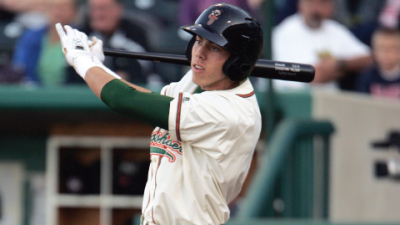
19-year-old Christian Yelich, in his first full professional season, slashed .312/.388/.484 with 15 bombs, 48 XBH’s, and 32 stolen bases. He struck out in nearly a quarter of his at-bats, but he also walked in over 10% of his plate appearances.
He basically had a phenomenal year in the Sally League and should start the year in High Class A and finish the year in the high Minors with a chance to crack a Big League roster by 2013. He has a below-average arm, but runs well enough to be an everyday left fielder. His power should be a 60 by the time he finishes filling out as well. He has terrific lower body hitting mechanics with an easy weight transfer and a firm front side.
He stays inside pitches well, which allows him to drive the ball to all fields with good carry. His lanky 6-foot-4 frame is loaded with projection, and Yelich is nothing close to a finished product yet. Nevertheless, he has ascended to the top of the Marlins’ rankings and should be an impact corner guy in the show with a very good chance to hit in the middle of the order.
 November 22, 2011
|
Posted by Daniel "Dee" Clark
November 22, 2011
|
Posted by Daniel "Dee" Clark











Recent Comments