April | 2010 | The Golden Sombrero Baseball Blog | MLB, Fantasy, College & High School Baseball News

Articles from April 2010


Justin Abramson’s 2010 Predictions

April 6, 2010

AL East: Yankees, Rays, Red Sox, Orioles, Blue Jays

AL Central: Twins, Sox, Tigers, Indians, Royals

AL West: Angels, Rangers, Mariners, A’s

AL Wildcard: Rays

NL East: Phillies, Braves, Marlins, Mets, Nationals

NL Central: Cardinals, Brewers, Cubs, Astros, Reds, Pirates

NL West: Rockies, Dodgers, Giants, Diamondbacks, Padres

NL Wildcard: Braves

ALCS: Rays def. Yankees

NLCS: Rockies def. Phillies

World Series: Rays def. Rockies

AL MVP: Evan Longoria

AL Cy Young: Felix Hernandez
AL ROY: Austin Jackson

AL MOY: Ron Gardenhire

NL MVP: Albert Pujols

NL Cy Young: Roy Halladay

NL ROY: Jason Heyward

NL MOY: Bobby Cox

Work That Wire

April 6, 2010

Working the waiver wire; who wants to worry about that?  Not many people work the waiver wire correctly.  Too often I hear people talking about, “Oh I don’t need to worry about that.  My guys are doing just fine.”  Or, “Who could there possibly be that is better than anyone I have on my bench already?”  Sure, you might not need a guy, but why not take a flyer once in a while?  Find a guy on a hot streak to replace that cold bat.  Or how about finding that arm for a quality spot start?
Working the wire is all about timing.  More often than not, if you are willing to take a risk, an educated one, it pays off big time.  Me, I have three different times where I try to use the wire to my advantage; spot start SP’s, a bat due for a good streak, or just to horde a guy before anyone else in my league can grab him.  Let’s take a look at spot starts.
Spot starting a pitcher is an excellent way to take advantage of quality matchups to help boost your pitching stats.  Before I go grab just anybody off the wire though, I always check trends.  The first trend I check is the pitcher’s home/road splits.  Don’t check just for the current season though.  Make sure to view career trends.  Obviously, the larger the sample size, the more accurately you can make your decision.  I like to use Baseball-Refernce.com for this.  They have a vast amount of data that can be used for just about anything you want.  If a guy has a huge difference in is home/road splits, let’s say road for this example, then take a look at his next couple of starts.  Who is he facing?  Where is the game played?  If you like who the pitcher is going against, i.e. the Pirates, take a look at line-ups.  How many lefties/righties is he facing?  What are the pitcher’s splits there?  Also, I recommend taking a look at what the pitcher has done over the past two-three years.  Two years ago, I was able to grab Cliff Lee off the wire after two starts.  Most people in my league laughed, and told me he was a fluke.  What they forgot to recognize was that only two years prior, Cliff Lee was being called a future Cy Young candidate by scouts.
What about hitters?  How do you find the guy that nobody is talking about?  I like to take a bit more risk with these type of guys, because if it doesn’t work out, so what.  It’s not like you’re losing much if you drop a guy from your roster that never plays.  Once again, I like to take a look at the next three or four pitchers that said hitter is facing in the coming days.  What type of success rate has he had over his career versus these guys?  I especially like to look at a hitter’s isolated power in this scenario.  That tells you a lot about how often the guy squares up balls, and that is the most important.  Even if he has a multitude of K’s, I am always willing to take a chance if the majority of balls hit are hit hard.  I also always take a chance on a guy riding a hot streak.  He’s 9 for his last 15?  Fuck yea I can find a spot on my bench for that guy the next few days!
The last reason I like to scour the wire is a simple one.  I want to prevent the other teams from getting something that I could potentially have.  Even if he just sits on my bench and I don’t record his stats, at least I know that nobody else is going to either.  This comes in handy late in the season when a few SB’s or RBI’s means trading spots in the standings.  Once again, don’t be afraid to subscribe to the theory of, “Even if I get nothing out of this guy, I didn’t lose anything in the player I dropped to clear roster space.”
All in all, working the wire can turn out to be pretty fruitless.  I easily make more than 100 transactions a year.  I may only keep a guy for a day and turn around and drop him for the guy he replaced the previous day.  With bench players, there is never a reason to fret over dropping them.  Most importantly, don’t be afraid to take a risk.  So go out there, find that diamond in the rough, and turn it into a thing of beauty.  One.

Are We There Yet? Troubled Franchice Finally Has Help On The Way: A Washington Nationals Season Preview

April 3, 2010

zim

Baseball here in the nation’s capital has been rather difficult to watch at times.  Since I arrived in the District of Columbia on June 5, 2008, the woebegone Nationals have compiled a record of 93-169, good for an anemic .355 winning percentage.  To put that in perspective, No team has posted a poorer mark in a single season since the Royals lost 106 games in 2005.  But with a couple of established veterans anchoring the lineup, some intelligent personnel moves from GM Mike Rizzo and an increasing amount of young talent down on the farm, there may be a glimmer of hope for this franchise, which has languished in baseball’s second division since it moved to the District in 2005.
Offense
In 2009, the Nationals were the tenth-best offense in the National League, posting a respectable 4.4 runs per game.  For 2010, the Opening Day lineup will look something like this:

1. Nyjer Morgan CF
2. Ian Desmond SS
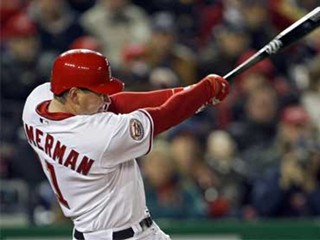
3. Ryan Zimmerman 3B
4. Adam Dunn 1B
5. Josh Willingham LF
6. Adam Kennedy 2B
7. Ivan Rodriguez C
8. Willie Harris RF

Nyjer Morgan replaces the since-released Elijah Dukes in the outfield to begin 2010.  Morgan, a midseason acquisition in 2009, was a very pleasant surprise in the second half of the season and looks to continue his hot hitting and base-stealing in 2010.  Rookie Ian Desmond, who beat out eight-million-dollar utility man Christian Guzman for the starting shortstop job, looks to provide youth, energy and the ability to actually take a pitch or two here and there to the second spot in the lineup.  If those two can generate some production at the top of the order, they can certainly make things exciting on the basepaths.
However, with a core of Ryan Zimmerman, Adam Dunn and Josh Willingham hitting behind them (95 home runs among the three last year), they may not have to.  Zimmerman, who racked up a thirty-game hitting streak on his way to an all-star game nomination in 2009, is just entering his prime and could easily have his best season yet at the hot corner.  Dunn moves over to first base full-time after resembling a statue in the outfield last year, and Willingham, who did not have a starting job locked down at this time in 2009, looks to make a significant contribution to the team early given more at-bats in an everyday role.  While this tandem may not be counted among the best in the game, they can score runs and score them in a hurry.
At second base, Adam Kennedy takes over for 2009 opening day starter Anderson Hernandez. While this is certainly an upgrade, it may be asking too much of Kennedy to repeat his 20-steal, 11-home run season of a year ago.  Some regression to the mean is in order here, but Kennedy is certainly an improvement over Nationals second basemen of the past.  Ivan Rodriguez will be the everyday catcher until Jesus Flores is healthy again—Rodriguez’s best days at the plate are well behind him, but his ability to work with a very young pitching staff and provide solid defense behind the plate will be a welcome addition to the franchise.  Rounding out the order will be a rather-unimpressive tandem of Willie Harris and Willy Taveras, who looks to return to the form he showed for the Rockies in 2007, when he helped lead the franchise to its first-ever National League championship.  If young prospect Justin Maxwell can impress early in Triple-A Syracuse, look for him to get a chance to prove himself in right—the Nationals hope that he can be their future at the position.
Overall, the Nationals lineup does not look like that of the worst team in baseball.  Expect them to improve on their mediocre 2009 run production and score enough runs to keep themselves in more games than in recent memory.
Pitching
There is plenty of room for concern in the starting rotation.  While there’s no question that young Stephen Strasburg is one of the five best Nationals starters right now, the team decided to have him begin the season in Double-A to further his development.  Chien-Ming Wang and phenom Jordan Zimmermann wait in the wings as well, but up with the big club will be Opening Day starter John Lannan, Jason Marquis, Craig Stammen, Livan Hernandez and Garrett Mock.
Lannan, who takes the ball on Opening Day for the second consecutive season, is a workmanlike performer, who managed an ERA under 4 in 2009 but struck out just 89 hitters in over 200 innings.  While Lannan is capable of keeping the walks to a minimum, his heavily defense-reliant style was a bad combination with the Nationals’ porous defense, which committed a league-worst 143 errors.
Marquis, fresh off a 15-win season and an All-Star game nomination with the Rockies a year ago, has garnered high expectations coming into camp this season, but has struggled mightily in camp.  Couple this with a rough second half of 2009 (just one win after August 19) and there is plenty of room for questions here.  Last year, Marquis became the first player in MLB history to reach the playoffs in ten consecutive seasons (his entire career) while playing for at least three teams over that span.  Expect that streak to end this season, and expect Marquis’s win total to fall significantly short of the fifteen he posted in the Mile High City.
Stammen’s strong spring led to his being handed the #3 spot in the rotation, but his 5.11 ERA and a K/9 rate of less than four means an adventure every time he gets the ball.  Hernandez, an aging workhorse who came to camp as a non-roster invitee, has put up the best numbers of his career as a National, but would be the first likely candidate to be released following a promotion of either Strasburg or Wang.  Mock was regarded as a rather strange choice as fifth starter, considering that lefty Scott Olsen had the better spring overall and improved throughout, but Mock and his 3-10 record and 5.72 ERA from 2009 will be taking the ball every fifth day—for now at least.
The Nationals, however, have even bigger concerns in the bullpen.  Veteran Matt Capps anchors the crew after coming over from Pittsburgh.  He looks to improve on a disastrous 2009 after counting himself among the league’s middle-of-the-pack closers in 2007 and 2008.  The Nats will need him to shut the door considerably more often than he did last year if they want any sort of respectability.  Capps will be joined by Sean Burnett, Tyler Clippard, one-time closer Mike MacDougal and new arrival Brian Bruney, who figures to be the primary set-up man.  Questions abound regarding this ramshackle collection of hurlers, and top prospect Drew Storen figures to step in sooner or later.  Until that time, however, the Nationals could find themselves giving away far more late leads than they would like.  Expect this developing group to struggle in 2010.
Overall
While hope springs eternal for the Nationals in the form of Zimmermann, Strasburg and Storen, and the 3-4-5 tandem of Zimmerman, Dunn and Willingham can be counted on for a good chunk of RBIs this season, 2010 won’t be the Nationals’ year.  There are simply too many questions—namely at the back end of the rotation, in right field and in middle relief, not to mention a full slate of games against the defending NL Champion Phillies and the wild-card favorite Braves.  Expect some improvement from 2010, but also expect Bob Marley’s “Three Little Birds” (played at the ballpark after every Nationals loss) to fill the air this summer on South Capitol Street.
This fan’s prediction: a 68-94 record and another last-place finish in the NL East.  However, things are looking up for this franchise with its developing stars and its no-longer-barren farm system.  The Nationals won’t be playing in October, but sooner rather than later, Bob Marley’s presence at Nationals Park will diminish and Nationals fans may be able to finally say that everything’s going to be all right here in DC.
Until that time, however, this fan will continue to enjoy having a major league baseball team just a five-dollar ticket and a ten-minute Metro ride away.  Because no matter who you are, no matter whom you root for and no matter where you live, last-place baseball is infinitely better than none at all.

Daniel “Dee” Clark’s 2010 Predictions

April 3, 2010

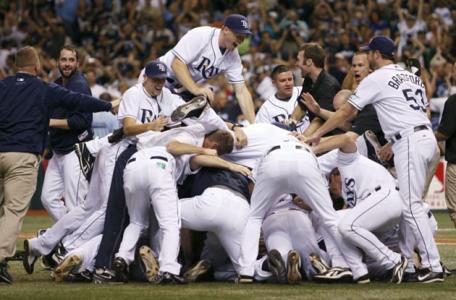
rays

NL West: Dodgers, Giants, Rockies, Diamondbacks, Padres
NL Central: Cardinals, Cubs, Brewers, Reds, Astros, Pirates
NL East: Phillies, Marlins, Braves, Mets, Nationals
NL Wild Card: Marlins
NL Pennant: Phillies over Dodgers
NLCS MVP: Chase Utley

AL West: Rangers, Mariners, Angels, Athletics
AL Central: Twins, Tigers, White Sox, Indians, Royals
AL East: Yankees, Rays, Red Sox, Orioles, Blue Jays
AL Wild Card: Rays
AL Pennant: Rays over Yankees
ALCS MVP: James Shields

World Series: Rays in 7…on the road.  Carl Crawford is the MVP.

AL ROY: Wade Davis
AL Cy Young: Felix Hernandez
AL MVP: Alex Rodriguez

NL ROY: Jason Heyward
NL Cy Young: Roy Halladay
NL MVP: Albert Pujols

Patience is for Suckers: The Case for Swinging First-ball, Fastball

April 1, 2010

Many coaches teach that the best way to approach hitting is to work the count against a pitcher.  After all, the more pitches a pitcher must throw, the better chance a hitter has to time his delivery, get a sense for his stronger and weaker pitches and learn what he might throw in certain situations.  This not only helps the hitter, these coaches argue, but also the team.  If a pitcher consistently has to throw four or more pitches to every hitter, he will be out of the game relatively quickly, even if he is pitching effectively.

As a hitter, I always looked at it differently.  I felt that the first pitch I saw during an at-bat was often the best one.  I also believed that as I got deep into the count, the pitcher would be able to dictate the at-bat more and force me to swing at pitchers’ pitches.  Further, true in all levels of baseball but especially in high school, pitchers are taught above all to get ahead of the hitter. This usually means that on the first pitch, pitchers will try to throw a strike, typically a fastball.  Very rarely will a pitcher start off by trying to get a hitter to chase an offspeed pitch out of the zone.  This only begins to happen when pitchers are already ahead of hitters—perhaps after the hitter has taken a quick strike or two.

Looking at the numbers, here are the batting averages by count in MLB:
0-0 = .344
1-0 = .341
2-0 = .351
3-0 = .394
0-1 = .324
1-1 = .327
2-1 = .338
3-1 = .368
0-2 = .166
1-2 = .178
2-2 = .195
3-2 = .233
Source: Baseball FactoryBlog: A Premier Scouting Partner for Baseball America http://baseballfactory.com/blog/labels/batting%20average.html

Looking at these numbers, one thing becomes clear—the only hitter’s counts better by a statistically significant amount than the first pitch are 3-0 and 3-1.  This makes sense—in these situations, pitchers are often forced to throw a fastball strike or risk a walk—a “free pass”.  Conversely, once a hitter gets two strikes on him, his batting average drops like a rock.  This also makes sense, because when a pitcher has worked an 0-2 or 1-2 count, he can afford to throw an offspeed pitch outside the strike zone in hopes that the hitter will chase.  The hitter also has to protect the plate, meaning that if the pitch is close, he has to swing.

Further, home runs occur most often in MLB on the first pitch—more often than in any other count.  0-0 counts also see the most doubles, triples and RBI.  While of course some of this can be explained by the fact that every hitter sees a 0-0 count in every at-bat, it also leads me to believe that hitters, when coming up to the plate looking to be aggressive, can jump on that first pitch well if the pitcher is just trying to get ahead in the count.

Finally, we can take a look at the OBP numbers for after the appropriate count.  This is calculated slightly differently because obviously, no one (not even Barry Bonds in 2001) can walk on anything other than a three-ball count, so the OBP for 1-0 represents the OBP for all hitters who begin their at-bat with ball one, regardless of how many more pitches they see:
1-0 .394
2-0 .516
3-0 .760
0-1 .281
1-1 .321
2-1 .404
3-1 .595
0-2 .211
1-2 .242
2-2 .306
3-2 .263
Here, we see a much sharper rise from 1-0 to 3-0.  However, more interesting is that we see a fall in OBP from 2-2 to 3-2.  We do see OBPs rise for non-two-strike counts.  Contrary to batting average, OBP is actually better on 2-1 than on 1-0.  Still, the biggest thing to notice is that the two-strike OBPs represent three of the lowest four on the chart.  Sure, great hitters like Luke Appling may have been able to foul pitches away (once even 24 in an at-bat!) until they found one they liked, but in reality, the advantage is to the pitcher in these situations.

In conclusion, I would draw the conclusion that if you have runners on in front of you and are trying to get a base hit to drive them in, taking pitches and getting deep in the count would be a horrible idea.  If you are trying to start an inning off, it’s still not a good idea to get too deep in the count because two-strike counts lead to the poorest OBPs, but taking pitches makes more sense in this situation.

I certainly don’t expect everyone to agree, not only because this is anathema to conventional wisdom on the game today, but because my baseball career was the shortest of all of this blog’s contributors.  But in one hitter’s opinion, the best way to hit with a two-strike count is to not get in one.