H/T to my colleagues from Prep Baseball Report Illinois for tweeting a link to this video earlier today. Connor Powers was the 2006 PBR Illinois Player of the Year and currently plays in the San Diego Padres organization.
In a previous post I commended San Francisco’s Kyle Zimmer for his standout career both as a student and as an athlete and suggested that he also will fall in the first half of round 1 come June, so I felt as though I should follow that up with a brief scouting report.
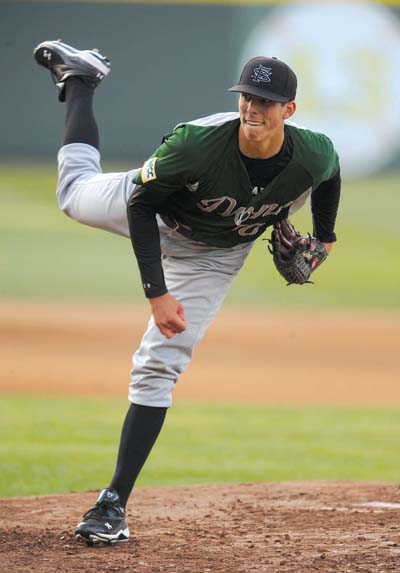
Zimmer has a prototypical pitcher’s frame at 6-foot-4 with lengthy limbs. He is an excellent athlete and often receives better grades for athleticism than for anything else, a terrific sign given the fact that he has had to learn pitching on the fly. He did not go to the University of San Francisco to pitch but rather as an infielder, but his arm is so strong that eventually he was bound to wind up on a mound even as simply an experiment.
Zimmer has added a lot of extension and length to his delivery and is far more solid in back than he was early in his pitching career, exactly what one expects from a converted infielder or catcher. Quality deliveries require enough length to provide the time necessary to reach a repeatable release point from a healthful slot. Zimmer definitely has a delivery now that allows him to do that. He has been up to 99 mph this spring already and could throw up a triple-digit readout at any time. With a potentially triple-plus fastball and some polish to his delivery, he immediately shoots into the one-one conversation.
His secondary stuff is behind the fastball, but not nearly as far as it could be given how little time he has spent on the mound thus far. His curveball (we are only considering the sharper and quicker version even though he has used a loopier one in the past as well) already is a 50 pitch, and his changeup, while fringy now, has shown enough promise to assume that it will always be useable and will always be improving.
He commands the ball well to both sides of the plate, and his numbers back up his projectability. He has filled out a lot in his time with USF (around 220 lbs. now), but he probably still has some development left in him as well. His changeup has already looked better in his spring starts than it did on the Cape, and he has used his tighter bender more frequently as well. All of this shows Zimmer’s propensity to listen and react to criticism. Zimmer’s makeup is off of the charts, and I like him a lot more than other righties in the 1-1 conversation right now.
Here at the Golden Sombrero I would like to take advantage of our viewership to spread the word about a charitable organization that is near and dear to me. Peach’s Neet Feet is a not-for-profit organization that provides custom shoes for children with cancer and other long-term disabilities. It was started by my friend Madison Steiner less than a year ago. Her idea was to change not just the world, but the world of each individual who was not fortunate enough to enjoy it as we do. Truly inspiring stuff. The video does more for it than my words, so I will just leave it at that.
Joey Gallo is a physically strong, 6-foot-5, 205-pound, CI/RHP from Bishop Gorman HS (NV). One of the elite bats in the 2012 draft class, Gallo possesses power to all fields with exceptional pull-side power. However, it’s not just the left-handed hitter’s bat that intrigues scouts – Gallo also has potential on the mound.
With a low-90s arm across the diamond, scouts will continue to debate whether Gallo is more projectable as a position player or pitcher. Given his 6-foot-5 frame, he has impressive athleticism and exhibits natural defensive actions at third base. However, he isn’t an elite defender and will probably never grade higher than a 55 at the hot corner.
Gallo’s best tool is without a doubt his power, which has the potential to be a 65 or 70 by the time he arrives in the Major Leagues. Last season at Bishop Gorman, he batted .471 with 25 home runs and 76 RBI while posting a 24/17 BB/K rate. In 2010, Gallo swatted 15 bombs while posting a .474 batting average.
His raw power was on full display this past summer at the Perfect Game All-American Classic at Petco Park where he belted a 442-foot home run – the 10th longest in the park’s history. The only knock on Gallo’s potential as a hitter is that, like most young power hitters, he has a tendency to drift and over-commit with his front side which causes his bat to drag. In turn, he struggles to hit quality offspeed pitches at times. But when he learns to adjust to such pitches, Gallo’s hit tool has the potential to be about a 60.
On the bump, Gallo’s fastball has already been clocked at 94 mph, and his size suggests there could be more in the tank. While his arm works well, Gallo is a big, powerful kid, and his mechanics can get a bit inconsistent at times and therefore affect his command. As for offspeed, Gallo features an above average breaker and a change up that needs some development.
Ranked by Baseball America as the No. 21 prep prospect, Gallo is in a precarious position headed into the 2011 season. He will be scrutinized until the draft as both a third baseman and pitcher, and disagreement about which position offers a higher ceiling could affect his stock. What could ultimately happen is something similar to when Kaleb Cowart was drafted 18th overall by the Angels in 2009 as a switch-hitting third baseman. If Gallo’s bat never develops at the professional level, he still possesses a potential 60-70 arm that could be utilized on the mound.
If Gallo isn’t drafted favorably he will head to Louisiana State, which, in reality, might not be a terrible idea if his bat and/or secondary offerings need further development.
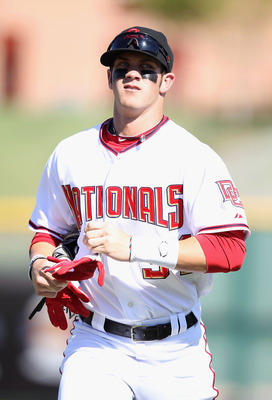
There just isn’t very much to say that hasn’t already been said about Harper. He is, in our opinion, the greatest offensive prospect in history, and he is second only to Strasburg in terms of history’s greatest prospects. For an 18-year-old, Harper was insane in 2011. He slashed .297/.392/.501 on the year across two levels including 37 games in Double-A. He went deep 17 times and stole 26 bags. He has no weaknesses aside from a lack of familiarity with professional secondary stuff, as his 87 strikeouts suggest. Nevertheless, he is a quick learner and has already softened his stride to account for better breaking pitches.
He followed up the Double-A season with a terrific 25 games in the Arizona Fall League, posting a 1.034 OPS and going deep six times. Perhaps the most impressive aspect of Harper’s professional debut, though, was the fact that he seemed so comfortable being at the levels that he was. The Sally League is no joke, and obviously an 18-year-old in Double-A is something to take note of. He showed some flexibility in the outfield, collecting some innings in center as well as right. His bat plays anywhere, but can you imagine a homerun champ in center? He’d be Griffey Jr. And that’s exactly what we think of Harper.
He can be one of the greatest players in the history of the sport. We expect him to return to Harrisburg to open 2012, but no one would be surprised if he is quickly promoted to Triple-A and ultimately finishes the year in Washington. We expect him to open 2013 in the Nationals outfield and to basically retire there 15 years or so down the road after winning several MVPs.
 March 9, 2012
|
Posted by Mike Rosenbaum
March 9, 2012
|
Posted by Mike Rosenbaum











Recent Comments