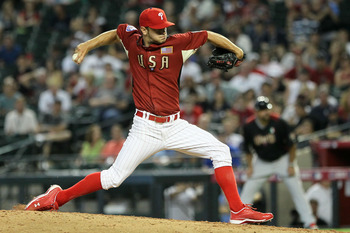
This report is written under the assumption that Cosart will start in the Majors instead of relieve, as some suggest he is better equipped to do. Cosart, alongside stud hitter Jonathan Singleton, was dealt at the deadline for Hunter Pence by Philadelphia. Cosart immediately became the top-pitching prospect in the Astros’ organization and features a 95-97 mph heater that can jump up to 99.
His secondary offerings are at least 50s in terms of stuff, but he does not command them well enough to use in high volume. At this point, his changeup is a 55 and the curve is a 50 with good shape when he works in front of his body with it. Cosart has a 6-foot-3 frame with room to add some bulk. His mechanics range from clean to jerky, but he is athletic and has time to gain consistency with them.
As far as stats go, 2011 was up and down. He absolutely dominated through the middle of June, got shelled for a month and a half or so, was traded, and finally was promoted to Double-A where he was bad. On the year his numbers are pretty meaningless, but he was able to keep his ERA near 4.00, take the ball in 26 starts, and strikeout over 100 guys in nearly 145 innings.
I personally don’t see a lot of reason to give these stats too much consideration, though, since his season was so full of off-the-field distractions that he could not control nor impact. Regardless, Cosart’s position in our top 50 is based on his arm, age, level, and likelihood of assuming a top-of-the-rotation spot within five years.
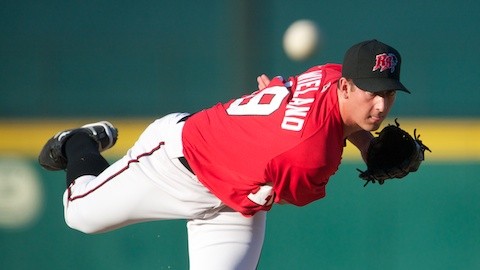
Joe Wieland was part of the deal that sent Mike Adams to Texas, and considering how valuable Adams was to the bullpen in both San Diego and Texas, Wieland is obviously viewed as a future Big League contributor. We at The Sombrero will go a step further. Wieland will be a top of the rotation arm for years. We are talking a solid two in the Show.
His stuff isn’t as imposing as other arms that will crack our top 50, but his command is outrageously good. He walked 21 guys over 150 innings in 2011 for Christ’s sake. The strikeout totals were nearly one per inning, and he did a solid job keeping the ball in the yard as well.
Wieland should start the year in San Antonio, but he should move quickly to Triple-A. There is a very real chance he cracks the rotation in San Diego by the end of 2012. His fastball reaches 93, and his breaking ball is of the 12-6 variety with quality shape. Both pitches are solid average to above on their own, but Wieland’s command plays each pitch into the 55-60 range. His changeup is not used as often, but it has decent fade and should be a solid 50 pitch. Wieland has an athletic 6-foot-3 frame and very clean and easy mechanics that should allow him to stay reasonably healthy. This is not an ace arm, but it is the kind of No. 2 that every team wants.
 November 9, 2011
|
Posted by Mike Rosenbaum
November 9, 2011
|
Posted by Mike Rosenbaum













Recent Comments