Major League Baseball | The Golden Sombrero Baseball Blog | MLB, Fantasy, College & High School Baseball News

Posts belonging to Category Major League Baseball


Catch My Drift?

April 15, 2010

taylor After a most unpredictable and exciting first week and a half of the Major League Baseball season, I’ve noticed a trend that has become all too clear to GMs and fantasy owners alike.  They wish that they had Joe Mauer and his sweet, sweet 1.167 OPS%.  During the off-season, Mauer and the Twins inked a 8yr/$184mil contract that essentially made him a Twin for life.  Yes, that is an obscene amount of money, but why not?  Who wouldn’t shell out the big bucks for a 6’4”, 5-tool, left-handed hitting catcher? However, Mauer’s greatness also brings to light a vast discrepancy in the quality of catchers across the league.  In both the AL and NL Central, there are too many teams receiving little or no production from their catcher(s).  Yes, I know that it’s early in the season and I sympathize with how constricting and relenting the cold can be, but I am not surprised by the specific catchers that are struggling.  Some have been over-hyped while others have fallen victim to the minors.  Some are just too old.  I guess that what I’m really trying to say, is that I’m sure Brad Ausmus is feeling pretty, pretty, pretty, pretty good about being on the DL to start the season .

NL Central
Cubs:
Should we really attribute Geovanny Soto’s highly disappointing 2009 campaign to the “sophomore slump,” or do the Cubs have a greater problem on their hands?  Soto’s slow start to the current season is reminiscent of his slow start last season that ultimately resulted in a .218/.321/.381.  Entering Wednesday, Soto was just 2-for-15(.133) with no extra base-hits and three walks.  The Cubs don’t seem to have the patience that they did last year with Soto; Koyie Hill was given consecutive starts on Thursday and Friday in lieu of Soto’s lack of production.  In those two games Hill went 1-for-6 (.167), which means that Cubs’ catchers are hitting a combined .143.  But wait, it gets worse.  Neither Soto or Hill have an extra base hit and neither have tallied an RBI.  In 2008, Soto carried the Cubs on his back into the postseason and it seems as though he will need to do so again this year.  On a personal note, Soto is the skidmark on my fantasy team; he’s really making me look an asshole for expecting immediate results.

Astros:
As Griff alluded to in his previous article, this is going to be a painful year for the Houston Astros.  Rather than trying to solve any of their offensive deficiencies, the Astros deemed it best to sign RP Brandon Lyon to a 3yr/$15mil contract. After trying to produce a homegrown catcher for the better part of a decade(with minimal success), when do you give up?  Apparently, not quite yet.  Former top prospect J.R. Towles was given the opening day nod(by default) and has done nothing to prove that he deserves it.  Prior to Wednesday’s games Towles was 1-for-16(.063) and yet to draw a walk.  Towles initial struggles prompted the Astros to mix in Humberto Quintero, who has only responded by hitting .111.  Much like the Cubs, the Astros’ catchers are yet to drive in a run and seem highly unlikely to do so with any consistency.  I’m tired of seeing them play catcher roulette every season.  On the bright side, Jason Castro is lurking in the minors and seems destined to assume the catching duties at some point this season.  For the sake of Asros’ fans, let’s just hope that it is sooner rather than later.

  • Over the past three seasons, former teammate and catcher for my high school team, Jon Fixler, has given himself a name within the Astros organization.  Currently playing for the Lexington Legends(A), Fix reached Chorpus Christi(AA) last season after showing continual improvements and an ability to adapt to each level.  I also recently learned that he has a blog, through the Astros, where he reflects on his Minor League experiences.

Brewers:
Is it me, or are the Brewers just reusing and recycling veteran catchers?  With Jason Kendall’s reign of terror over Milwaukee complete, I would have liked to seen the Brewers stray from the path of employing another old, irrelevant catcher.  But of course, they signed Greg Zaun.  It could have gotten really crazy had the Cardinals not resigned Jason LaRue for the season.  Headed into Wednesday, Zaun’s 0-for-18 with two walks has been a black hole in an otherwise productive, Brewer lineup.  In an effort to ignite the lower third of the lineup Ken Macha has given George Kottaras increased opportunities to step up.  Kottaras has produced a .167/.250/.167 line that just screams, “Eat your heart out J.R. Towles!”

AL Central

Indians:
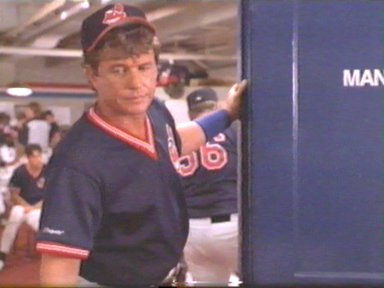
Where is Jake Taylor when you need him?  Although, at his age, I suspect that his level of production would rival those of Zaun and Kendall. That would have to be better than the Indians’ atrocious Marson/Redmond tandem, right?  Marson entered Wednesday’s action rocking a dismal .077/.143/.077, which makes Redmond’s .182/.250/.273 seem acceptable.  If you didn’t know already, the Tribe is just laying low before they unveil their coveted, catching-phenom Carlos Santana.  I’m really excited for that to happen, whenever it does, but for the time being, rough.

Tigers:
I’m going to go relatively easy on Gerald Laird because I still think he is a great, overall catcher.  However, he doesn’t have to report to me with that .056 batting average.  It is clear that Tigers are scheming over their catching situation based upon their choice to include Alex Avila on the opening day roster.  In his 69 career at-bats with the TIgers, the 22 year-old Avila has posted an impressive .910% OPS.  Avila could be a nice fantasy addition within the next couple weeks for those that have any of the players I just hacked into.
My Current Thoughts on Hitting

April 15, 2010

Recently my thoughts on hitting have been addressed in other blogger’s pieces.  While I certainly don’t take offense to these allusions, I feel as though it is necessary to explicitly state my current hitting philosophy.  Before I begin, however, I must make perfectly clear that, like all philosophies, my thoughts on hitting are perpetually evolving and truly quite fluid in time.  To think that it has taken me twenty years and countless influences to develop the philosophy to which I currently subscribe reminds me of how far the game has travelled and that where it is going can scarcely be imagined.

Let’s begin.  We must first define hitting before we can explore it.  Hitting in its simplest terms must reflect in some way the ultimate goal of run production.  Since only a single player can be the hitter at any given period of the game, hitting therefore is the individual act of run production while in the box.  How does an individual influence run production while at bat?  The only way to score without the assistance of teammates essentially is by going yard.  I would certainly call that the best result.  Since this is a rare occurrence, we must address ways to score that eventually involve teammates.  The only way to score is by not getting out.  If a player is out at any point along his way to home, he cannot possibly score.  Therefore, the goal of hitting must be to prevent getting out.  Implicit in this statement is the act of prevention.  Already we notice a flaw.  Hitting the ball requires a great deal of positive action, so beginning with a negative inevitably results in conflict.  We will address this more completely later.  For now, we will simply continue understanding that homeruns are best, and getting out is failure.

What must we do to accomplish the first goal?  Homeruns are products of bat speed, bat path, and contact.  Contact means both the area on the bat striking the ball as well as the point in the swing where contact takes place.  Ideally, force will be greatest at a position in which the ball strikes the “sweet spot” of the bat.  This area is defined as the portion of the bat that produces the least mechanical vibration and varies with the bat.  These vibrations are basically wasted force that could have been transferred to the ball that is instead being transferred elsewhere.  In terms of body position, we find the greatest force to be created with the hands at the plane of the lead hip and with the lead triceps contracted while the rear biceps contracted.  We desire a lead leg with the quadriceps contracted and a rear leg with the hamstring contracted.  What we find when these all take place in unison is a head in line with the rear thigh and torso.  The torso will rotate as a product of these factors, but I prefer not to think of hitting in terms of rotational vs. linear.  Hitting is a combination and a rejection of these absolutes all in one. The goal of the lower half is to drive as much mass forward as possible as rapidly as possible, thereby maximizing the force we generate.  Bat speed comes nearly entirely from the lower half when it is used to its fullest.

Bat path is the concern of the upper half.  Ideal bat path is one headed downward from a position above the strikezone.  Logically in order to travel downward, we must begin from above, so to cover the zone, we must begin above it.  Because force depends on acceleration as well as mass, we must take the most linear path we can to the ball while staying inside of it.  We must stay inside the ball with our hands in order to strike the ball on the sweet spot.  So, the hands must begin above the ball, travel downwardly to it, and stay inside enough of it to strike with the sweet spot.  These are the only roles the hands play.

The pre-pitch goal of the body is to establish our weight to be transferred as well as reduce frictional coefficient.  Since the coefficient of static friction will always be higher than that of the active coefficient, in order to overcome resistance, we must begin our swing with a body in motion, upper and lower.  This way we can accelerate more quickly in our path to contact.  When people speak of “loading,” they simply are using baseball vernacular to describe a decrease in friction and a maximization of mass to be accelerated.

Vision is absolutely essential to contact.  Since the ball spends so little time in flight, it is a quite a tall order to expect the eyes to relay perceptions to the cortex and make adequate adjustments.  Asking for these same adjustments with eyes drifting excessively makes this request practically impossible.  Generally speaking, I prefer a relatively quiet load for this very reason.

When do we load?  Since the goal of the load remains to eliminate friction, ideally there exists no temporal separation between the end of the load and the initiation of the swing.  An average fastball will call for a load whose termination approximates release.  However, we notice immediate contradictions in the case of off-speed pitches.  This is another reason why a quiet load is preferred.  Forceful loading likely leads to a forceful stride that inevitably causes the hitter’s front half to leak resulting in a reduced contraction in the lead leg quadriceps and a drifting axis.  A drifting axis of the swing will be the end result, and bat speed will be dramatically reduced.  Quiet loads allow weight to stay loaded longer.

I never place much emphasis on following through.  Personally, I believe an acceptable follow-through is simply one that is the product of everything happening correctly up until and including contact.  Because the hands must take a linear approach to the ball, however, single-handed follow-throughs are ideal since a two-handed follow-through would be the result of an angled approach to contact.

The strategic portion of hitting is unique in sports.  It demands awareness, discipline, concentration, and resilience.  Hitting is comprised of both an offensive and defensive component despite the illusion that it is purely offensive.

The offensive component is essentially everything we have discussed in the previous paragraphs.  Generation of maximum bat speed allows the hitter to aggressively attack the pitch.  Making contact is a challenge, however, and every single swing that has ever been taken by anyone has been at some level a compromise.  No player can actually swing at 100% and still make contact.  The hitters with the most power tend to come closest, but they tend to swing and miss more frequently.  Immediately we notice the inherent tradeoff occurring with every swing.  Hitting for average is basically the defensive component of hitting while hitting for power is the offensive.  Strike-zone judgment is at least equally important to these two components, and I think it belongs in both the offensive and defensive categories.

If all three of these features were utilized cohesively, the hitter would only hit strikes and every space of the strikezone would be coverable with bomb potential.  No one can do this.  Awareness of this impossibility is where the mental side of hitting begins.  It is really quite simple.  As hitters develop, they tend to improve all three of these aspects.  They tend to cover more of the zone, hit the ball harder, and exercise more discriminating taste in pitches.  When others have mentioned my affection for walks, it is because I recognize that walking is a manifestation of a skill just as valuable in terms of player development as bat speed.  Getting on base is forever the goal. I am not suggesting that getting hits is secondary to walks.  I am suggesting that hits are a manifestation of a different type of skill, not completely independent, but not necessarily intertwined with strikezone discipline.  The combination of these skills is the goal, and all are equally important in terms of developing as a hitter.  Statistically power is the least important in terms of run production, but the skills necessary to hit for power begin with hitting for average, so suggesting that power is less important that average is flawed.
The reason for not attacking the first pitch, in my opinion, is not because it is not a great pitch to hit.  The reason for not attacking it, especially a first-pitch fastball, is that the box is a different environment.  No matter how great a hitter is at preparing in the dugout and on-deck circle, he still is not entirely familiar with the view he will have at the plate.  Taking the first pitch provides the hitter with information unattainable in any other environment that certainly will prove useful in the immediate future.  Are some pitches too good to take?  Occasionally.  Answer me this, though.  Would you be better off with that pitch had you seen one similar to it from the box shortly prior to it?

Absolutely.

That being said, on-deck work is an absolute imperative.  Understanding what pitch the opponent thinks is his best as well as his worst provides a great deal of information about pitch sequences.  Hitters are often told not to think like pitchers and just to drive the ball, but it is far easier to hit a pitch when the hitter knows it is coming.  If a guy throws his 3rd pitch 5% of the time, why would he throw it in any key situation?  He clearly has little confidence in it.  If he has not thrown his second pitch in the zone in 20 pitches, why would he throw it behind in any count?  Now that you know what is coming, go hit his fastball to the moon.

And finally, pitch counts.  The skills required to relieve are less than the skills required to start.  Getting into a team’s bullpen early should be the goal of the starting nine every single game not just because it helps win the current game, but also because it taxes the team’s bullpen for the next game in the series and possibly for the remainder of the series.  Strike zone discipline is the primary skill involved in taxing pitchers.

Like I said, this is how I think about hitting today.  It was not necessarily the same yesterday and may not be the same tomorrow, but any amendments will be the result of a lot of thought and a lot of experience.  Hitting is an American treasure, and I invite everyone to develop your own philosophies and ideas regarding it.  No two hitters are alike, and that in many ways is the fun of hitting.

Why Didn’t They Just Walk Casey? The use of the intentional walk in Major League Baseball

April 14, 2010

casey

Saturday night, in the bottom of the 14th inning with the Padres up one run on the Rockies, manager Bud Black had a decision to make.  There were two outs and the tying run was on second.  Ian Stewart was at the plate and Chris Iannetta was on deck.  Black decided to walk Stewart, putting the winning run on base, and pitch to Iannetta (even though Iannetta had already gone deep in that game), who struck out to end the game.  He looked like a genius at the time, but things could’ve been much different had Iannetta ripped a two-RBI double down the right field line to win it.
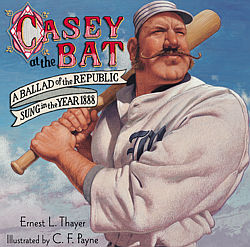
This reminded me of Ernest Thayer’s famous 1888 poem, “Casey At the Bat”.  For those who don’t know it, it can be found here.  The story details a team down by two runs with two outs in the bottom of the ninth inning.  Two weak hitters proceed to hit a single, then a double, which brings up the star hitter, “Casey,” with the tying run in scoring position and two out.
We all know how the story ends.  But what might a major league manager have done in this situation?  If he’s 2009 Manager of the Year Jim Tracy, he might have walked Casey.  And this seems to make sense.  First base was open and Casey represents the most feared hitter on the team, if not in the game.  In addition, Casey was likely a big, strong home run hitter built like Jason Giambiit’s unlikely that he had even average speed, and so he may not even have been able to score on a double from the next hitter.  What’s not to like?

The first thing not to like is that an intentional walk increases the expected number of runs scored in any inning (Source: Baseball Prospectus at http://www.baseballprospectus.com/statistics/sortable/index.php?cid=68778), regardless of how many are on base and how many are out.  Of course, this doesn’t mean it’s never a good idea—sometimes the hitter at the plate is significantly better than the one on deck, and sometimes the extra 1/3 of a run (or so) that the walk creates would be nearly meaningless to the outcome of the game.  In the top of the ninth, with the pitching team down a single run and with runners on second and third with two outs, an intentional walk does not hurt the pitching team in any significant way, because if that run were to eventually score, it would mean the difference between having to score three and four runs in the ninth inning—a scenario so unlikely anyway that only a small difference in ability between the on-deck hitter and the hitter at the plate would prompt an IBB.

Steven Biel did an analysis here: http://bleacherreport.com/articles/320766-rating-the-managers-by-intentional-walks of intentional walks issued in 2009, and he ranked the managers by how often they issued intentional walks that had no statistical chance of improving the pitching team’s chance of winning.  For this analysis, I care less about the manager and more about the aggregate picture of the walks issued.  In 2009, there were 1179 intentional—roughly one every two games.  Biel’s very conservative analysis (done with the help of Baseball Prospectus’s run prediction indexes) showed that 246 of these provided no help to the pitching team.  This is an amount in excess of 20%.  More than one in five times where the manager decides to go to the well with the intentional walk, it is a mistake.  Further, with 246 “bad” IBBs in 2,431 games in 2009, this means that once in every ten games (well over once per day) a manager is making a mistake and putting his team at a disadvantage by allowing another runner to reach base.

So to answer my own question earlier, issuing an intentional pass to Casey might have worked out all right.  But considering that Casey was probably batting in the #3 spot, walking him would have put the winning run on base with the cleanup hitter at the plate—likely providing a much better opportunity for joy in Mudville than the opposing team did by taking their chances with Casey.  However, Biel’s analysis suggests that many of the 30 major league managers would have chosen to walk Casey, as Bud Black did most recently on Saturday, April 10.  Taking into account the number of intelligent people in the United States who would leave well-paying jobs today for a chance to make $10 an hour as a major league manager, it does seem strange that managers so often make the move to put a runner on base when it makes no statistical sense to do so.

Why It Sucks To Be An Astros’ Fan

April 12, 2010

killerbs

As an avid, lifelong, true Astros fan, I have experienced bliss as well as turmoil.  It was only 5 years ago that the ‘Stros found themselves in the World Series.  Yet there is now a putrid taste in my mouth when I think of my beloved big league club.  How could this be?  What went so wrong that only 5 years removed from winning the NL pennant, Houston is now ranked as one of the worst organizations in professional baseball?
For starters, we can look at a couple declining stars.  While it hurts me to even utter these words (let alone type and post them for all to see) Lance Berkman and Carlos Lee are finally on the downhill track of their careers.  The Puma is always a health concern, even managing to find himself on the DL before the 2010 season even started.  2009 was the first season that Fat Elvis fell short of the 600 PA plateau since 2005, and only the 3rd time since he became an everyday player.  Secondly, his WAR, according to FanGraphs, tied a career low at 3.2 (as compared to previous years in the 6’s.)  While his BB rate increased last year from 14 to 17%, his K rate has been on the rise since 2005.  It made a jump from 15.4% in ’05, to 19.8% in ’06, and has continued to hover at, or above, the 20% rate since then.  All of this, along with the fact that Berkman is not getting any younger (he is 34 this year) tells me that we may be seeing the beginning of the end for the Big Puma.

Then there is Carlos Lee.  By most accounts, El Caballero had a tremendous season last year.  There are just a few stats that concern me.  The first being his O-swing%, or percentage of balls swung at outside of the strike zone.  This number stands at a gaudy 36.6% for last year; a whopping 13% above his career average.  The next problem I have is Lee’s isolated power.  Last year C. Lee posted a paltry .186 in this department.  You can chalk some of this up to age, (he turns 34 this June) but when you play in one of the most hitter friendly parks, Minute Maid, it makes you wonder a little. Even if you don’t want to look at the numbers, face the facts that most big leaguers do not have very successful careers once they reach the age of 34-35; including Berkman and Lee.

Well what about the guys we have coming up?  Sure there is Wandy and Pence, and maybe even Bourn will work out. (I am a big Bourn supporter despite what most critics predict.)  Ok, sure those are a few guys who have the possibility to be studs for a while.  But for those few guys, there are the J.R. Towles (a busted stud), Tommy Manzella (a 27 year old “prospect”), of the organization who have not panned out.  Sure, Houston is devoting new time and efforts into finding quality prospects internationally, especially in the D.R., but only time will tell how that works out.  For now, we are stuck with what little we have on the farm.
To top it off, we go and make Brandon Lyon one paid motherfucker at 15 mill for 3 years.  Why give that kind of money to a guy who has only had one season of 15 saves or more, has a career ERA of 4.23 as a reliever, and has never shown dominant stuff on the hill?  I don’t know why, and there may be more to it, as Mclane has shown that all these oddball signings come off the book at the same time in a few years.  But until then, we will have to settle with that putrid taste, and have to do enough other things during the summer to help reduce the strength of that taste.  One.

Gallardo a Steal?

April 11, 2010

gallardo

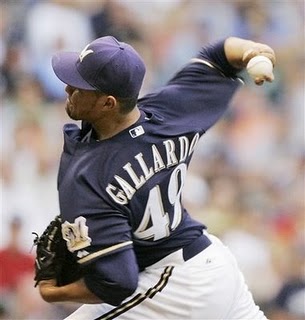
Yesterday Milwaukee inked 24-year old Yovanni Gallardo to a five-year deal worth a minimum of $30.1 million and potentially as much as $42.5 million.  The deal could keep Gallardo a Brewer through 2015 if the club so chooses.  The deal is really quite novel in that it provides both the Brewers and Gallardo a number of incentives, such as parameters regarding which teams Gallardo could potentially be traded to as well as bonuses based on Cy Young voting.  While Cy Young voting is a rather subjective way of distributing payment, the clause at least provides the Brewers some level of merit-based control on their checkbook.  Compared to the contracts awarded to a few of Gallardo’s peers such as Justin Verlander, Tim Lincecum, Felix Hernandez, and Matt Cain, Jon Lester, and Zack Greinke this deal comes off looking rather genius for the Brewers.  The question, though, lies in whether or not Gallardo can justify being considered a peer of these elite young righties.

Last year Gallardo cracked the 200-strikeout milestone for the first time in his career while making 30 starts for the first time as well.  Considering that he was coming off a season shortened by knee surgery in 2008, 2009 was a significant step in the right direction.  He still failed to reach the 200-IP plateau, but in many ways I consider that a good thing for the Brewers considering they were fully aware that they would ultimately miss the playoffs relatively early in the season.  Why not manage their young ace conservatively if he is basically just practicing for next year?

How about his stuff?  The wrap on Gallardo since he was a flame-throwing yet erratic high schooler has been that he lacks a developed third pitch.  I’m not sure that remains the case.  He still tends to favor his fastball (95+ whenever he needs it)/curve (at least plus, sometimes plus-plus) duo, but his changeup has made considerable strides since Gallardo reached the Bigs in 2007.  Still, he does not use it enough.  Gallardo’s high ¾ release point and carry on his fastball, when coupled with Miller’s short porch, tend to drive a lot of balls to the seats, but that same carry allows Gallardo to pitch at the letters a little more often, especially to righties, in order to generate strike 3.

Delivery?  It sounds like Milwaukee extensively analyzed Gallardo’s delivery to determine if anything about it would lead to career-threatening injuries later on.  From the sounds of it, Gallardo checked out nicely.  Personally, I think he fights to create a downward plane more than someone with his build and athleticism should, – primarily by using his front side to “climb” – but that same athleticism probably allows him the necessary leeway he needs to do it.

So why am I not convinced?  Gallardo is not efficient.  His K/BB is the worst of the pitchers I mentioned earlier as potential peers, he has thrown the fewest innings, and he has had a major surgery already.  Still, with the way his contract is structured, the Brewers have provided themselves with a situation that will provide Gallardo incentive for finding ways to solve these problems.  I think he has the stuff, athleticism and organizational support to really make a run at a few Cy Young Awards, and that would help both Yovanni and the Brewers.