College Baseball | The Golden Sombrero Baseball Blog | MLB, Fantasy, College & High School Baseball News

Posts belonging to Category College Baseball


Ricketts Park: A True Diamond in the Rough (Part I)

April 25, 2010

ricketts

My first full season as a high school baseball coach has finally come to an end.  For the grand finale, we were able to hook the C-teamers up with a dream come true…playing at Ricketts Park.  They got the whole deal, including pre-game batting practice on the field.  Watching the grins roll across those 8th and 9th graders faces reminded me just how special Ricketts is.  I couldn’t help but smile too, seeing as how this was my first time coaching on Ricketts as a Scorpion.  It is that unforgettable feeling, that you can only get when you play baseball on Ricketts, which is acting as the inspiration for this piece.
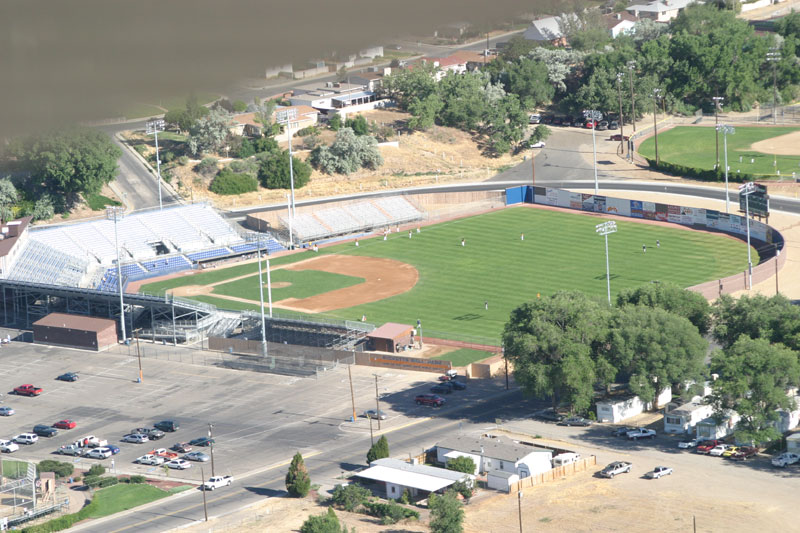
Growing up in Farmington, New Mexico has allowed me to enjoy one of the greatest treasures that baseball has to offer, Ricketts Park.  For those of you who are unfamiliar with Farmington, or Ricketts, let me tell you about this ball field.  It is a spectacular yard.  Its dimensions are 330’ down the lines, 370’ to the gaps, and 400’ to dead center.  The wall is approximately 20’ tall, give or take a few feet.  The outfield walls are covered with two rows of signs advertising for local businesses.  Surrounding this field is a stadium setting, similar to a spring training or minor league yard.  The seats extend from behind home plate, down the lines, but not all the way out to the fence.  Seating is arranged in two tiers.  The lower tier has actual stadium seating, while the upper tier is comprised of bleacher seats.  The stadium holds over 6,100 people at full capacity.  If you would like to see larger pictures of this high-desert oasis, please click on each individual photo:

ricketts1
ricketts2
ricketts3
field

Ricketts Park holds a special place in a local baseball player’s heart.  As a young child, it is where you can go with your family to watch big kid baseball.  As you age, and enter high school, it becomes your goal to make the varsity squad and play and practice on the field daily.  At age 16, you have your first chance to play in the Connie Mack summer league whose games are played on Ricketts.  And if you win that summer league, you are invited to partake in one of the greatest amateur baseball tournaments this world has to offer…The Connie Mack World Series.  Teams from all corners of the nation come together in Farmington, for one week, and play on Ricketts in front of a packed house until a champion is decided.  It is one of the greatest weeks of the year for me, as well my fellow blogger, Dee.  See, Ricketts means something special to baseball players in Farmington, New Mexico.  Every age group sees something special about the place.  It is a diamond in the rough.  It is THE landmark of the entire city.  Ricketts Park is baseball.

This is simply an introduction.  It is the first in a series of pieces on Ricketts Park, and what it means to a kid who grew up playing baseball in little, old, podunk Farmington, New Mexico.  I feel truly blessed to have this baseball field in my hometown.  Hopefully, piece-by-piece, I will allow you to experience the joys of baseball at Ricketts vicariously.  Hopefully.  One.

Thinking at the Plate

April 22, 2010

A lot of coaches, fans, parents, friends, and critics talk about the elimination of thinking during at-bats. In some respects I have no room to argue. Thoughts, typically those deviating from the task at hand, are simply distractions and ultimately lead to inefficiencies likely resulting in a slow bat. However, I have found through playing, coaching, and fan-ing that certain types of players simply cannot shut down their thoughts. Ever. When these players are slumping, it is common to hear critics suggesting that these players are “thinking too much.” That very sentence demonstrates an unreasonable and useless analysis and critique of the given player because the suggestion is impossible to carry out. Even the most dimwitted player is at least awake and is therefore thinking on some level at the plate.  While I cannot argue that baseball has its fair share of morons, it has its share of geniuses too. It has its compulsives as well.

So what do you tell a young player who is clearly not allowing himself to function because he is too caught up in the ticks and routines that he has developed over time? What do you tell the player that is concerned with his statistics, or his role, or anything other than the ball and the release point?

I have been lucky to coach a player that I feel has a lot of the same concerns that i did as a player, and it has led me to some conclusions about managing a cerebral player of that fashion. First and very foremost, it is imperative to understand that players of this type cannot and will never stop thinking. The suggestion to do so is both insensitive and illogical and represents a respect-less and erroneous opinion of the game and the player. I have had success with this player by suggesting to control thoughts and aim them in different directions. By taking the reverse route and suggesting to think equally as much if not more, the player does not begin by addressing a negative but instead by embracing and utilizing a positive. The advantage that intelligence has over stupidity is that it provides awareness. A player capable of understanding simple logical schemes like release point variations and scouting charts can provide the cerebral player with key advantages.

For example, by focusing thoughts on a pitcher’s release point, players well-versed in critical analysis are capable of noticing deviations from normal patterns and may stand a better chance of recognizing off-speed stuff. The same applies to running bases. Even bench players can pick signs and find creative ways to deliver them to teammates such that the other team may never catch on. One weekend at Grinnell we had another team’s signs from the fourth pitch until the last one of the series. When we met the following season, we had them from the first one until the last.

Intelligent players may understand that emotions tend to be controllable on some levels, and that player may have noticed that he tends to perform better in certain emotional states. His ability to recreate this emotional state may be the highest level of of thinking we have as athletes because it essentially allows us to begin controlling our nervous system and hormonal output. Through the use of certain stimulus such as music, movies, movements, dietary patterns, or conversations, players possess the ability to arrive at their own favorite emotional state for a game. Intelligent and aware players understand more how to control these patterns.

Never before have we had such extensive and readily available research regarding the game and how best to play it. Moneyball had a monumental effect on the style of play I exercised on the field. The game has come a long way since then too. Nowadays players have access to so much literature that can help them develop. The interested and intelligent ones have at their disposal countless theories to utilize, but very few actually will explore these mediums. The intelligent ones have quite the leg up in this regard.

I’m not trying to say that dummies don’t have their place in the game. My point is simply that intelligence is by no means a disadvantage. It is traditional for the field to be a place of inclusion, and because it is more acceptable for smart individuals to dumb down than it is for stupid folks to “smart up” the game between the lines has traditionally been dumbed down. That is why it took a century to discover that a proficiency for avoiding outs would inevitably lead to runs. Intelligent players must embrace their talents instead of hiding them. By focusing thoughts in useful and advantageous directions, smart players are exercising a unique skill arguably as valuable as any other of the five traditional tools.

My Current Thoughts on Hitting

April 15, 2010

Recently my thoughts on hitting have been addressed in other blogger’s pieces.  While I certainly don’t take offense to these allusions, I feel as though it is necessary to explicitly state my current hitting philosophy.  Before I begin, however, I must make perfectly clear that, like all philosophies, my thoughts on hitting are perpetually evolving and truly quite fluid in time.  To think that it has taken me twenty years and countless influences to develop the philosophy to which I currently subscribe reminds me of how far the game has travelled and that where it is going can scarcely be imagined.

Let’s begin.  We must first define hitting before we can explore it.  Hitting in its simplest terms must reflect in some way the ultimate goal of run production.  Since only a single player can be the hitter at any given period of the game, hitting therefore is the individual act of run production while in the box.  How does an individual influence run production while at bat?  The only way to score without the assistance of teammates essentially is by going yard.  I would certainly call that the best result.  Since this is a rare occurrence, we must address ways to score that eventually involve teammates.  The only way to score is by not getting out.  If a player is out at any point along his way to home, he cannot possibly score.  Therefore, the goal of hitting must be to prevent getting out.  Implicit in this statement is the act of prevention.  Already we notice a flaw.  Hitting the ball requires a great deal of positive action, so beginning with a negative inevitably results in conflict.  We will address this more completely later.  For now, we will simply continue understanding that homeruns are best, and getting out is failure.

What must we do to accomplish the first goal?  Homeruns are products of bat speed, bat path, and contact.  Contact means both the area on the bat striking the ball as well as the point in the swing where contact takes place.  Ideally, force will be greatest at a position in which the ball strikes the “sweet spot” of the bat.  This area is defined as the portion of the bat that produces the least mechanical vibration and varies with the bat.  These vibrations are basically wasted force that could have been transferred to the ball that is instead being transferred elsewhere.  In terms of body position, we find the greatest force to be created with the hands at the plane of the lead hip and with the lead triceps contracted while the rear biceps contracted.  We desire a lead leg with the quadriceps contracted and a rear leg with the hamstring contracted.  What we find when these all take place in unison is a head in line with the rear thigh and torso.  The torso will rotate as a product of these factors, but I prefer not to think of hitting in terms of rotational vs. linear.  Hitting is a combination and a rejection of these absolutes all in one. The goal of the lower half is to drive as much mass forward as possible as rapidly as possible, thereby maximizing the force we generate.  Bat speed comes nearly entirely from the lower half when it is used to its fullest.

Bat path is the concern of the upper half.  Ideal bat path is one headed downward from a position above the strikezone.  Logically in order to travel downward, we must begin from above, so to cover the zone, we must begin above it.  Because force depends on acceleration as well as mass, we must take the most linear path we can to the ball while staying inside of it.  We must stay inside the ball with our hands in order to strike the ball on the sweet spot.  So, the hands must begin above the ball, travel downwardly to it, and stay inside enough of it to strike with the sweet spot.  These are the only roles the hands play.

The pre-pitch goal of the body is to establish our weight to be transferred as well as reduce frictional coefficient.  Since the coefficient of static friction will always be higher than that of the active coefficient, in order to overcome resistance, we must begin our swing with a body in motion, upper and lower.  This way we can accelerate more quickly in our path to contact.  When people speak of “loading,” they simply are using baseball vernacular to describe a decrease in friction and a maximization of mass to be accelerated.

Vision is absolutely essential to contact.  Since the ball spends so little time in flight, it is a quite a tall order to expect the eyes to relay perceptions to the cortex and make adequate adjustments.  Asking for these same adjustments with eyes drifting excessively makes this request practically impossible.  Generally speaking, I prefer a relatively quiet load for this very reason.

When do we load?  Since the goal of the load remains to eliminate friction, ideally there exists no temporal separation between the end of the load and the initiation of the swing.  An average fastball will call for a load whose termination approximates release.  However, we notice immediate contradictions in the case of off-speed pitches.  This is another reason why a quiet load is preferred.  Forceful loading likely leads to a forceful stride that inevitably causes the hitter’s front half to leak resulting in a reduced contraction in the lead leg quadriceps and a drifting axis.  A drifting axis of the swing will be the end result, and bat speed will be dramatically reduced.  Quiet loads allow weight to stay loaded longer.

I never place much emphasis on following through.  Personally, I believe an acceptable follow-through is simply one that is the product of everything happening correctly up until and including contact.  Because the hands must take a linear approach to the ball, however, single-handed follow-throughs are ideal since a two-handed follow-through would be the result of an angled approach to contact.

The strategic portion of hitting is unique in sports.  It demands awareness, discipline, concentration, and resilience.  Hitting is comprised of both an offensive and defensive component despite the illusion that it is purely offensive.

The offensive component is essentially everything we have discussed in the previous paragraphs.  Generation of maximum bat speed allows the hitter to aggressively attack the pitch.  Making contact is a challenge, however, and every single swing that has ever been taken by anyone has been at some level a compromise.  No player can actually swing at 100% and still make contact.  The hitters with the most power tend to come closest, but they tend to swing and miss more frequently.  Immediately we notice the inherent tradeoff occurring with every swing.  Hitting for average is basically the defensive component of hitting while hitting for power is the offensive.  Strike-zone judgment is at least equally important to these two components, and I think it belongs in both the offensive and defensive categories.

If all three of these features were utilized cohesively, the hitter would only hit strikes and every space of the strikezone would be coverable with bomb potential.  No one can do this.  Awareness of this impossibility is where the mental side of hitting begins.  It is really quite simple.  As hitters develop, they tend to improve all three of these aspects.  They tend to cover more of the zone, hit the ball harder, and exercise more discriminating taste in pitches.  When others have mentioned my affection for walks, it is because I recognize that walking is a manifestation of a skill just as valuable in terms of player development as bat speed.  Getting on base is forever the goal. I am not suggesting that getting hits is secondary to walks.  I am suggesting that hits are a manifestation of a different type of skill, not completely independent, but not necessarily intertwined with strikezone discipline.  The combination of these skills is the goal, and all are equally important in terms of developing as a hitter.  Statistically power is the least important in terms of run production, but the skills necessary to hit for power begin with hitting for average, so suggesting that power is less important that average is flawed.
The reason for not attacking the first pitch, in my opinion, is not because it is not a great pitch to hit.  The reason for not attacking it, especially a first-pitch fastball, is that the box is a different environment.  No matter how great a hitter is at preparing in the dugout and on-deck circle, he still is not entirely familiar with the view he will have at the plate.  Taking the first pitch provides the hitter with information unattainable in any other environment that certainly will prove useful in the immediate future.  Are some pitches too good to take?  Occasionally.  Answer me this, though.  Would you be better off with that pitch had you seen one similar to it from the box shortly prior to it?

Absolutely.

That being said, on-deck work is an absolute imperative.  Understanding what pitch the opponent thinks is his best as well as his worst provides a great deal of information about pitch sequences.  Hitters are often told not to think like pitchers and just to drive the ball, but it is far easier to hit a pitch when the hitter knows it is coming.  If a guy throws his 3rd pitch 5% of the time, why would he throw it in any key situation?  He clearly has little confidence in it.  If he has not thrown his second pitch in the zone in 20 pitches, why would he throw it behind in any count?  Now that you know what is coming, go hit his fastball to the moon.

And finally, pitch counts.  The skills required to relieve are less than the skills required to start.  Getting into a team’s bullpen early should be the goal of the starting nine every single game not just because it helps win the current game, but also because it taxes the team’s bullpen for the next game in the series and possibly for the remainder of the series.  Strike zone discipline is the primary skill involved in taxing pitchers.

Like I said, this is how I think about hitting today.  It was not necessarily the same yesterday and may not be the same tomorrow, but any amendments will be the result of a lot of thought and a lot of experience.  Hitting is an American treasure, and I invite everyone to develop your own philosophies and ideas regarding it.  No two hitters are alike, and that in many ways is the fun of hitting.

Battle to the Mistake

April 12, 2010

Plan the work, work the plan.  This is a mantra that I heard over and over again while pitching for the University of Arizona.  Thanks Coach Lopez.  It might be one of the best pieces of advice I have ever heard.  It transcends the baseball field and carries over in to the real-life sector as well.  Regardless, it was the first thing that came to my mind after reading fellow authors Justin Abramson and Dee Clark’s opposing pieces on hitting philosophy.  As a coach, I rely heavily on teaching my hitters to plan their work, and work their plan.  When it comes to hitting, I want them to plan on hitting the mistake.

As a former pitcher, I am quite familiar with what quality hitters do with mistake pitches.  They shit all over ‘em.  It never mattered if it was the first pitch or the 8th pitch of the at-bat either.  It only mattered that the pitch was not where it was supposed to be.  As a hitting coach, I now work to instill this idea in all of my hitters.  I preach, “Battle to the mistake.”  If I were to subscribe to Dee’s philosophy this might mean trying to work a 9 pitch sequence.  On the other hand, if I were to subscribe to Justin’s philosophy, this would mean that I should jump at the first fastball I see in the sequence.  While I tend to be more conservative in my plate approach (I was schooled by Dee in the ideas of plate approach) I still am very fond of seeing a good pitch early and jumping all over it.  Sometimes pitchers will attack the zone early with fastballs to get ahead, and this often times leads to a pitch finding itself traveling over too much of the white, or heart of the plate.  Other times, especially in later or more meaningful at-bats, a hitter may not see a mistake pitch until the 4th, 5th, or even 6th pitch of the AB.  If the latter is the case, the hitter must be disciplined enough to withstand the pitchers attack until the pitcher makes a mistake.

No matter when the mistake pitch is thrown, the hitter must have it in his mind to attack the mistake.  When dealing with high caliber baseball there is usually just one mistake pitch thrown per AB (if that.)  This means that if the hitter neglects to take a chance (swing) at the mistake, he will more than likely end up swinging at a pitcher’s pitch and have difficulty squaring up the baseball, thus leading to a probable out.  This is why it is so important to take advantage of the mistake, no matter when it occurs.  You can bet the farm that you will not get any second chances that AB.  I guess what I am trying to say is that as a hitting philosophy, I believe in hitting the mistake.  All pitchers make them, so why not try to hit the one pitch in the sequence that the pitcher wishes he could get back?  While the more pitches you see tends to give you a higher percentage chance of seeing a mistake, what happens if the mistake is that 0-1 CB that hangs in the zone?  You bang the damn thing.  Just ask Pujols, or Longoria, or any other high caliber hitter in Major League Baseball.  Taking advantages of mistakes trumps any other hitting approach.  So plan your work and work your plan, and battle to the mistake at the dish.  This mentality, or philosophy if you will, will give you the highest percentage opportunity for success.  I’ll put a Griffin Phelps guarantee on that one.  One love, I’m out.

The Next Ryan Braun?

March 26 , 2010

After spending a couple of weeks with Stephen Strasburg this spring, Nyjer Morgan decided to nickname him, “Jesus.”  It seems nowadays like every organization, especially those in dire need of a savior, tout their young prospects as though they will one day absolutely be middle-of-the-order smashers with Ozzie’s skills at whatever positions they play or frontline aces in the Roy Halladay mold.  Consider these names: Dominic Brown, Justin Smoak, Buster Posey, Desmond Jennings, Brian Matusz, Yonder Alonso, Dustin Ackley, Aroldis Chapman, Jason Heyward, etc.  Any club in baseball would/should want any and all of these players.  Remember these names, however, Cameron Maybin, Alex Gordon, Brandon Wood, Delmon Young, Fernando Martinez, Homer Bailey, etc?  It’s easy to understand what drives such lofty expectations with young talent.  When was the last time the Yankees put a decent amount of stock into what any rookie might accomplish?  Joba does not count.  Desperate and poorly funded teams tend to spend a lot more time praying than those who can so easily write massive checks.  It’s almost as though the first mention of a talented player’s careful development and steady promotion leads to Ryan Braun-esque expectations.  Ryan Braun is obviously not on the second list nor do I truly think any player in the minors will one day be as good as Braun is now.  Justin Upton may grow into a similar type of player.  Maybe.  Of all the prospects mentioned, there are three who I think will be all-stars within 5 years.  The others are destined for mediocrity for one reason or another.  Strasburg is in a different class altogether.  He will be Josh Beckett.  We won’t consider him.

The three of interest are Buster Posey, Desmond Jennings, and Jason Heyward.  Why these three?  They walk and make contact.  Both Jennings and Heyward walked as many times as they fanned last season, and Posey was not far off.  These players all possess outstanding athleticism, but in baseball all that truly translates to when young is the ability to learn positions quickly in order to get to the big squad sooner.  Exceptional talent means something different in baseball.  This is not the NFL.  Morons who can run fast and jump high do not necessarily translate into all-stars.  Athleticism never hurts, but it only goes so far in understanding what to expect from rookies.  In 2007 the folks at Baseball America, right before Braun exploded onto the National League scene, ranked Cameron Maybin 20 places ahead of Ryan Braun.  How could they have missed by so much?  Simple.  Bad teams and bad scouts place way, way too much stock into athleticism.  Baseball America is certainly quite reputable, but they tend to see the game as it was and not so much as what it is and what it could be.  Would Cameron Maybin have a better NFL career than Ryan Braun? Likely.  So what?  Big fastballs and fast 60’s mean nothing in the minor leagues and the big leagues.  What does?  Baserunners.  Posey, Heyward, and Jennings already know how to do the most important thing in sports.  Getting on base.  Strasburg already knows how to prevent this.  His fastball/slider combo is dazzling, but the single aspect of his collegiate stats that stand out the most is his otherworldly K/BB ratio.  For baseball purposes, it may make more sense to simply consider it infinity and move on.  Sign them all up now.  Or wait if you have no interest in winning (Braves and Rays).  Either way, when these players do begin their big league careers (Posey’s dozen or so AB’s in September excluded) they will continue to do the things they did in the minors.  Play baseball with the realization that first base is the new plate.

I told a friend in lab today that I would talk a little about the Rangers in my next post since I’m living in Dallas now.  As I don’t want to give the impression that I have anything serious against Baseball America, I will make mention of the fact that they have given Texas the top organizational review for the second consecutive season.  They are absolutely right on in doing so.  Texas has talent in every position, and for the most part it tends to be young.  Their farm system is as stocked as any in the game except possibly Tampa.  All this being said, they are essentially a lineup of question marks.  I project it to look something like this whenever Ron Washington gets off the cocaine and moves Nelson Cruz up in the order.

  1. Julio Borbon
  2. Michael Young
  3. Josh Hamilton
  4. Vladimir Guerrero
  5. Ian Kinsler
  6. Nelson Cruz
  7. Chris Davis
  8. Elvis Andrus
  9. Jarrod Saltalamacchia/Taylor Teagarden

It should look like this:

  1. Michael Young
  2. Josh Hamilton
  3. Ian Kinsler
  4. Nelson Cruz
  5. Vladimir Guerrero
  6. Chris Davis
  7. Elvis Andrus
  8. Catcher
  9. Julio Borbon

There is injury risk top to bottom here, and not very many of these guys have truly demonstrated the ability to get on base all that frequently, but they have ungodly thump here and easily the best lineup in the AL West.  The rotation is worse, but why would a team build around arms in Arlington?  Even so, young guys like Neftali Feliz and Derek Holland possess considerable upside, and Martin Perez, likely the best pitching prospect the Rangers have had this decade, is not too far away from arrival.  These guys catch the ball very well, and the addition of Borbon in center will only prevent more runs.  The Mariners made a lot of improvements this winter, and the Angels are still the team to beat, but I personally think the West will be very tight, and I expect these three teams to be very active in the trading market in June and July.  I think the Rangers have a slight edge if everyone is healthy.  Maybe by a game or two.

I just want to give a shout to young Grinnellian rightfielder, Paden Roder.  His slashes right now read .440/.559/.840.  The Ivy League-bound senior has had quite a career for the Pioneers.  Let’s wish Paden and the other Pioneers a strong finish in Florida free of injuries and full of sun and W’s.