Daniel “Dee” Clark | The Golden Sombrero Baseball Blog | MLB, Fantasy, College & High School Baseball News

Who Are the Highest Profile Players in the 2011 CMWS?

Last year’s Connie Mack World Series featured perhaps the finest collection of amateur pitching the tournament has ever featured.  This group of horses included Lucas Jackson of the Florida Legends (Rangers-supplemental round, 2010), Jake McCasland of the Strike Zone Cardinals (UNM, offered and turned down 2nd round money), Adrian Houser of the Strike Zone Cardinals (Astros-2nd round, 2011), Dylan Bundy of the DBAT Mustangs (Orioles-4th overall, 2011), Dillon Howard of Midland (Indians-2nd round, 2011), Archie Bradley of DBAT (Diamondbacks-7th overall, 2011), and Daniel Norris of the East Cobb Yankees (Blue Jays-2nd round, 2011).  Last year’s pitcher heavy CMWS produced plenty of low-scoring games and a disproportionately high amount of strikeouts.  It was very exciting as a coach and fan to witness these talented arms knowing that a finer group of prep pitchers had likely never been in Farmington before.  Which players have the highest ceiling at this year’s CMWS?

As mentioned previously, the Legends return with new management and a new financial situation, but the talent level is still through the roof led by Albert Almora and David Thompson, both 2012 HS grads and both committed to Miami.  Almora is an easy plus hitter with terrific speed and an arm capable of a RF job professionally, where his foot speed will play up a bit.  Almora has a projectable frame and enough loft in his swing currently to hit for plus power in the future.  Long story short, I highly doubt he falls out of the first round come June.  Thompson is a tougher player to call because he likely will be a 3B in the pros despite playing a number of innings at both left-side infield spots as a prep player.  He may not have the arm to be on the left side of the infield professionally, but his hit and power tools are both good enough to slide to left.  Personally, I’d prefer that he gets a shot to stay at short until he absolutely must move, but that’s how I feel about just about everyone who has even a semblance of a shot to stay at short.  Thompson is easily one of the best rising seniors in the United States.

Midland is bringing a pair of giants who both project as top of the draft arms in 6’8” lefty Matt Smoral (committed to UNC) and 6’10” righty Taylore Cherry (also committed to UNC).  Cherry and Smoral can both reach the mid-90s with live fastballs with good bite on breaking pitches.  Cherry throws more of a 10/4 or 11/5 true curveball while Smoral throws a low to mid-80s slider due to a lower slot.  Both are good athletes who repeat their deliveries well, and those bodies are worth millions in signing bonus dollars, although Smoral has the more projectable build. Both pitchers will be heavily scouted this year prior to the draft, and Farmington is sure to appreciate their quality arms.

DBAT righty Jack Moffitt can reach the low-90s with his fastball with great arm-side action and good command.  His delivery is clean and consistent with an athletic ¾ slot.  His curveball is tight and more of the 11 to 5 variety.  His changeup is behind the breaker, and he tends to slow his delivery a bit with it, but it has a chance to be an effective third pitch.  Rising junior infielder Niko Buentello is also an exciting young player with a lot of upside in the field and with the bat.  He is the only 16-year old on the DBAT club and one of the few in the entire tournament.

The Strike Zone Cardinals possess a potential helium guy in Shilo McCall. McCall turned a lot of heads when he ran a 6.6 60 at the Perfect Game Nationals as a 6’1”, 205 lb. 16-year old.  He will be one of the youngest draft eligible players at the CMWS and nationwide.  His hit tool and power tool are very strong with a lot of projection.  Shilo’s arm is at least a 50 now with a chance at a 55-60 in the future, which means he could slide to right as well.  Shilo has quality makeup and the talent and head to achieve a lot in the game.  He is without question the best position player Farmington has produced since Casey Andrews (FHS 2001) and quite possibly the best yet.

The CMWS has helped launch the careers of a lot of young players as they attempt to take their games beyond the prep ranks, and 2011’s tourney will surely be no different.  The Series is not typical of national recruiting events because the scores of the game actually matter.  The national showcase circuit has its pros and cons, but the biggest con is the fact that there exists no team atmosphere at many of these events.  Baseball is a sport to be won and lost as a team beyond anything else, and the CMWS reflects this more than any other club tournament in the United States, year after year.  These are just a handful of the most highly regarded participants in 2011’s Series with likely dozens of other top recruits and draft prospects also gearing up for the week ahead.  I’m psyched.

2011 Connie Mack World Series Preview

With the Connie Mack World Series slated to begin Friday night at Ricketts Park, the city of Farmington is once again beginning to stir with baseball anticipation.  The tournament is again loaded with a collection of national powerhouse clubs including the Legends from Miami, the Midland Redskins, South Troy Dodgers, and Arizona Firebirds.  The Series is also welcoming several newcomers like the Murfreesboro Diamondbacks, who accomplished the near impossible last week in the Southeast regional when they knocked off both the East Cobb Yankees and Florida Bombers.

The East Cobb Yankees organization has a tremendous following in Farmington, a product of the tourney’s host family tradition, and the fact that they have been here practically every August since the mid-90’s.  They surely will be missed, but Farmington always welcomes talent regardless of what uniform it is wearing, and the town is very excited to watch the group of 17-year olds from Tennessee that were able to win one of the toughest regionals in the country.  Also headed to the Series for the first time are the Arecibo Lobos from Puerto Rico, who open up Friday in the nightcap against the host Strike Zone Cardinals from Farmington and Farmington’s own Dominic Moreno, who will be on the mound for the home squad.

Moreno is no stranger to the World Series spotlight as he took the ball last year for the Cards against the Firebirds in an elimination game.  Moreno, signed at 2009 JUCO national champion Howard College, features a fastball that reaches the low-90s and two quality secondary pitches in the form of a breaker and changeup – the latter of which is the pitch to get excited about.  While the Legends take on South Troy in the early game Friday, there is a realistic chance that the best arm of Friday night will belong to Moreno.  Saturday’s match ups include Midland vs. the Danville Hoots, Murfreesboro against Sam Carpenter’s D-BAT Mustangs, and the Firebirds taking on the Ann Arbor Travelers, a newcomer but with a coaching staff that is no stranger to Farmington.

Travelers’ coach Jordan Banfield was a member of the Ann Arbor Braves, the last group from Ann Arbor to make it to Farmington, in 2005.  That squad featured 2005 Gatorade Player of the Year Zach Putnam, currently a reliever in Triple-A for Cleveland.  This Ann Arbor bunch features similar talent and several major conference signees, including three early commits in Daniel McKinney, Travis Maezes, and Jason Gamble.  Of these three, Maezes has the highest ceiling featuring at least three average or better tools in the form of his bat, feet, and arm as a position player, and a low-90s fastball on the bump.

Sam Carpenter is once again on his way to Farmington for his zillionth CMWS appearance despite missing last year’s event.  Instead the top 17-year old DBAT squad was able to win the tough 2010 South Plains regional.  That group featured Dylan Bundy and Archie Bradley, the 4th and 7th players selected in June’s MLB draft.  Neither has signed yet, but they will both make well over $5 million.  This year’s DBAT Mustangs are essentially last year’s team minus those two arms.  They still feature premier talent like CF Adam Toth, who is signed at Baylor.  They will not, however, be featuring last year’s SS, Mike Bernal.  Bernal of El Paso instead is the SS for the host Cardinals.  Bernal (signed at OK State) hits third for the Cards in front of CF Shilo McCall, who could very well also commit to a major conference university in the next couple of months.

The Redskins again feature a tremendous pitching staff of nothing but flamethrowers; three pitchers 6’8” or over (Chase Mullins, Matt Smoral, Taylore Cherry), who feature fastballs that reach the mid-90s, as well as Dillon Howard, Cleveland’s 2nd round pick.  Danville is making its second trip in three years after qualifying in 2009, the first time a team from northern California had done so in decades at the time.  Since winning the West in 2009, Danville has emerged as a premier national organization with appearances in many of the top club events.  Their lineup features lefty and University of San Diego commit Robert Martinez, who got the win in the regional final against the 2001 West regional champs, the Orange County Renegades.  Martinez features excellent command of a high-80s fastball with decent arm-side action as well as a tight bender, which also can command well to both sides of the plate.  His changeup lacks fade, but he maintains arm speed with it, and a commandable changeup is a must to win in the high elevation in northern New Mexico.  He very well could take the ball against Midland at noon on Saturday.

The Dodgers from South Troy have become the premier organization in the northeastern United States, as have the Arizona Firebirds in the desert southwest.  The Dodgers won a nail-biter in the regional finals against last year’s CMWS representatives, the Ontario Blue Jays, 5-4.  The Firebirds won one of two national qualifier events in Phoenix, thereby bypassing the formidable West regional.  The other national qualifier took place in New Jersey and was won by the Florida Legends, who bypassed the Southeast Regional in the process.  The Dodgers, Legends, and Firebirds all know what it takes to play deep into the week here in Farmington as Arizona won the CMWS in 2006, South Troy played for the title in 2000, and the Legends have played into the semifinals three times.  This year’s Legends group is under new management and has a new financial situation, but the talent is still there.  The 2011 Legends feature 3B David Thompson, who is headed to Miami, and CF Albert Almora, who has a chance at the 2012 first-round and is also headed to Miami.

This is going to be a tremendously exciting week of baseball as it always is.  I can’t wait.  We here at the Sombrero will certainly miss Griffin Phelps managing the host squad.  He led last year’s Cardinals to the finest showing a host team had produced in a decade, but hopefully the Cardinals can continue to succeed in the way they did under Griff.  With players like Bernal, Moreno, and Shilo McCall, they certainly have the talent.  Best of luck to all of the tournament’s participants!

Go Cards!

How Division III Players Become Draft Prospects

This year thirteen players were selected from Division III institutes, which is fairly typical of most drafts.  The highest D3 player selected was Ben Hughes of St. Olaf, who was taken by the Rockies in the 10th round (their fifth pitcher selected).  The lowest was Ken Wiser, another pitcher, of Linfield who was selected by the Rangers in the 50th round.

Division III baseball and athletics in general are fundamentally different than either Division I or II, and not even on the same wavelength as NAIA or NJCAA athletics.  The difference likely begins with the nature of the institutions themselves.  Whereas D1 and D2 universities tend to be on the larger side, some D3 schools enroll less than 1,000 students.  Committing such a large percentage of the budget to a full D1 athletics program would grossly misinterpret the needs of most of these student bodies and therefore relegates these institutions to a lesser financial commitment.

While that is seen largely as a disadvantage to most Neanderthalic morons, student-athletes at D3 schools are also typically provided tremendous educations capable of sending their graduates to fulfilling and unique careers in and out of athletics.  That’s typically the draw, and many of these students receive very large scholarships.  While they are not technically deemed athletic scholarships, many financial aid packages are distributed based on likely contributions to campus life.  Athletics is included in these contributions.

Typically, however, players recruited by D3 schools are of the late-blooming type and/or have zero interest in professional athletics or have never seriously considered it a possibility.  Instead these players tend to recognize that they are good, love the game, and want a quality undergraduate education.  For many of these athletes, baseball has never once been the most important thing in their lives and likely never will be.  That in no way makes them lesser baseball players, however.  Many of these players are high achievers in all walks of life and refuse to half-ass anything.  Recent All-American selection Mike Nodzenski fits this profile well.  Robbie Unsell comes to mind too.  Robbie is currently in vet school in London and was a tremendous D3 baseball player breaking numerous school records and picking up an All-Region selection as well.  He also majored in one of the toughest departments in school and received tremendous grades in the process.

So then how does a guy like Jordan Zimmerman go from a D3 school to the 1st round, or a guy like Billy Wagner go from D3 to the HOF?  Well, most importantly, it takes a scout willing to take a chance.  Most D3 players are not draft prospects, so results tend to be completely meaningless in player evaluation.  It also takes a terrific coaching staff to ensure that players are developing properly despite tremendous academic workloads and likely other interests.  Perhaps most important is what the player does in the summer.  Selection to a top league like the Valley or Northwoods can greatly boost a player’s resume.  It unfortunately can also shatter it.  In Hughes’ case, it boosted his draft standing considerably.  He was an all-star last summer with the Duluth Mustangs of the Northwoods.

D3 baseball is different.  That’s beyond debate, but every single year a collection of players are selected from tiny schools in unusual corners of the United States to begin professional careers on the baseball field.  What likely also is beyond debate is that whenever these players’ careers end, however, is that they will have some very interesting second careers ahead of them after their days at the yard come to a close.  With that in mind, these players are not unlike the thousands of other D3 athletes who compete every season.  Hopefully as we settle into our second year writing here at the Sombrero, you’ve enjoyed reading what a handful of Division III players have written over the last year or so.

2012 MLB Draft Preview: Michael Wacha

As a student of the Texas A&M Health Science Center, and in celebration of the Aggies making it to Omaha, today I will write up likely 2012 first-rounder Michael Wacha, the ace of the Aggie staff now that John Stilson is injured.  Also, a good buddy of mine from class is a neighbor of the Wacha family, and they sound like tremendous people.

Wacha is a big righty with great mechanics and an easy-higher ¾ arm slot.  His delivery is clean and repeatable, and he is on top of every pitch with good downward action that generates a lot of grounders, especially for a fastball/changeup guy.  His fastball, which can reach the mid-90s but typically sits a few mph’s less, is a little on the flat side for a true 60 grading, but the downward action he develops from his delivery allows it to overcome this flatness to an extent.  His changeup is a no-doubt 60 today with great fade and a chance to tick up still.  His breaking ball is less of a finished product and will require some time, but he is athletic enough and repeats a quality delivery well enough that he should develop it into a solid-average 3rd pitch.  What’s more, his slot likely will allow him to generate enough depth with it to get botch sides of the plate out once he learns the feel of it.

Wacha had dynamite numbers for the Aggies this season with a 2.12 ERA in 18 starts with 118 K’s and only 28 BB’s, beating surefire first-rounder prior to injury Stilson in both regards.  The Big XII had some outstanding squads this season, and those numbers should be taken very seriously.  We at the Sombrero are way in on Wacha and think he will be a very big riser in the next year possibly challenging to be the first arm off the board out of the Big XII.

2012 MLB Draft Preview: Deven Marrero

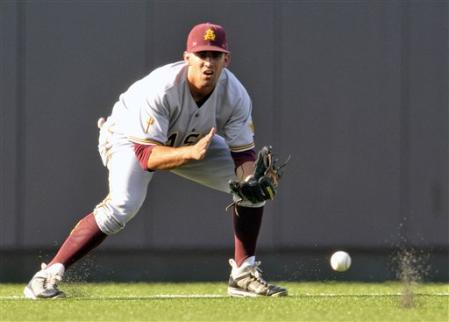
As the Super Regionals head toward a conclusion and the Omaha field is set, it seems appropriate to introduce to our readers to Arizona State shortstop Deven Marrero, who is likely to land in the first-round and perhaps even within the first 10 picks.  Yet, he is not even the top shortstop in his own conference that will be eligible for the 2012 draft.  That honor belongs to Stanford’s Kenny Diekroeger.

Marrero profiles as an above-average defender at short with a plus arm and a plus glove.  He has outstanding instincts for the position and should have no problem staying there as a professional.  At the plate, he fails to generate tremendous bat speed in large part due to a lack of lower body action.  He hits against a pretty quiet front, though, and keeps his hands inside well enough to be a 50 to 55 hit tool player.  He will never hit many bombs in the pros, but he runs well enough to at least have an isolated power.

(more…)