College Baseball | The Golden Sombrero Baseball Blog | MLB, Fantasy, College & High School Baseball News

Posts belonging to Category College Baseball


Sombrero Staff Videos: Reliving our glory days

In conjunction with Dee’s post about our recent Grinnell College alumni weekend, I thought it would be a nice change-of-pace to post some videos from our glory days.

We’ll get things going with a yardball from Dee circa 2008.  He may have only hit a couple in his college career, but that no-doubt trot would have you think otherwise.  Things to look for: the light wind that accentuates his flowing mane; his Brandon Phillips-like speed around the bases; Dee screaming “Gotta Eat!” right before touching the plate.

“It’s gotta be the hair, Cotton. It’s beautiful! Feathered and lethal.”

Here’s a double-dose of Dee.  In this video, he demonstrates his defensive prowess:

Next up is yours truly, going yard and unabashedly pumping my fists before hitting first base:

I know, tough act to follow. But this just might top it. Here’s Ryan Harris getting knocked cold while trying to catch an infield pop up.  This is precisely why the pitcher needs to get the hell out of the way, unless you’re Harris, who lives for these plays.  Not only did he catch the ball, but he also received a few stitches to commemorate the play.

And now for the Sombrero’s newest staff writer, Jim Malewitz. In 2008, Jyme Tyme was an extra-base machine. He also happens to be a ginger, which frankly frightens the crap out of me.

And last but not least, me again.  This might be the best catch I’ve ever made (in the outfield). I was told I should have pimped it and flipped the ball to our fans, which would have only been for show.  It’s not like we can afford to just give away game balls like that in Division III baseball, folks.


Grinnell College Alumni Weekend


Labor Day weekend across the United States marks in many ways the end of summer.  For students this means a return to the lab and the classroom.  For working Americans it means, well, I’ve never really been a “working American”, so I’m not exactly sure.  Regardless, at Grinnell College in central Iowa, Labor Day meant, at least for a collection of baseball alums, a return to the town and school that was our home for four years.  For this particular alum, it marked the first return trip since 2008.  In fact, despite frequent communication via text, email, and this blog, I had not seen Arlo (Mike) since we bid farewell to Robbie prior to his departure to London for veterinary school around three years ago.  Words simply cannot explain what it meant to see these people again.  In many ways the entire weekend truly felt as though I was still a member of the GC baseball team getting used to a new semester back in Iowa with my friends and teammates.

Grinnell College and Tim Hollibaugh, the head coach of the Pioneers, have shaped the lives of each player who has stepped between the lines for GC.  It is impossible to say what each of us would be doing had we not been teammates at Grinnell, but what each of us has done since we graduated is rather inspiring, at least, for me.  We all seem to be moving in directions that will allow us to be happy adults and positive contributors to each of our environments.  While we all probably had very busy weeks and months ahead, everyone seemed able to let go of work/school for the weekend and very relaxed as a result.  During our time together, I’m not sure any of us had what could possibly constitute a serious conversation.  Amidst an entire weekend full of inside jokes and recollecting our times shared years ago, we walked away from Grinnell still in nearly every way the same kids and ballplayers we were during our time in the scarlet and black.

The good fortune and persistent recruiting that somehow was able to land us all in the same small town in Iowa will never fully be accounted for by any of us, but there is no way to really describe how thankful I am now for spending my collegiate experience there with the group of guys that I did.  In talking with some of the current GC players, I was reminded of just what it felt like to be a student and athlete there.  They surprised me with how aware they were of who they are and what the game and the team meant to them.  The Pioneers of today make me endlessly proud to call myself an alum.  I am very confident that they will hoist the MWC trophy in 2012.

I don’t think the game ever leaves our lives, even after our play between the lines comes to an end.  During fungo work over the weekend, I was reminded of what it was that made me a valuable member of the Pioneer team and even before.  My hands in the infield allowed me to stay on the field well beyond what my bat could justify, and picking the ball up was always something I could do pretty well.  In watching Robbie and Arlo take cuts, I was reminded of just how well they swung the bat.  Robbie got more out of his set of tools than anyone I’ve ever known and continues to do so in London today.  Mike may not even be done improving.  His arm has held up better than any of the rest of the other alums’, and I think his bat has a little more lift in it than it used to, although it’s a little tough to recall since I had not seen him take a cut in three years.  It is my belief that if not for baseball and constantly trying to grip four-seams as quickly as possible that my hands could not adequately control a dental handpiece or forceps.  Labor Day weekend reminded me of that, but this time it likely was dentistry that had kept my hands in decent shape for groundball work instead of vice versa.

My experience at Grinnell is something I am very proud of, but I don’t think I understood how proud until I returned after some time away.  Seeing the new yard and the new athletic center as well as the current crop of players reinforced in me the positive direction in which the program is headed.  I feel very proud when Coach Hollibaugh suggests that Rob, Mike, and I helped begin the program’s climb, even though it is my belief that Kevin Byrne essentially taught us how to be captains.  As we’ve moved into our own lives independent of one another, this weekend, more so than perhaps anything else, reminded me that we are not and will never be fully independent of our teammates.  My time at Grinnell particularly shapes what I do on a daily basis, and I could not be prouder of the friendships I made while I was there and the time I spent as a Pioneer.  I would like to thank all of my fellow baseball alums for making Labor Day weekend as meaningful as it was for me.  Marsh, special thanks to you for helping organize it.

GO PIONEERS!

Will Latimer Cracks AFL Roster; Jake McCasland Receives Cape Cod Invite

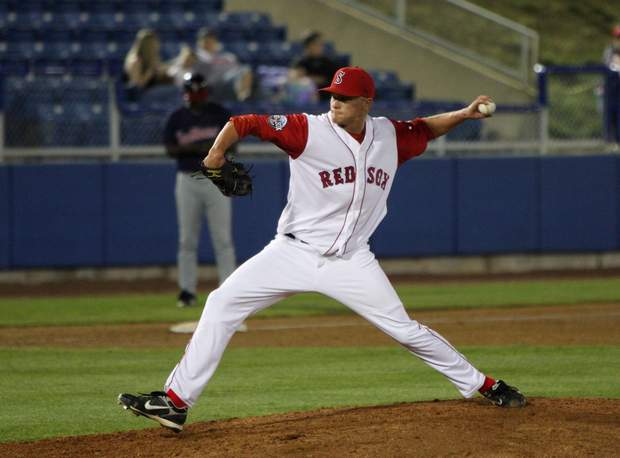
This week preliminary rosters for the Arizona Fall League were announced.  The AFL is a prestigious league for what are typically regarded as the surest bets in the Minor Leagues.  While there are some exceptions, in general the rosters for the AFL are comprised of the top prospects in the game.  Exceptions include those pitchers and hitters receiving September call-ups and obviously those players making playoff rosters as well as pitchers who have approached appearance caps, innings caps, or other forms of usage limitations.  Even without these players the rosters can be pretty damn impressive.  Look no further than the Scottsdale Scorpions’ outfield for proof.  It will feature the game’s top two prospects in Mike Trout and Bryce Harper.  Whitney also happens to live a few blocks from their home yard, so I am absolutely ecstatic about the Scorps.  What has me even more thrilled, however, about the Scottsdale roster is a lefty reliever named Will Latimer, a Four Corners baseball product hailing from Bayfield, CO.

Bayfield is a tiny community located immediately east of Durango and well within the gorgeous San Juan Range, which is famous for ski areas like Telluride, Purgatory, and Silverton.  In recent years Bayfield has become a community where Durango’s workforce establishes residence to flee outlandish real estate costs in the Durango city limits.  Will Latimer was raised in this community and ultimately graduated from Bayfield High in 2004.  Latimer played his club baseball in the Farmington Connie Mack league but was never a standout talent until college.  Latimer signed at Trinidad State (CO), which currently rosters former Strike Zone Cardinal Austin Rochford.  While at Trinidad, Latimer saw his fastball begin to pick up pace and his slider begin to bite harder.  He was selected by Boston in the 22nd round of the 2007 draft and, after missing much of 2008 and 2009 due to injury, is on the right track at the age of 25, reaching as high as Double-A this season.  With a healthy ERA in the low 3’s and more than 3 K’s per BB, his stats certainly justify his AFL invitation.  A quality showing for Scottsdale could land Latimer in the high minors to begin 2012, and with a three-pitch mix featuring a low-90’s fastball and a lanky 6-foot-3 build; the former BHS Wolverine has a very realistic shot at the Show.

In other Four Corners baseball news, former Piedra Vista Panther and current UNM Lobo Jake McCasland has received an invitation to the Cape Cod Baseball League.  If you are a regular guest at The Sombrero, I assume you know what that means.  For those of you who aren’t, The Cape is the premier amateur baseball league worldwide.  Rosters are comprised of nothing but elite collegiate players fighting to climb draft boards.  Jake is the first product of Farmington baseball to crack a Cape roster, and the community is absolutely ecstatic about his invitation.  Jake is arguably the finest local product the town has ever produced, and, after a freshman season at UNM in which he started 15 games, Jake is ready to step back into the weekend rotation in Albuquerque as the Lobos look to build on their 2011 Mountain West title.  Congratulations!

Which New Prospects Immediately Ascend to #1?

Gerrit Cole: This is a tougher call than one might expect, as Jameson Taillon is also a power righty in Pittsburgh’s system that arguably had the finest pitch of his draft class too.  Cole’s fastball is bigger and he is more polished than Taillon and probably closer to the Show.

Danny Hultzen: Hultzen is not really competing against anyone here and was the most polished guy in the ’11 class with excellent command and secondary stuff to go with a plus fastball from the left side.

Trevor Bauer: This is another tough one to call because he probably does not have the limitless projection that Archie Bradley possesses.  Nevertheless, he will arrive very quickly and will succeed from the second he shows up.  He has the unshakable poise that will allow him to immediately adapt to the Major League environment.

Dylan Bundy: Manny Machado is awesome and quite clearly the top infield prospect today, but Bundy would have been my first overall selection if I was Pittsburgh.  I personally believe that no other high school pitcher in history has been on the same level as Dylan Bundy.

Bubba Starling: Starling might take a little while to get there, but his tools are without rival in the Royals’ system and quite possibly the Minors today.  He needs time and patience from the organization because he is not remotely close to a finished product.  KC must remember that this is a good thing.

Francisco Lindor: The Tribe dismantled their system to get Ubaldo, so this is a no-brainer.  Nevertheless, Lindor has tremendous upside and tools.  I was not as high on him as many, but I think I am a little slow to accept the fact that the SS landscape is far from what it once was.  The way prospects are evaluated must adapt with the Major League landscape, and I personally have a difficult time assessing premium positions like SS.

George Springer: He has tools to drool over but lacks zone judgment and has his share of mechanical flaws.  I think he will take longer than other guys who were available, but this was far from the typical botched Houston pick.

Taylor Jungmann: Milwaukee made the smart pick here by going with the polished big-conference collegiate superstar.  Jungmann is already close and should arrive quickly.  After blowing the system up over the winter, this was the kind of draft they needed in Milwaukee as they collected two high profile collegiate aces in Jungmann and Jed Bradley.

Matt Barnes: Oh what it must be like to be the Red Sox during a draft like this.  With unlimited funds they were able to take 3 guys I had in the top 20 in Barnes, Blake Swihart, and Jackie Bradley Jr., and Henry Owens who I had immediately outside of it.  Their top guy prior to this week was Will Middlebrooks, and I just don’t see the same kind of upside in him that I do in Barnes.  Barnes certainly needs to improve his secondary stuff as well as command of all of his pitches, but he can work at 95 mph for 70 pitches and is very comfortable throwing in the cold New England air.  Oh, and I see him as a starter.  Duh.

Other teams that totally killed the draft were Washington and Tampa who have the Minor Leagues’ best hitting and pitching prospects respectively.  It should be noted that no one drafted this year would land in front of Bryce Harper or Matt Moore in any ranking of mine.


Club Baseball’s Flaws

Recently I wrote an article expressing my preference for club events as opposed to showcase-style events.  My comparisons centered on the Connie Mack World Series and Area Code Games, which take place simultaneously most summers and immediately precede Aflac weekend, which is now a Perfect Game event.  My preference for club ball stemmed from my belief that real games with substance and meaning beyond simply recruitment, scholarship dollars, and the draft is not only better for fans and players, but also actually leads to more effective and accurate player evaluation.  I personally find this to be beyond debate.  However, club baseball is certainly not devoid of flaws, and in some ways may be reflective of an accelerating problem within amateur baseball.

Like many large baseball events, the CMWS houses its visiting players with host families.  This both provides players a convenient way of getting from place to place and being attended to so that their focus can be on the game during their stay as well as a way of saving money.  Nearly all baseball families with the means to host players join in actively in the process especially those households with young children.  As a child my family housed players for the CMWS.  We typically housed players from the West region since during my childhood New Mexico was a member of that region of AABC.

Since then New Mexico has been moved to the South Plains region.  My recollection of what the teams from the West region represented displays club baseball in the 90’s as essentially a collection of players of similar skill level who primarily played events within a 500-mile radius of where the squads were based.  This in no way limited what the talent levels of the teams constituted, but simply reflected the quality of play within their region.  Understandably our hosting of the West players typically meant that we hosted players from southern California, the finest recruiting area in the U.S.A. for the last 50 years.  Nevertheless, these players, when asked by a pre-pubescent version of me how they got so good, simply replied nearly unanimously, “We play great players every single night.”  They didn’t participate in big tournament prior to the West regional or have 40 uniform combinations.  They went to the yard and played.  That’s it.  It was that simple to them.  When asked where they did this, they told me, “In our summer Connie Mack league.”  I was stunned.

In Farmington there are at most four competitive U18 teams annually – typically two.  Over half of the teams in the local Connie Mack league are capable of providing no real challenge to anyone who even came close to starting for a high school varsity.  However, the structure of the league every season is one in which each team must play each other team at least once.  It is possible that, given the schedule and the unfortunate and incorrect illusion that playing at Ricketts during the months of June and July is somehow of more value than simply playing comparably talented and skilled players as many times and at as many venues as possible, the best two teams in the league will not play each other a single time.  What’s more is that the top U16 teams are often not permitted to play any of the top U18 squads.  It is possible that a team like the Strike Zone Cardinals or Naataanii, good club teams with quality showings at various nationally renown tournaments, might go the entire month of June without playing even a single meaningful game in Farmington.  So obviously it is difficult to comprehend playing great players night in and night out, as is the case in leagues like the Lone Star league in Dallas, the East Cobb league in Atlanta, and the South Coast league in southern California.  Farmington baseball is not unique in this regard, but it may be the least capable of solving the problem due to the requirements in place that must be fulfilled to earn the hosting rights of the CMWS.

To somehow ensure that the premier talent in town is challenged as often as possible, teams play in numerous tournaments nationwide throughout the fall and summer from around the ages of 12 through age 18.  Obviously these events require money for travel, hotels, tournament entry fees, and food, and obviously not all of the players who ability-wise should be on the top team are rostered by these squads.  This has far-reaching implications for players of pre-high school age since it stunts their development relative to their peers.  Because the level of play in local leagues has become so stratified, a product of the players with the means to travel doing so in effort to find competitive games, many youth nationwide have found little joy in the game since they get manhandled nightly by those teams who travel.  These players who either lack the means to travel or are simply not among the best in town as young children are weeded out early, and the quality of the local leagues is perpetually downgraded as a result.

The threat to the game as a whole is found in the fact that the earlier and earlier that players are weeded out, the smaller and smaller the pool of players becomes such that many potentially talented players are removed prior to adolescence.  Who among us is the same guy now that we were when we were 10?  It should be blatantly obvious that this poses massive potential problems and is far from exclusive to Farmington, although in all cases the effect is felt more the smaller the population.  The danger of high profile club baseball events is that it belongs only to the players, teams, families, and programs that can afford it.  This group is certainly not inclusive of all players whose ability justifies inclusion in this group.  The beauty of Area Code is that it belongs to everyone who has shown a scout that they deserve to be there theoretically based solely on ability.  But what happens if a player was weeded out before he could show a scout that he deserves the exposure because he couldn’t pay to play as a pre-pubescent child?

Providing players with club opportunities and access to events like the CMWS and World Wood Bats is a service to the players and to the game as a whole, but efforts must be made to ensure that players who lack the funds to take part in travel baseball prior to school ball age is reached are not lost to the game before sponsors can take over, which usually happens at the ages of 16-18.